Tag: LLMs

Describe Features and Capabilities of Azure OpenAI Service (AI-900 Exam Prep)

Overview

The Azure OpenAI Service provides access to powerful OpenAI large language models (LLMs)—such as GPT models—directly within the Microsoft Azure cloud environment. It enables organizations to build generative AI applications while benefiting from Azure’s security, compliance, governance, and enterprise integration capabilities.

For the AI-900 exam, Azure OpenAI is positioned as Microsoft’s primary service for generative AI workloads, especially those involving text, code, and conversational AI.


What Is Azure OpenAI Service?

Azure OpenAI Service allows developers to deploy, customize, and consume OpenAI models using Azure-native tooling, APIs, and security controls.

Key characteristics:

  • Hosted and managed by Microsoft Azure
  • Provides enterprise-grade security and compliance
  • Uses REST APIs and SDKs
  • Integrates seamlessly with other Azure services

👉 On the exam, Azure OpenAI is the correct answer when a scenario describes generative AI powered by large language models.


Core Capabilities of Azure OpenAI Service

1. Access to Large Language Models (LLMs)

Azure OpenAI provides access to advanced models such as:

  • GPT models for text generation and understanding
  • Chat models for conversational AI
  • Embedding models for semantic search and retrieval
  • Code-focused models for programming assistance

These models can:

  • Generate human-like text
  • Answer questions
  • Summarize content
  • Write code
  • Explain concepts
  • Generate creative content

2. Text and Content Generation

Azure OpenAI can generate:

  • Articles, emails, and reports
  • Chatbot responses
  • Marketing copy
  • Knowledge base answers
  • Product descriptions

Exam tip:
If the question mentions writing, summarizing, or generating text, Azure OpenAI is likely the answer.


3. Conversational AI (Chatbots)

Azure OpenAI supports natural, multi-turn conversations, making it ideal for:

  • Customer support chatbots
  • Virtual assistants
  • Internal helpdesk bots
  • AI copilots

These chatbots:

  • Maintain conversation context
  • Generate natural responses
  • Can be grounded in enterprise data

4. Code Generation and Assistance

Azure OpenAI can:

  • Generate code snippets
  • Explain existing code
  • Translate code between languages
  • Assist with debugging

This makes it valuable for developer productivity tools and AI-assisted coding scenarios.


5. Embeddings and Semantic Search

Azure OpenAI can create vector embeddings that represent the meaning of text.

Use cases include:

  • Semantic search
  • Document similarity
  • Recommendation systems
  • Retrieval-augmented generation (RAG)

Exam tip:
If the scenario mentions searching based on meaning rather than keywords, think embeddings + Azure OpenAI.


6. Enterprise Security and Compliance

One of the most important exam points:

Azure OpenAI provides:

  • Data isolation
  • No training on customer data
  • Azure Active Directory integration
  • Role-Based Access Control (RBAC)
  • Compliance with Microsoft standards

This makes it suitable for regulated industries.


7. Integration with Azure Services

Azure OpenAI integrates with:

  • Azure AI Foundry
  • Azure AI Search
  • Azure Machine Learning
  • Azure App Service
  • Azure Functions
  • Azure Logic Apps

This allows organizations to build end-to-end generative AI solutions within Azure.


Common Use Cases Tested on AI-900

You should associate Azure OpenAI with:

  • Chatbots and conversational agents
  • Text generation and summarization
  • AI copilots
  • Semantic search
  • Code generation
  • Enterprise generative AI solutions

Azure OpenAI vs Other Azure AI Services (Exam Perspective)

ServicePrimary Focus
Azure OpenAIGenerative AI using large language models
Azure AI LanguageTraditional NLP (sentiment, entities, key phrases)
Azure AI VisionImage analysis and OCR
Azure AI SpeechSpeech-to-text and text-to-speech
Azure AI FoundryEnd-to-end generative AI app lifecycle

Key Exam Takeaways

For AI-900, remember:

  • Azure OpenAI = Generative AI
  • Best for text, chat, code, and embeddings
  • Enterprise-ready with security and compliance
  • Uses pre-trained OpenAI models
  • Integrates with the broader Azure ecosystem

One-Line Exam Rule

If the question describes generating new content using large language models in Azure, the answer is likely related to Azure OpenAI Service.


Go to the Practice Exam Questions for this topic.

Go to the AI-900 Exam Prep Hub main page.

AI in Cybersecurity: From Reactive Defense to Adaptive, Autonomous Protection

“AI in …” series

Cybersecurity has always been a race between attackers and defenders. What’s changed is the speed, scale, and sophistication of threats. Cloud computing, remote work, IoT, and AI-generated attacks have dramatically expanded the attack surface—far beyond what human analysts alone can manage.

AI has become a foundational capability in cybersecurity, enabling organizations to detect threats faster, respond automatically, and continuously adapt to new attack patterns.


How AI Is Being Used in Cybersecurity Today

AI is now embedded across nearly every cybersecurity function:

Threat Detection & Anomaly Detection

  • Darktrace uses self-learning AI to model “normal” behavior across networks and detect anomalies in real time.
  • Vectra AI applies machine learning to identify hidden attacker behaviors in network and identity data.

Endpoint Protection & Malware Detection

  • CrowdStrike Falcon uses AI and behavioral analytics to detect malware and fileless attacks on endpoints.
  • Microsoft Defender for Endpoint applies ML models trained on trillions of signals to identify emerging threats.

Security Operations (SOC) Automation

  • Palo Alto Networks Cortex XSIAM uses AI to correlate alerts, reduce noise, and automate incident response.
  • Splunk AI Assistant helps analysts investigate incidents faster using natural language queries.

Phishing & Social Engineering Defense

  • Proofpoint and Abnormal Security use AI to analyze email content, sender behavior, and context to stop phishing and business email compromise (BEC).

Identity & Access Security

  • Okta and Microsoft Entra ID use AI to detect anomalous login behavior and enforce adaptive authentication.
  • AI flags compromised credentials and impossible travel scenarios.

Vulnerability Management

  • Tenable and Qualys use AI to prioritize vulnerabilities based on exploit likelihood and business impact rather than raw CVSS scores.

Tools, Technologies, and Forms of AI in Use

Cybersecurity AI blends multiple techniques into layered defenses:

  • Machine Learning (Supervised & Unsupervised)
    Used for classification (malware vs. benign) and anomaly detection.
  • Behavioral Analytics
    AI models baseline normal user, device, and network behavior to detect deviations.
  • Natural Language Processing (NLP)
    Used to analyze phishing emails, threat intelligence reports, and security logs.
  • Generative AI & Large Language Models (LLMs)
    • Used defensively as SOC copilots, investigation assistants, and policy generators
    • Examples: Microsoft Security Copilot, Google Chronicle AI, Palo Alto Cortex Copilot
  • Graph AI
    Maps relationships between users, devices, identities, and events to identify attack paths.
  • Security AI Platforms
    • Microsoft Security Copilot
    • IBM QRadar Advisor with Watson
    • Google Chronicle
    • AWS GuardDuty

Benefits Organizations Are Realizing

Companies using AI-driven cybersecurity report major advantages:

  • Faster Threat Detection (minutes instead of days or weeks)
  • Reduced Alert Fatigue through intelligent correlation
  • Lower Mean Time to Respond (MTTR)
  • Improved Detection of Zero-Day and Unknown Threats
  • More Efficient SOC Operations with fewer analysts
  • Scalability across hybrid and multi-cloud environments

In a world where attackers automate their attacks, AI is often the only way defenders can keep pace.


Pitfalls and Challenges

Despite its power, AI in cybersecurity comes with real risks:

False Positives and False Confidence

  • Poorly trained models can overwhelm teams or miss subtle attacks.

Bias and Blind Spots

  • AI trained on incomplete or biased data may fail to detect novel attack patterns or underrepresent certain environments.

Explainability Issues

  • Security teams and auditors need to understand why an alert fired—black-box models can erode trust.

AI Used by Attackers

  • Generative AI is being used to create more convincing phishing emails, deepfake voice attacks, and automated malware.

Over-Automation Risks

  • Fully automated response without human oversight can unintentionally disrupt business operations.

Where AI Is Headed in Cybersecurity

The future of AI in cybersecurity is increasingly autonomous and proactive:

  • Autonomous SOCs
    AI systems that investigate, triage, and respond to incidents with minimal human intervention.
  • Predictive Security
    Models that anticipate attacks before they occur by analyzing attacker behavior trends.
  • AI vs. AI Security Battles
    Defensive AI systems dynamically adapting to attacker AI in real time.
  • Deeper Identity-Centric Security
    AI focusing more on identity, access patterns, and behavioral trust rather than perimeter defense.
  • Generative AI as a Security Teammate
    Natural language interfaces for investigations, playbooks, compliance, and training.

How Organizations Can Gain an Advantage

To succeed in this fast-changing environment, organizations should:

  1. Treat AI as a Force Multiplier, Not a Replacement
    Human expertise remains essential for context and judgment.
  2. Invest in High-Quality Telemetry
    Better data leads to better detection—logs, identity signals, and endpoint visibility matter.
  3. Focus on Explainable and Governed AI
    Transparency builds trust with analysts, leadership, and regulators.
  4. Prepare for AI-Powered Attacks
    Assume attackers are already using AI—and design defenses accordingly.
  5. Upskill Security Teams
    Analysts who understand AI can tune models and use copilots more effectively.
  6. Adopt a Platform Strategy
    Integrated AI platforms reduce complexity and improve signal correlation.

Final Thoughts

AI has shifted cybersecurity from a reactive, alert-driven discipline into an adaptive, intelligence-led function. As attackers scale their operations with automation and generative AI, defenders have little choice but to do the same—responsibly and strategically.

In cybersecurity, AI isn’t just improving defense—it’s redefining what defense looks like in the first place.

The State of Data for the Year 2025

As we close out 2025, it’s clear that the global data landscape has continued its unprecedented expansion — touching every part of life, business, and technology. From raw bytes generated every second to the ways that AI reshapes how we search, communicate, and innovate, this year has marked another seismic leap forward for data. Below is a comprehensive look at where we stand — and where things appear to be headed as we approach 2026.


🌐 Global Data Generation: A Tidal Wave

Amount of Data Generated

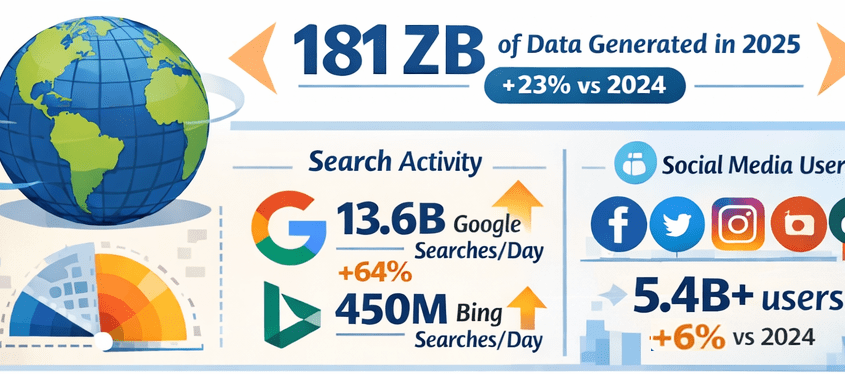
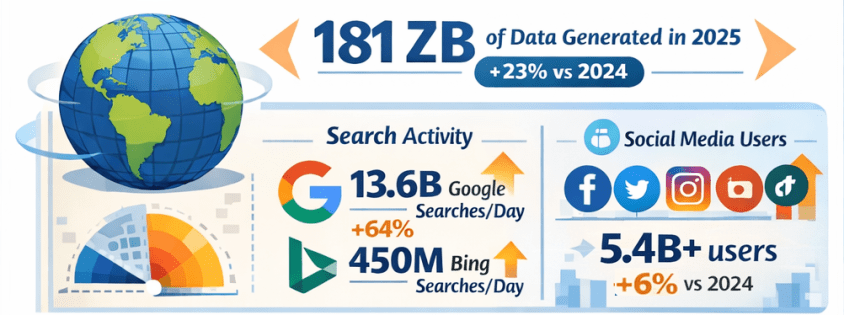
  • In 2025, the total volume of data created, captured, copied, and consumed globally is forecast to reach approximately 181 zettabytes (ZB) — up from about 147 ZB in 2024, representing roughly 23% year-over-year growth. Gitnux+1
  • That equates to an astonishing ~402 million terabytes of data generated daily. Exploding Topics

Growth Comparison: 2024 vs 2025

  • Data is growing at a compound rate: from roughly 120 ZB in 2023 to 147 ZB in 2024, then to about 181 ZB in 2025 — illustrating an ongoing surge of data creation driven by digital adoption and connected devices. Exploding Topics+1

🔍 Internet Users & Search Behavior

Number of People Online

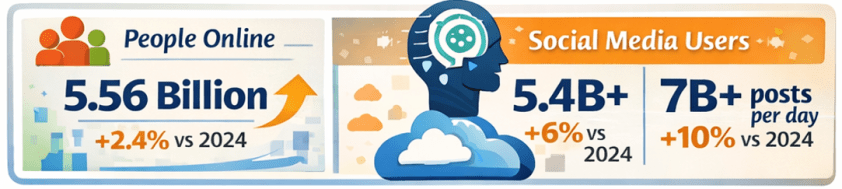
  • As of early 2025, around 5.56 billion people are active internet users, accounting for nearly 68% of the global population — up from approximately 5.43 billion in 2024. DemandSage

Search Engine Activity

  • Google alone handles roughly 13.6 billion searches per day in 2025, totaling almost 5 trillion searches annually — a significant increase from the estimated 8.3 billion daily searches in 2024. Exploding Topics
  • Bing, while much smaller in scale, processes around 450+ million searches per day (~13–14 billion per month). Nerdynav

Market Share Snapshot

  • Google continues to dominate search with approximately 90% global market share, while Bing remains one of the top alternatives. StatCounter Global Stats

📱 Social Media Usage & Content Creation

User Numbers

  • There are roughly 5.4–5.45 billion social media users worldwide in 2025 — up from prior years and covering about 65–67% of the global population. XtendedView+1

Time Spent & Trends

  • Users spend on average about 2 hours and 20+ minutes per day on social platforms. SQ Magazine
  • AI plays a central role in content recommendations and creation, with 80%+ of social feeds relying on algorithms, and an increasing share of generated images and posts assisted by AI tools. SQ Magazine

📊 The Explosion of AI: LLMs & Tools

LLM Adoption

  • Large language models and AI assistants like ChatGPT have become globally pervasive:
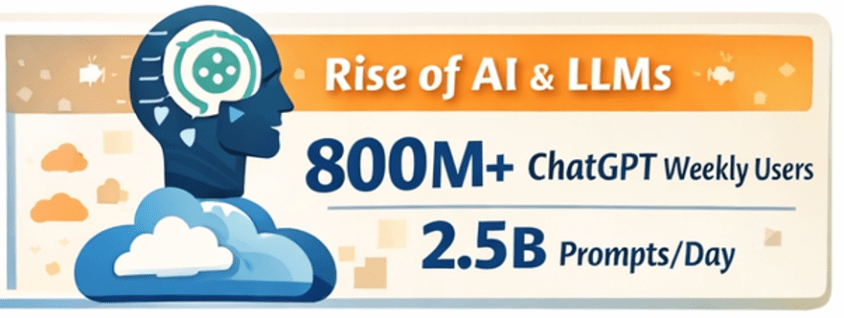
    • ChatGPT alone has around 800 million weekly active users as of late 2025. First Page Sage
    • Daily usage figures exceed 2.5 billion user prompts globally, highlighting a massive shift toward direct AI interaction. Exploding Topics
  • Studies have shown that LLM-assisted writing and content creation are now embedded across formal and informal communication channels, indicating broad adoption beyond curiosity use cases. arXiv

AI Tools Everywhere

  • Generative AI is now a staple across industries — from content creation to customer service, data analytics to software development. Investments and usage in AI-powered analytics and automation tools continue to rise rapidly. layerai.org

💡 Trends in Data Collection & Analytics

Real-Time & Edge Processing

  • In 2025, more than half of corporate data processing is happening at the edge, closer to the source of data generation, enabling real-time insights. Pennsylvania Institute of Technology

Data Democratization

  • Data access and analytics tools have become more user-friendly, with low-code/no-code platforms enabling broader organizational participation in data insight generation. postlo.com

☁️ Cloud & Data Infrastructure

Cloud Data Growth

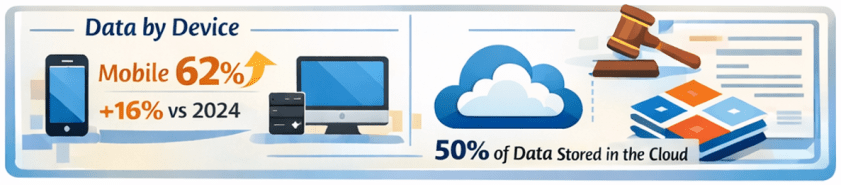
  • An ever-increasing portion of global data is stored in the cloud, with estimates suggesting around half of all data resides in cloud environments by 2025. Axis Intelligence

Data Centers & Energy

  • Data centers, particularly those supporting AI workloads, are expanding rapidly. This infrastructure surge is driving both innovation and concerns — including power consumption and sustainability challenges. TIME

📜 Data Laws & Regulation

New Legal Frameworks

  • In the UK, the Data (Use and Access) Act of 2025 was enacted, updating data protection and access rules related to UK-specific GDPR implementations. Wikipedia
  • Elsewhere, data regulation remains a focal point globally, with ongoing debates around privacy, governance, AI accountability, and cross–border data flows.

🛠️ Top Data Tools/Platforms of 2025

While specific rankings vary by industry and use case, 2025’s data ecosystem centers around:

  • Cloud data platforms: Snowflake, BigQuery, Redshift, Databricks
  • BI & visualization: Tableau, Power BI
  • AI/ML frameworks: TensorFlow, PyTorch, scalable LLM platforms
  • Automation & low-code analytics: dbt, Airflow, no-code toolchains
  • Real-time streaming: Kafka, ksqlDB

Ongoing trends emphasize integration between AI tooling and traditional analytics pipelines — blurring the lines between data engineering, analytics, and automation.

Note: specific tool adoption percentages vary by firm size and sector, but cloud-native and AI-augmented tools dominate enterprise workflows. Reddit


🌟 Novel Uses of Data in 2025

2025 saw innovative applications such as:

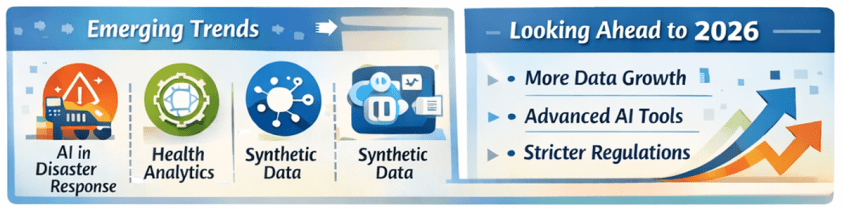
  • AI-powered disaster response using real-time social data streams.
  • Conversational assistants embedded into everyday workflows (search, writing, decision support).
  • Predictive analytics in health, finance, logistics, accelerated by real-time IoT feeds.
  • Synthetic datasets for simulation, security research, and model training. arXiv

🔮 What’s Expected in 2026

Continued Growth

  • Data volumes are projected to keep rising — potentially doubling every few years with the proliferation of AI, IoT, and immersive technologies.
  • LLM adoption will likely hit deeper integration into enterprise processes, customer experience workflows, and consumer tech.
  • AI governance and data privacy regulation will intensify globally, balancing innovation with accountability.

Emerging Frontiers

  • Multimodal AI blending text, vision, and real-time sensor data.
  • Federated learning and privacy-preserving analytics gaining traction.
  • Data meshes and decentralized data infrastructures challenging traditional monolithic systems.
  • Unified data platforms with AI-focused features and AI-focused business-ready data models are becoming common place.

📌 Final Thoughts

2025 has been another banner year for data — not just in sheer scale, but in how data powers decision-making, AI capabilities, and digital interactions across society. From trillions of searches to billions of social interactions, from zettabytes of oceans of data to democratized analytics tools, the data world continues to evolve at breakneck speed. And for data professionals and leaders, the next year promises even more opportunities to harness data for insight, innovation, and impact. Exciting stuff!

Thanks for reading!

AI in Retail and eCommerce: Personalization at Scale Meets Operational Intelligence

“AI in …” series

Retail and eCommerce sit at the intersection of massive data volume, thin margins, and constantly shifting customer expectations. From predicting what customers want to buy next to optimizing global supply chains, AI has become a core capability—not a nice-to-have—for modern retailers.

What makes retail especially interesting is that AI touches both the customer-facing experience and the operational backbone of the business, often at the same time.


How AI Is Being Used in Retail and eCommerce Today

AI adoption in retail spans the full value chain:

Personalized Recommendations & Search

  • Amazon uses machine learning models to power its recommendation engine, driving a significant portion of total sales through “customers also bought” and personalized homepages.
  • Netflix-style personalization, but for shopping: retailers tailor product listings, pricing, and promotions in real time.

Demand Forecasting & Inventory Optimization

  • Walmart applies AI to forecast demand at the store and SKU level, accounting for seasonality, local events, and weather.
  • Target uses AI-driven forecasting to reduce stockouts and overstocks, improving both customer satisfaction and margins.

Dynamic Pricing & Promotions

  • Retailers use AI to adjust prices based on demand, competitor pricing, inventory levels, and customer behavior.
  • Amazon is the most visible example, adjusting prices frequently using algorithmic pricing models.

Customer Service & Virtual Assistants

  • Shopify merchants use AI-powered chatbots for order tracking, returns, and product questions.
  • H&M and Sephora deploy conversational AI for styling advice and customer support.

Fraud Detection & Payments

  • AI models detect fraudulent transactions in real time, especially important for eCommerce and buy-now-pay-later (BNPL) models.

Computer Vision in Physical Retail

  • Amazon Go stores use computer vision, sensors, and deep learning to enable cashierless checkout.
  • Zara (Inditex) uses computer vision to analyze in-store traffic patterns and product engagement.

Tools, Technologies, and Forms of AI in Use

Retailers typically rely on a mix of foundational and specialized AI technologies:

  • Machine Learning & Deep Learning
    Used for forecasting, recommendations, pricing, and fraud detection.
  • Natural Language Processing (NLP)
    Powers chatbots, sentiment analysis of reviews, and voice-based shopping.
  • Computer Vision
    Enables cashierless checkout, shelf monitoring, loss prevention, and in-store analytics.
  • Generative AI & Large Language Models (LLMs)
    Used for product description generation, marketing copy, personalized emails, and internal copilots.
  • Retail AI Platforms
    • Salesforce Einstein for personalization and customer insights
    • Adobe Sensei for content, commerce, and marketing optimization
    • Shopify Magic for product descriptions, FAQs, and merchant assistance
    • AWS, Azure, and Google Cloud AI for scalable ML infrastructure

Benefits Retailers Are Realizing

Retailers that have successfully adopted AI report measurable benefits:

  • Higher Conversion Rates through personalization
  • Improved Inventory Turns and reduced waste
  • Lower Customer Service Costs via automation
  • Faster Time to Market for campaigns and promotions
  • Better Customer Loyalty through more relevant, consistent experiences

In many cases, AI directly links customer experience improvements to revenue growth.


Pitfalls and Challenges

Despite widespread adoption, AI in retail is not without risk:

Bias and Fairness Issues

  • Recommendation and pricing algorithms can unintentionally disadvantage certain customer groups or reinforce biased purchasing patterns.

Data Quality and Fragmentation

  • Poor product data, inconsistent customer profiles, or siloed systems limit AI effectiveness.

Over-Automation

  • Some retailers have over-relied on AI-driven customer service, frustrating customers when human support is hard to reach.

Cost vs. ROI Concerns

  • Advanced AI systems (especially computer vision) can be expensive to deploy and maintain, making ROI unclear for smaller retailers.

Failed or Stalled Pilots

  • AI initiatives sometimes fail because they focus on experimentation rather than operational integration.

Where AI Is Headed in Retail and eCommerce

Several trends are shaping the next phase of AI in retail:

  • Hyper-Personalization
    Experiences tailored not just to the customer, but to the moment—context, intent, and channel.
  • Generative AI at Scale
    Automated creation of product content, marketing campaigns, and even storefront layouts.
  • AI-Driven Merchandising
    Algorithms suggesting what products to carry, where to place them, and how to price them.
  • Blended Physical + Digital Intelligence
    More retailers combining in-store computer vision with online behavioral data.
  • AI as a Copilot for Merchants and Marketers
    Helping teams plan assortments, campaigns, and promotions faster and with more confidence.

How Retailers Can Gain an Advantage

To compete effectively in this fast-moving environment, retailers should:

  1. Focus on Data Foundations First
    Clean product data, unified customer profiles, and reliable inventory systems are essential.
  2. Start with Customer-Critical Use Cases
    Personalization, availability, and service quality usually deliver the fastest ROI.
  3. Balance Automation with Human Oversight
    AI should augment merchandisers, marketers, and store associates—not replace them outright.
  4. Invest in Responsible AI Practices
    Transparency, fairness, and explainability build trust with customers and regulators.
  5. Upskill Retail Teams
    Merchants and marketers who understand AI can use it more creatively and effectively.

Final Thoughts

AI is rapidly becoming the invisible engine behind modern retail and eCommerce. The winners won’t necessarily be the companies with the most advanced algorithms—but those that combine strong data foundations, thoughtful AI governance, and a relentless focus on customer experience.

In retail, AI isn’t just about selling more—it’s about selling smarter, at scale.