Create and configure deployment pipelines

This post is a part of the DP-600: Implementing Analytics Solutions Using Microsoft Fabric Exam Prep Hub; and this topic falls under these sections: 
Maintain a data analytics solution
--> Maintain the analytics development lifecycle
--> Create and configure deployment pipelines

Development pipelines in Microsoft Fabric provide a structured, governed way to promote analytics content across environments—typically Development, Test, and Production. They are a core lifecycle management feature that helps teams deploy changes safely, consistently, and with minimal risk. For the DP-600 exam, you should understand what development pipelines are, how they are configured, what they support, and how they differ from Git-based version control.

What Are Development Pipelines?

A development pipeline is a Fabric feature that:

  • Connects multiple workspaces into an ordered promotion flow
  • Enables controlled deployment of items between environments
  • Supports validation and testing before production release

Pipelines are especially important for enterprise-scale analytics solutions.

Typical Pipeline Structure

A standard Fabric pipeline consists of three stages:

  1. Development
    • Active development
    • Frequent changes
    • Used by engineers and analysts
  2. Test
    • Validation and user acceptance testing
    • Data and logic verification
    • Limited access
  3. Production
    • Certified, trusted content
    • Broad consumer access
    • Minimal direct changes

Each stage is linked to a separate Fabric workspace.

Creating a Development Pipeline

At a high level, the process is:

  1. Create a deployment pipeline in Microsoft Fabric
  2. Assign a workspace to each stage:
    • Dev workspace
    • Test workspace
    • Prod workspace
  3. Configure pipeline settings
  4. Control who can deploy between stages

Once created, the pipeline provides a visual interface showing item differences across stages.

What Items Can Be Deployed Through Pipelines?

Development pipelines support deployment of many Fabric items, including:

  • Semantic models
  • Reports and dashboards
  • Dataflows Gen2
  • Lakehouses and Warehouses (supported scenarios)
  • Other supported analytics artifacts

Exam note:
Not every Fabric item supports pipeline deployment equally—expect questions to focus on Power BI and core analytics items.

How Deployment Works

Comparing Changes

  • Pipelines show differences between stages
  • You can review what will change before deploying

Deploying Content

  • Deploy from Dev → Test
  • Validate
  • Deploy from Test → Prod

Deployments:

  • Copy item definitions
  • Can update existing items or create new ones
  • Do not automatically move workspace permissions

Deployment Rules and Parameters

Pipelines support deployment rules, such as:

  • Changing data source connections per environment
  • Switching parameters between Dev, Test, and Prod
  • Avoiding hard-coded environment values

This is critical for:

  • Separating development and production data
  • Supporting safe testing

Pipelines vs Git Integration (Exam Comparison)

This distinction is frequently tested.

FeatureDevelopment PipelinesGit Integration
PurposeEnvironment promotionSource control
FocusDeploymentVersioning
Tracks historyNoYes
Supports branchingNoYes
Typical useDev → Test → ProdCode collaboration

Key insight:
They are complementary, not competing features.

Permissions and Governance

To use pipelines:

  • Users need appropriate pipeline permissions
  • Workspace access is still required
  • Production deployments are often restricted to a small group

Pipelines support governance by:

  • Reducing direct changes in production
  • Enforcing controlled release processes
  • Improving auditability

Common Exam Scenarios

You may be asked to:

  • Choose pipelines for controlled promotion of reports
  • Identify when pipelines are preferable to manual publishing
  • Combine pipelines with Git and PBIP
  • Configure different data sources per environment
  • Prevent accidental production changes

Example:

A report must be tested before being released to executives.
Correct concept: Use a development pipeline with Dev, Test, and Prod stages.

Best Practices to Remember

  • Use separate workspaces per environment
  • Restrict production deployment permissions
  • Combine pipelines with:
    • PBIP projects
    • Git integration
    • Endorsements and certification
  • Avoid direct editing in production

Key Exam Takeaways

  • Development pipelines manage content promotion across environments
  • They connect multiple Fabric workspaces
  • Pipelines support comparison, validation, and controlled deployment
  • They do not replace Git-based version control
  • A core feature of the Fabric analytics lifecycle

Exam Tips

  • If a question focuses on moving content safely from development to production, the correct answer is development pipelines.
  • If it focuses on tracking changes or collaboration, the answer is Git or PBIP.
  • Know how pipelines support:
    • Dev/Test/Prod lifecycle
    • Governance & change control
    • Environment-specific configuration
    • Enterprise-scale BI practices
  • Common exam traps:
    • Confusing workspace roles with deploy permissions
    • Assuming pipelines manage security or performance
    • Forgetting deployment rules

Practice Questions

Question 1 (Single choice)

What is the PRIMARY purpose of a deployment pipeline in Microsoft Fabric?

A. Schedule dataset refreshes
B. Promote content across lifecycle environments
C. Enable row-level security
D. Optimize DAX performance

Correct Answer: B

Explanation:
Deployment pipelines are designed to promote content across environments (for example, Development → Test → Production) in a controlled and governed manner.

  • ❌ A: Refresh scheduling is handled separately
  • ❌ C: Security is not the primary purpose
  • ❌ D: Performance tuning is unrelated

Question 2 (Multi-select)

Which stages are available by default in a Fabric deployment pipeline? (Select all that apply.)

A. Development
B. Test
C. Production
D. Sandbox

Correct Answers: A, B, C

Explanation:
Fabric deployment pipelines use a three-stage lifecycle:

  • Development
  • Test
  • Production

There is no default Sandbox stage.


Question 3 (Scenario-based)

A team wants analysts to freely modify reports, while only approved changes reach production. Which pipeline stage should analysts primarily work in?

A. Production
B. Test
C. Development
D. Any stage

Correct Answer: C

Explanation:
The Development stage is intended for:

  • Frequent changes
  • Experimentation
  • Initial validation

Higher stages are more controlled.


Question 4 (Single choice)

Which permission is required to deploy content from one stage to the next in a deployment pipeline?

A. Viewer
B. Contributor
C. Admin
D. Pipeline deploy permission

Correct Answer: D

Explanation:
Deploying content requires explicit pipeline deployment permissions, not just workspace roles.

  • ❌ Admin alone is not sufficient
  • ❌ Contributor may edit but not deploy

Question 5 (Scenario-based)

You deploy a semantic model from Test to Production. What happens to data source connections by default?

A. They are deleted
B. They remain unchanged
C. They can be overridden per stage
D. They must be manually reconfigured

Correct Answer: C

Explanation:
Deployment pipelines support parameter and data source rules, allowing environment-specific connections.


Question 6 (Multi-select)

Which items can be deployed using deployment pipelines? (Select all that apply.)

A. Reports
B. Semantic models
C. Dashboards
D. Notebooks

Correct Answers: A, B, C

Explanation:
Deployment pipelines support Power BI artifacts, including:

  • Reports
  • Semantic models
  • Dashboards

❌ Notebooks are Fabric artifacts but are not deployed via Power BI deployment pipelines.


Question 7 (Scenario-based)

A deployment shows warnings that some items are skipped. What is the MOST likely cause?

A. The workspace is full
B. Unsupported artifacts exist
C. The dataset is too large
D. Git integration is disabled

Correct Answer: B

Explanation:
Unsupported or incompatible artifacts (for example, unsupported report types) may be skipped during deployment.


Question 8 (Single choice)

Which feature allows different environments to use different data sources during deployment?

A. Row-level security
B. Dynamic format strings
C. Deployment rules
D. Incremental refresh

Correct Answer: C

Explanation:
Deployment rules allow:

  • Data source switching
  • Parameter overrides
  • Environment-specific configuration

Question 9 (Scenario-based)

You want production users to access only certified content. How do deployment pipelines help?

A. By enforcing sensitivity labels
B. By promoting tested content only
C. By encrypting production reports
D. By disabling edit access

Correct Answer: B

Explanation:
Deployment pipelines ensure:

  • Content is validated in Test
  • Only approved changes reach Production

They support trust and governance, not encryption or labeling.


Question 10 (Multi-select)

Which best practices apply when configuring deployment pipelines? (Select all that apply.)

A. Restrict deploy permissions
B. Use separate data sources per stage
C. Allow all users to deploy to Production
D. Validate content in Test before Production

Correct Answers: A, B, D

Explanation:
Best practices include:

  • Limited deploy access
  • Environment-specific configurations
  • Mandatory testing before production

❌ Allowing everyone to deploy defeats governance.


Perform impact analysis of downstream dependencies from lakehouses, data warehouses, dataflows, and semantic models in Microsoft Fabric

This post is a part of the DP-600: Implementing Analytics Solutions Using Microsoft Fabric Exam Prep Hub; and this topic falls under these sections: 
Maintain a data analytics solution
--> Maintain the analytics development lifecycle
--> Perform impact analysis of downstream dependencies from lakehouses,
data warehouses, dataflows, and semantic models

Impact analysis in Microsoft Fabric helps analytics engineers understand how changes to upstream data assets affect downstream items such as datasets, reports, dashboards, notebooks, and pipelines. It is a critical lifecycle practice that reduces the risk of breaking analytics solutions when making schema, logic, or data changes.

For the DP-600 exam, you should understand what impact analysis is, which Fabric tools support it, what dependencies are tracked, and how to use it in real-world lifecycle scenarios.

What Is Impact Analysis?

Impact analysis answers the question:

“If I change or delete this item, what else will be affected?”

It allows you to:

  • Identify downstream dependencies
  • Assess risk before making changes
  • Communicate potential impacts to stakeholders
  • Support safe development and deployment practices

Impact analysis is observational and informational—it does not enforce controls.

Where Impact Analysis Is Used in Fabric

Impact analysis applies across many Fabric items, including:

  • Lakehouses
  • Data Warehouses
  • Dataflows Gen2
  • Semantic models
  • Reports and dashboards
  • Notebooks and pipelines

These items form a connected analytics graph, which Fabric can visualize.

Lineage View: The Core Tool for Impact Analysis

The primary tool for impact analysis in Fabric is Lineage View.

What Lineage View Shows

  • Upstream data sources
  • Transformations and processing steps
  • Downstream consumers
  • Relationships between items

Lineage view provides a visual map of dependencies across workloads.

Impact Analysis by Asset Type

Lakehouses

Changing a Lakehouse can impact:

  • Notebooks reading tables
  • Semantic models using Direct Lake
  • Dataflows writing or reading data
  • Reports built on dependent models

Common risk: Dropping or renaming a column.

Data Warehouses

Warehouse changes may affect:

  • Views and SQL queries
  • Semantic models using DirectQuery
  • Reports and dashboards
  • External tools

Exam insight: Schema changes are a common source of downstream failures.

Dataflows Gen2

Dataflows often sit between raw data and analytics.

Changes can impact:

  • Lakehouses or Warehouses they load into
  • Semantic models consuming curated tables
  • Pipelines orchestrating refreshes

Semantic Models

Semantic models are among the most sensitive assets.

Changes may affect:

  • Reports and dashboards
  • Excel workbooks
  • Composite models
  • End-user self-service analytics

Exam note: Removing measures or renaming fields is high risk.

How to Perform Impact Analysis (High Level)

  1. Select the item (Lakehouse, Warehouse, Dataflow, or Semantic Model)
  2. Open Lineage view
  3. Review downstream dependencies
  4. Identify:
    • Reports
    • Datasets
    • Pipelines
    • Other dependent items
  5. Communicate or mitigate risk before making changes

Impact Analysis in the Development Lifecycle

Impact analysis is typically performed:

  • Before deploying changes
  • Before modifying schemas
  • Before deleting items
  • During troubleshooting

It supports:

  • Safe Git commits
  • Controlled pipeline deployments
  • Production stability

Common Exam Scenarios

You may see questions such as:

  • A column change breaks multiple reports → impact analysis was skipped
  • An engineer needs to know which reports use a dataset → lineage view
  • A Lakehouse schema update affects downstream models → review dependencies
  • A dataset should not be modified due to executive reports → high downstream impact

Example:

Before removing a table from a semantic model, what should you do?
Correct concept: Perform impact analysis using lineage view.

Impact Analysis vs Deployment Pipelines

These concepts are related but distinct.

FeatureImpact AnalysisDeployment Pipelines
PurposeRisk assessmentControlled promotion
EnforcedNoYes
TimingBefore changesDuring deployment
ToolLineage viewPipeline UI

Best Practices to Remember

  • Always check lineage before schema changes
  • Pay extra attention to semantic models and certified items
  • Communicate impacts to report owners
  • Pair impact analysis with:
    • Version control
    • Development pipelines
    • Endorsements and certification

Key Exam Takeaways

  • Impact analysis identifies downstream dependencies
  • Lineage view is the primary tool in Fabric
  • Applies to Lakehouses, Warehouses, Dataflows, and Semantic Models
  • Supports safe lifecycle and governance practices
  • A common scenario-based exam topic

Final Exam Tip

  • If a question asks what will break if I change this, the answer is impact analysis via lineage view.
  • If it asks how to safely move changes, the answer is pipelines or Git.
  • Expect questions that test:
    • When to perform impact analysis
    • Which items are affected by changes
    • Operational decision-making before deployments
  • Common traps:
    • Confusing impact analysis with lineage documentation
    • Assuming Fabric blocks breaking changes automatically
    • Forgetting semantic models are often the most impacted layer

Practice Questions

Question 1 (Single choice)

What is the PRIMARY purpose of impact analysis in Microsoft Fabric?

A. Improve query performance
B. Identify downstream objects affected by a change
C. Enforce data security policies
D. Reduce data refresh frequency

Correct Answer: B

Explanation:
Impact analysis helps you understand what items depend on a given artifact, so you can assess the risk of changes.

  • ❌ A: Performance tuning is separate
  • ❌ C: Security is not the focus
  • ❌ D: Refresh tuning is unrelated

Question 2 (Multi-select)

Which Fabric items can be analyzed for downstream dependencies? (Select all that apply.)

A. Lakehouses
B. Data warehouses
C. Dataflows
D. Semantic models

Correct Answers: A, B, C, D

Explanation:
Microsoft Fabric supports dependency tracking across all major analytical artifacts, enabling end-to-end lineage visibility.


Question 3 (Scenario-based)

You plan to rename a column in a lakehouse table. Which Fabric feature should you use FIRST?

A. Version control
B. Deployment pipeline
C. Impact analysis
D. Incremental refresh

Correct Answer: C

Explanation:
Renaming a column may break:

  • Semantic models
  • SQL queries
  • Reports

Impact analysis identifies what will be affected before the change.


Question 4 (Single choice)

Where do you access impact analysis for an item in Fabric?

A. Power BI Desktop
B. Microsoft Purview portal
C. Item settings in the Fabric workspace
D. Azure DevOps

Correct Answer: C

Explanation:
Impact analysis is accessible directly from the item context or settings within a Fabric workspace.

  • ❌ Purview focuses on governance/catalog
  • ❌ DevOps is not used for lineage

Question 5 (Scenario-based)

A dataflow loads data into a lakehouse that feeds multiple semantic models. What does impact analysis show?

A. Only the lakehouse
B. Only the semantic models
C. All downstream dependencies
D. Only refresh schedules

Correct Answer: C

Explanation:
Impact analysis provides a full dependency graph, showing all downstream items affected by changes.


Question 6 (Multi-select)

Which changes typically REQUIRE impact analysis before execution? (Select all that apply.)

A. Dropping columns
B. Renaming tables
C. Changing data types
D. Adding a new report page

Correct Answers: A, B, C

Explanation:
Structural changes can break dependencies. Adding a report page does not affect downstream items.


Question 7 (Scenario-based)

A semantic model is used by several reports and dashboards. What happens if you delete the model without impact analysis?

A. Nothing; reports are cached
B. Reports automatically reconnect
C. Reports and dashboards break
D. Fabric blocks the deletion

Correct Answer: C

Explanation:
Deleting a semantic model removes the data source for:

  • Reports
  • Dashboards

Impact analysis helps prevent such disruptions.


Question 8 (Single choice)

Which view best represents impact analysis results?

A. Tabular grid
B. SQL execution plan
C. Dependency graph
D. DAX query view

Correct Answer: C

Explanation:
Impact analysis is presented as a visual dependency graph, showing upstream and downstream relationships.


Question 9 (Scenario-based)

Which role MOST benefits from performing impact analysis regularly?

A. Report consumers
B. Workspace admins and data engineers
C. End-user analysts
D. External auditors

Correct Answer: B

Explanation:
Admins and engineers are responsible for:

  • Schema changes
  • Deployments
  • Stability

Impact analysis supports safe operational changes.


Question 10 (Multi-select)

Which best practices apply when using impact analysis? (Select all that apply.)

A. Perform before structural changes
B. Use in conjunction with deployment pipelines
C. Skip for minor schema updates
D. Communicate findings to stakeholders

Correct Answers: A, B, D

Explanation:
Impact analysis should:

  • Precede schema changes
  • Inform deployment decisions
  • Be communicated to stakeholders

❌ “Minor” changes can still break dependencies.


Deploy and Manage Semantic Models Using the XMLA Endpoint

This post is a part of the DP-600: Implementing Analytics Solutions Using Microsoft Fabric Exam Prep Hub; and this topic falls under these sections: 
Maintain a data analytics solution
--> Implement security and governance
--> Deploy and manage semantic models by using the XMLA endpoint

The XMLA endpoint enables advanced, enterprise-grade management of Power BI semantic models in Microsoft Fabric. It allows analytics engineers to deploy, modify, automate, and govern semantic models using external tools and scripts—bringing full ALM (Application Lifecycle Management) capabilities to analytics solutions.

For the DP-600 exam, you should understand what the XMLA endpoint is, when to use it, what it enables, and how it fits into the analytics development lifecycle.

What Is the XMLA Endpoint?

The XMLA (XML for Analysis) endpoint is a programmatic interface that exposes semantic models in Fabric as Analysis Services-compatible models.

Through the XMLA endpoint, you can:

  • Deploy semantic models
  • Modify model metadata
  • Manage partitions and refreshes
  • Automate changes across environments
  • Integrate with DevOps workflows

Exam note:
The XMLA endpoint is enabled by default in Fabric workspaces backed by appropriate capacity.

When to Use the XMLA Endpoint

The XMLA endpoint is used when you need:

  • Advanced model editing beyond Power BI Desktop
  • Automated deployments
  • Bulk changes across models
  • Integration with CI/CD pipelines
  • Scripted refresh and partition management

It is commonly used in enterprise and large-scale deployments.

Tools That Use the XMLA Endpoint

Several tools connect to Fabric semantic models through XMLA:

  • Tabular Editor
  • SQL Server Management Studio (SSMS)
  • PowerShell scripts
  • Azure DevOps pipelines
  • Custom automation tools

These tools operate directly on the semantic model metadata.

Common XMLA-Based Management Tasks

Deploying Semantic Models

  • Push model definitions from source control
  • Promote models across Dev, Test, and Prod
  • Align models with environment-specific settings

Managing Model Metadata

  • Create or modify:
    • Measures
    • Calculated columns
    • Relationships
    • Perspectives
  • Apply bulk changes efficiently

Managing Refresh and Partitions

  • Configure incremental refresh
  • Trigger or monitor refresh operations
  • Manage large models efficiently

XMLA Endpoint and the Development Lifecycle

XMLA plays a key role in:

  • CI/CD pipelines for analytics
  • Automated model validation
  • Environment promotion
  • Controlled production updates

It complements:

  • PBIP projects
  • Git integration
  • Development pipelines

Permissions and Requirements

To use the XMLA endpoint:

  • The workspace must be on supported capacity
  • The user must have sufficient permissions:
    • Workspace Admin or Member
  • Access is governed by Fabric and Entra ID

Exam insight:
Viewers cannot use XMLA to modify models.

XMLA Endpoint vs Power BI Desktop

FeaturePower BI DesktopXMLA Endpoint
Visual modelingYesNo
Scripted changesNoYes
AutomationLimitedStrong
Bulk editsNoYes
CI/CD integrationLimitedYes

Key takeaway:
Power BI Desktop is for design; XMLA is for enterprise management and automation.

Common Exam Scenarios

Expect questions such as:

  • Automating semantic model deployment → XMLA
  • Making bulk changes to measures → XMLA
  • Managing partitions for large models → XMLA
  • Integrating Power BI models into DevOps → XMLA
  • Editing a production model without Desktop → XMLA

Example:

A company needs to automate semantic model deployments across environments.
Correct concept: Use the XMLA endpoint.

Best Practices to Remember

  • Use XMLA for production changes and automation
  • Combine XMLA with:
    • Git repositories
    • Tabular Editor
    • Deployment pipelines
  • Limit XMLA access to trusted roles
  • Avoid manual production edits when automation is available

Key Exam Takeaways

  • XMLA enables advanced semantic model management
  • Supports automation, scripting, and CI/CD
  • Used with tools like Tabular Editor and SSMS
  • Requires appropriate permissions and capacity
  • A core ALM feature for DP-600

Exam Tips

  • If a question mentions automation, scripting, bulk model changes, or CI/CD, the answer is almost always the XMLA endpoint.
  • If it mentions visual report design, the answer is Power BI Desktop.
  • Expect questions that test:
    • When to use XMLA vs Power BI Desktop
    • Tool selection (Tabular Editor vs pipelines)
    • Security and permissions
    • Enterprise deployment scenarios
  • High-value keywords to remember:
    • XMLA • TMSL • External tools • CI/CD • Metadata management

Practice Questions

Question 1 (Single choice)

What is the PRIMARY purpose of the XMLA endpoint in Microsoft Fabric?

A. Enable SQL querying of lakehouses
B. Provide programmatic management of semantic models
C. Secure data using row-level security
D. Schedule data refreshes

Correct Answer: B

Explanation:
The XMLA endpoint enables advanced management and deployment of semantic models using tools such as:

  • Tabular Editor
  • SQL Server Management Studio (SSMS)
  • Power BI REST APIs

Question 2 (Multi-select)

Which tools can connect to a Fabric semantic model via the XMLA endpoint? (Select all that apply.)

A. Tabular Editor
B. SQL Server Management Studio (SSMS)
C. Power BI Desktop
D. Azure Data Studio

Correct Answers: A, B

Explanation:

  • Tabular Editor and SSMS use XMLA to manage models.
  • ❌ Power BI Desktop uses a local model, not XMLA.
  • ❌ Azure Data Studio does not manage semantic models via XMLA.

Question 3 (Scenario-based)

You want to deploy a semantic model from Development to Production while preserving model metadata. What is the BEST approach?

A. Export and re-import a PBIX file
B. Use deployment pipelines only
C. Use XMLA with model scripting
D. Rebuild the model manually

Correct Answer: C

Explanation:
XMLA enables:

  • Model scripting (TMSL)
  • Metadata-preserving deployments
  • Controlled promotion across environments

Question 4 (Single choice)

Which capability requires the XMLA endpoint to be enabled?

A. Creating reports
B. Editing DAX measures outside Power BI Desktop
C. Viewing model lineage
D. Applying sensitivity labels

Correct Answer: B

Explanation:
Editing measures, calculation groups, and partitions using external tools requires XMLA connectivity.


Question 5 (Scenario-based)

An enterprise team wants to automate semantic model deployment through CI/CD pipelines. Which XMLA-based artifact is MOST commonly used?

A. PBIP project file
B. TMSL scripts
C. DAX Studio queries
D. SQL views

Correct Answer: B

Explanation:
Tabular Model Scripting Language (TMSL) is the standard XMLA-based format for:

  • Creating
  • Updating
  • Deploying semantic models programmatically

Question 6 (Multi-select)

Which operations can be performed through the XMLA endpoint? (Select all that apply.)

A. Create and modify measures
B. Configure partitions and refresh policies
C. Apply row-level security
D. Build report visuals

Correct Answers: A, B, C

Explanation:
XMLA supports model-level operations. Report visuals are created in Power BI reports, not via XMLA.


Question 7 (Scenario-based)

You attempt to connect to a semantic model via XMLA but the connection fails. What is the MOST likely cause?

A. XMLA endpoint is disabled for the workspace
B. Dataset refresh is in progress
C. Data source credentials are missing
D. The report is unpublished

Correct Answer: A

Explanation:
XMLA must be:

  • Enabled at the capacity or workspace level
  • Supported by the Fabric SKU

Question 8 (Single choice)

Which security requirement applies when using the XMLA endpoint?

A. Viewer permissions are sufficient
B. Read permission only
C. Contributor or higher workspace role
D. Report Builder permissions

Correct Answer: C

Explanation:
Managing semantic models via XMLA requires Contributor, Member, or Admin roles.


Question 9 (Scenario-based)

A developer edits calculation groups using Tabular Editor via XMLA. What happens after saving changes?

A. Changes remain local only
B. Changes are immediately published to the semantic model
C. Changes require a dataset refresh to apply
D. Changes are stored in the PBIX file

Correct Answer: B

Explanation:
Edits made via XMLA tools apply directly to the deployed semantic model in Fabric.


Question 10 (Multi-select)

Which are BEST practices when managing semantic models using XMLA? (Select all that apply.)

A. Use source control for TMSL scripts
B. Limit XMLA access to production workspaces
C. Make direct changes in production without testing
D. Combine XMLA with deployment pipelines

Correct Answers: A, B, D

Explanation:
Best practices include:

  • Version control
  • Controlled access
  • Structured deployments

❌ Direct production changes without testing increase risk.


Create and Update Reusable Assets, including Power BI template (.pbit) files, Power BI data source (.pbids) files, and shared semantic models in Microsoft Fabric

This post is a part of the DP-600: Implementing Analytics Solutions Using Microsoft Fabric Exam Prep Hub; and this topic falls under these sections: 
Maintain a data analytics solution
--> Maintain the analytics development lifecycle
--> Create and update reusable assets, including Power BI template (.pbit)
files, Power BI data source (.pbids) files, and shared semantic models

Reusable assets are a key lifecycle concept in Microsoft Fabric and Power BI. They enable consistency, scalability, and efficiency by allowing teams to standardize how data is connected, modeled, and visualized across multiple solutions.

For the DP-600 exam, you should understand what reusable assets are, how to create and manage them, and when each type is appropriate.

What Are Reusable Assets?

Reusable assets are analytics artifacts designed to be:

  • Used by multiple users or teams
  • Reapplied across projects
  • Centrally governed and maintained

Common reusable assets include:

  • Power BI template (.pbit) files
  • Power BI data source (.pbids) files
  • Shared semantic models

Power BI Template Files (.pbit)

What Is a PBIT File?

A .pbit file is a Power BI template that contains:

  • Report layout and visuals
  • Data model structure (tables, relationships, measures)
  • Parameters and queries (without data)

It does not include actual data.

When to Use PBIT Files

PBIT files are ideal when:

  • Standardizing report design and metrics
  • Distributing reusable report frameworks
  • Supporting self-service analytics at scale
  • Onboarding new analysts

Creating and Updating PBIT Files

  • Create a report in Power BI Desktop
  • Remove data (if present)
  • Save as Power BI Template (.pbit)
  • Store in source control or shared repository
  • Update centrally and redistribute as needed

Power BI Data Source Files (.pbids)

What Is a PBIDS File?

A .pbids file is a JSON-based file that defines:

  • Data source connection details
  • Server, database, or endpoint information
  • Authentication type (but not credentials)

Opening a PBIDS file launches Power BI Desktop and guides users through connecting to the correct data source.

When to Use PBIDS Files

PBIDS files are useful for:

  • Standardizing data connections
  • Reducing configuration errors
  • Guiding business users to approved sources
  • Supporting governed self-service analytics

Managing PBIDS Files

  • Create manually or export from Power BI Desktop
  • Store centrally (e.g., Git, SharePoint)
  • Update when connection details change
  • Pair with shared semantic models where possible

Shared Semantic Models

What Are Shared Semantic Models?

Shared semantic models are centrally managed datasets that:

  • Define business logic, measures, and relationships
  • Serve as a single source of truth
  • Are reused across multiple reports

They are one of the most important reusable assets in Fabric.

Benefits of Shared Semantic Models

  • Consistent metrics across reports
  • Reduced duplication
  • Centralized governance
  • Better performance and manageability

Managing Shared Semantic Models

Shared semantic models are:

  • Developed by analytics engineers
  • Published to Fabric workspaces
  • Shared using Build permission
  • Governed with:
    • RLS and OLS
    • Sensitivity labels
    • Endorsements (Promoted/Certified)

How These Assets Work Together

A common pattern:

  • PBIDS → Standardizes connection
  • Shared semantic model → Defines logic
  • PBIT → Standardizes report layout

This layered approach is frequently tested in exam scenarios.

Reusable Assets and the Development Lifecycle

Reusable assets support:

  • Faster development
  • Consistent deployments
  • Easier maintenance
  • Scalable self-service analytics

They align naturally with:

  • PBIP projects
  • Git version control
  • Development pipelines
  • XMLA-based automation

Common Exam Scenarios

You may be asked:

  • How to distribute a standardized report template → PBIT
  • How to ensure users connect to the correct data source → PBIDS
  • How to enforce consistent business logic → Shared semantic model
  • How to reduce duplicate datasets → Shared model + Build permission

Example:

Multiple teams need to create reports using the same metrics and layout.
Correct concepts: Shared semantic model and PBIT.

Best Practices to Remember

  • Centralize ownership of shared semantic models
  • Certify trusted reusable assets
  • Store templates and PBIDS files in source control
  • Avoid duplicating business logic in individual reports
  • Pair reusable assets with governance features

Key Exam Takeaways

  • Reusable assets improve consistency and scalability
  • PBIT files standardize report design
  • PBIDS files standardize data connections
  • Shared semantic models centralize business logic
  • All are core lifecycle tools in Fabric

Exam Tips

  • If a question focuses on standardization, reuse, or self-service at scale, think PBIT, PBIDS, and shared semantic models—and choose the one that matches the problem being solved.
  • Expect scenarios that test:
    • When to use PBIT vs PBIDS vs shared semantic models
    • Governance and consistency
    • Enterprise BI scalability
  • Quick memory aid:
    • PBIT = Layout + Model (no data)
    • PBIDS = Connection only
    • Shared model = Logic once, reports many

Practice Questions

Question 1 (Single choice)

What is the PRIMARY purpose of a Power BI template (.pbit) file?

A. Store report data for reuse
B. Share report layout and model structure without data
C. Store credentials securely
D. Enable real-time data refresh

Correct Answer: B

Explanation:
A .pbit file contains:

  • Report layout
  • Semantic model (tables, relationships, measures)
  • No data

It’s used to standardize report creation.


Question 2 (Multi-select)

Which components are included in a Power BI template (.pbit)? (Select all that apply.)

A. Report visuals
B. Data model schema
C. Data source credentials
D. DAX measures

Correct Answers: A, B, D

Explanation:

  • Templates include visuals, schema, relationships, and measures.
  • ❌ Credentials and data are never included.

Question 3 (Scenario-based)

Your organization wants users to quickly connect to approved data sources while preventing incorrect connection strings. Which reusable asset is BEST?

A. PBIX file
B. PBIT file
C. PBIDS file
D. Shared semantic model

Correct Answer: C

Explanation:
PBIDS files:

  • Predefine connection details
  • Guide users to approved data sources
  • Improve governance and consistency

Question 4 (Single choice)

Which statement about Power BI data source (.pbids) files is TRUE?

A. They contain report visuals
B. They contain DAX measures
C. They define connection metadata only
D. They store dataset refresh schedules

Correct Answer: C

Explanation:
PBIDS files only store:

  • Data source type
  • Server/database info
    They do NOT include visuals, data, or logic.

Question 5 (Scenario-based)

You want multiple reports to use the same curated dataset to ensure consistent KPIs. What should you implement?

A. Multiple PBIX files
B. Power BI templates
C. Shared semantic model
D. PBIDS files

Correct Answer: C

Explanation:
A shared semantic model allows:

  • Centralized logic
  • Single source of truth
  • Multiple reports connected via Live/Direct Lake

Question 6 (Multi-select)

Which benefits are provided by shared semantic models? (Select all that apply.)

A. Consistent calculations across reports
B. Reduced duplication of datasets
C. Independent refresh schedules per report
D. Centralized security management

Correct Answers: A, B, D

Explanation:

  • Shared models enforce consistency and reduce maintenance.
  • ❌ Refresh is managed at the model level, not per report.

Question 7 (Scenario-based)

You update a shared semantic model’s calculation logic. What is the impact?

A. Only new reports see the change
B. All connected reports reflect the change
C. Reports must be republished
D. Only the workspace owner sees updates

Correct Answer: B

Explanation:
All reports connected to a shared semantic model automatically reflect changes.


Question 8 (Single choice)

Which reusable asset BEST supports report creation without requiring Power BI Desktop modeling skills?

A. PBIX file
B. PBIT file
C. PBIDS file
D. Shared semantic model

Correct Answer: D

Explanation:
Users can build reports directly on shared semantic models using existing fields and measures.


Question 9 (Scenario-based)

You want to standardize report branding, page layout, and slicers across teams. What should you distribute?

A. PBIDS file
B. Shared semantic model
C. PBIT file
D. XMLA script

Correct Answer: C

Explanation:
PBIT files are ideal for:

  • Visual consistency
  • Reusable layouts
  • Standard filters and slicers

Question 10 (Multi-select)

Which are BEST practices when managing reusable Power BI assets? (Select all that apply.)

A. Store PBIT and PBIDS files in version control
B. Update shared semantic models directly in production without testing
C. Document reusable asset usage
D. Combine shared semantic models with deployment pipelines

Correct Answers: A, C, D

Explanation:
Best practices emphasize:

  • Governance
  • Controlled updates
  • Documentation

❌ Direct production edits increase risk.


COUNT vs. COUNTA in Power BI DAX: When and How to Use Each

When building measures in Power BI using DAX, two commonly used aggregation functions are COUNT and COUNTA. While they sound similar, they serve different purposes and choosing the right one can prevent inaccurate results in your reports.

COUNT: Counting Numeric Values Only

The COUNT function counts the number of non-blank numeric values in a column.

DAX syntax:
COUNT ( Table[Column] )

Key characteristics of COUNT”:

  • Works only on numeric columns
  • Ignores blanks
  • Ignores text values entirely

When to use COUNT:

  • You want to count numeric entries such as:
    • Number of transactions
    • Number of invoices
    • Number of scores, quantities, or measurements
  • The column is guaranteed to contain numeric data

Example:
If Sales[OrderAmount] contains numbers and blanks, COUNT(Sales[OrderAmount]) returns the number of rows with a valid numeric amount.

COUNTA: Counting Any Non-Blank Values

The COUNTA function counts the number of non-blank values of any data type, including text, numbers, dates, and Boolean values.

DAX syntax:
COUNTA ( Table[Column] )

Key characteristics of “COUNTA”:

  • Works on any column type
  • Counts text, numbers, dates, and TRUE/FALSE
  • Ignores blanks only

When to use COUNTA:

  • You want to count:
    • Rows where a column has any value
    • Text-based identifiers (e.g., Order IDs, Customer Names)
    • Dates or status fields
  • You are effectively counting populated rows

Example:
If Customers[CustomerName] is a text column, COUNTA(Customers[CustomerName]) returns the number of customers with a non-blank name.

COUNT vs. COUNTA: Quick Comparison

FunctionCountsIgnoresTypical Use Case
COUNTNumeric values onlyBlanks and textCounting numeric facts
COUNTAAny non-blank valueBlanks onlyCounting populated rows

Common Pitfall to Avoid

Using COUNTA on a numeric column can produce misleading results if the column contains zeros or unexpected values. Remember:

  • Zero (0) is counted by both COUNT and COUNTA
  • Blank is counted by neither

If you are specifically interested in numeric measurements, COUNT is usually the safer and clearer choice.

In Summary

  • Use COUNT when the column represents numeric data and you want to count valid numbers.
  • Use COUNTA when you want to count rows where something exists, regardless of data type.

Understanding this distinction ensures your DAX measures remain accurate, meaningful, and easy to interpret.

Thanks for reading!

Merging Two Excel Files or Sheets Using Power Query (with the merge based on Multiple Columns)

Excel Power Query is a powerful, no-code/low-code tool that allows you to combine and transform data from multiple sources in a repeatable and refreshable way. One common use case is merging two Excel files or worksheets based on multiple matching columns, similar to a SQL join. Power Query is a major part of Power BI, but it can be used in Excel.

When to Use Power Query for Merging

Power Query is ideal when:

  • You receive recurring Excel files with the same structure
  • You need a reliable, refreshable merge process
  • You want to avoid complex formulas like VLOOKUP or XLOOKUP across many columns

Step-by-Step Overview

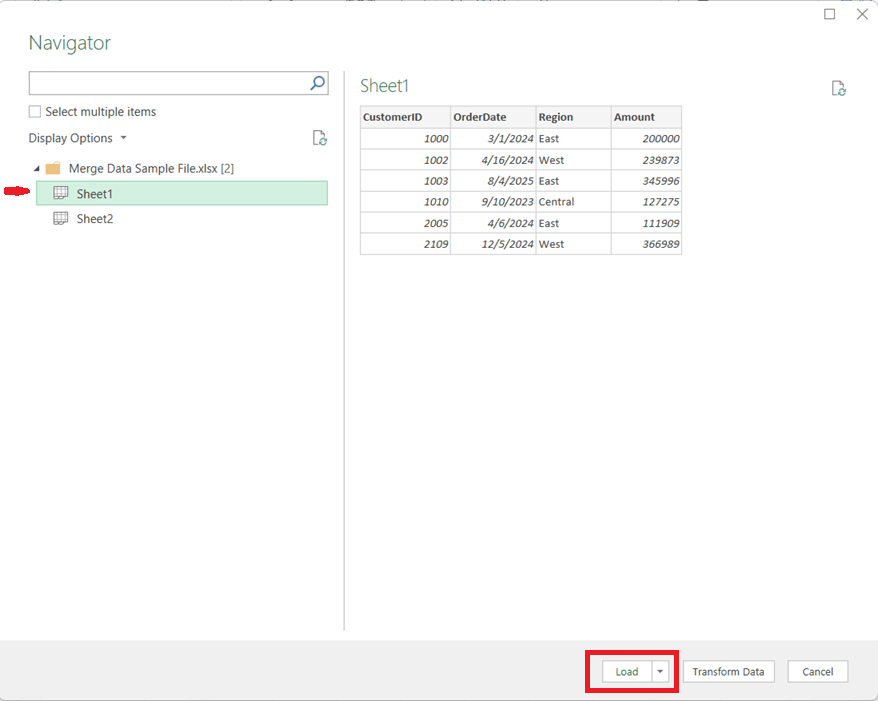
1. Load Both Data Sources into Power Query

  • Open Excel and go to Data → Get Data
  • Choose From Workbook (for separate files) or From Table/Range (for sheets in the same file)

Tip: Ensure the columns you plan to merge on have the same data types (e.g., text vs. number).


  • Load each dataset into Power Query as a separate query

2. Start the Merge Operation

  • In Power Query, select the primary table
  • Go to Query → Merge Queries
  • Choose the secondary table from the dropdown

3. Select Multiple Matching Columns

  • Click the first matching column in the primary table
  • Hold Ctrl (or Cmd on Mac) and select additional matching columns
  • Repeat the same column selections in the secondary table, in the same order

For example, if you needed to perform the merge on CustomerID, OrderDate, and Region, you would click Customer ID, then hold the Ctrl key and click OrderDate, then (while still holding down the Ctrl key) click Region.

Power Query treats this as a composite key, and all selected columns must match for rows from both tables to merge.


4. Choose the Join Type

Select the appropriate join kind:

  • Left Outer – Keep all rows from the first table (most common) and brings in the values for the matching rows from the second table
  • Inner – Keep only matching rows from both tables
  • Full Outer – Keep all rows from both tables, merging the table where there is a match and having just the values from the respective tables when there is no match

Click OK to complete the merge.


5. Expand the Merged Data

  • A new column appears containing nested tables
  • Click the expand icon to select which columns to bring in
  • Remove unnecessary columns to keep the dataset clean

6. Load and Refresh

  • Click Close & Load
  • The merged dataset is now available in Excel
  • When source files change, simply click Refresh to update everything automatically

Key Benefits

  • Handles multi-column joins cleanly and reliably
  • Eliminates fragile lookup formulas
  • Fully refreshable and auditable
  • Scales well as data volume grows

In Summary

Using Power Query to merge Excel data on multiple columns brings database-style joins into Excel, making your workflows more robust, maintainable, and professional. Once set up, it saves time and reduces errors—especially for recurring reporting and analytics tasks.

Thanks for reading!

AI in Financial Services: From Back Office Automation to Intelligent Decision-Making

Few industries have embraced AI as broadly—or as aggressively—as financial services. Banks, insurers, investment firms, and fintechs operate in data-rich, highly regulated environments where speed, accuracy, and trust matter. AI is increasingly the engine that helps them balance all three.

How AI Is Being Used Today

AI shows up across nearly every function in financial services:

  • Fraud Detection & Risk Monitoring
    Machine learning models analyze transactions in real time to identify suspicious patterns, often catching fraud faster and more accurately than rule-based systems. PayPal utilizes AI-powered systems to detect fraud by comparing transactions with historical patterns, reducing financial losses. This is extremely critical in this time of rampant fraud. Financial Institutions also use AI to analyze real-time working capital and historical data to forecast financial performance and predict trends with greater accuracy.
  • Credit Scoring & Underwriting
    AI evaluates borrower risk using far more signals than traditional credit scores, including transaction behavior and alternative data (where regulations allow). Upstart, an AI-based lending platform, uses non-traditional data to assess creditworthiness, approving loans quickly for customers who might otherwise be denied by conventional models.
  • Customer Service & Virtual Assistants
    Chatbots and voice assistants handle balance inquiries, dispute tracking, loan status updates, and more—freeing human agents for complex cases. Bank of America’s Erica, a virtual assistant, assists customers with account information, bill payments, and personalized financial advice through chat or voice.
  • Algorithmic & Quantitative Trading
    AI models analyze market signals, news sentiment, and historical trends to inform trading strategies and portfolio optimization. Goldman Sachs uses generative AI to optimize trading strategies and forecast market trends, gaining a competitive edge in dynamic markets.
  • Compliance & AML (Anti–Money Laundering)
    AI tools assist in ensuring compliance with regulatory requirements by automating the monitoring transactions and reporting. This reduces the risk if non-compliance and associated penalties. HSBC utilizes AI to process compliance documents efficiently, ensuring adherence to evolving regulations and minimizing manual errors. AI also helps identify money laundering patterns, reduce false positives, and prioritize investigations.
  • Personalized Financial Advice
    Robo-advisors and recommendation engines tailor savings, investment, and retirement strategies to individual customers. Wells Fargo’s predictive banking feature provides personalized prompts about future financial activities leading to improved user engagement.

Tools, Technologies, and Forms of AI

Financial services organizations typically use a layered AI stack:

  • Machine Learning & Deep Learning
    Core to fraud detection, risk modeling, and forecasting.
  • Natural Language Processing (NLP)
    Used to analyze customer communications, earnings reports, regulatory filings, and market news.
  • Generative AI & Large Language Models (LLMs)
    Emerging use cases include advisor copilots, automated report generation, customer communication drafting, and internal knowledge search.
  • AI Platforms & Infrastructure
    Cloud platforms like AWS, Azure, and GCP provide scalable ML services, while many firms also invest in proprietary, on-prem models for sensitive workloads.
  • Decision Intelligence & Optimization Models
    AI combined with rules engines to support pricing, underwriting, and capital allocation decisions.
  • Blockchain and AI Integration
    Blockchain and AI integration will redefine how financial transactions are managed, enhancing security, transparency, and efficiency. Blockchain technology ensures trust and accountability, while AI improves transaction validation and fraud detection. Together, these technologies will streamline cross-border payments, smart contracts, and digital identities, creating a more secure and efficient financial ecosystem.

Benefits Financial Institutions Are Seeing

Organizations that have successfully deployed AI are seeing tangible gains:

  • Reduced Fraud Losses and faster detection
  • Lower Operating Costs through automation of high-volume tasks and improved efficiencies
  • Improved Customer Experience with faster responses and personalization
  • Better Risk Management via more dynamic and data-driven models
  • Increased Revenue through smarter cross-sell, upsell, and pricing strategies

In short, AI helps firms move from reactive decision-making to proactive, predictive operations.

Pitfalls and Challenges

Despite the promise, AI in financial services comes with real risks:

  • Bias and Fairness Concerns
    AI models can unintentionally reinforce historical bias in lending or underwriting decisions, creating regulatory and ethical challenges.
  • Model Explainability
    Regulators and auditors often require clear explanations for decisions—something black-box models struggle to provide.
  • Data Quality and Silos
    Poor data governance leads to unreliable models and failed AI initiatives.
  • Regulatory Risk
    Financial institutions must ensure AI usage aligns with evolving regulations across regions.
  • Overhyped Projects
    Some AI initiatives fail because they chase cutting-edge technology without clear business ownership or measurable outcomes.

Where AI Is Headed in Financial Services

Looking ahead, several trends are emerging:

  • AI as a Copilot, Not a Replacement
    Advisors, underwriters, and analysts will increasingly work alongside AI systems that augment—not replace—human judgment.
  • More Explainable and Governed AI
    Expect increased focus on transparency, auditability, and model governance.
  • Real-Time, Embedded Intelligence
    AI will be embedded directly into workflows—credit decisions, claims processing, and trade execution—rather than sitting in separate tools.
  • Greater Use of Generative AI
    From personalized financial guidance to internal knowledge assistants, GenAI will reshape how employees and customers interact with financial systems.

How Financial Services Companies Can Gain an Advantage

To stay ahead in this fast-changing landscape, organizations should:

  1. Start with High-Impact Use Cases
    Focus on areas like fraud, customer experience, or risk where ROI is clear.
  2. Invest in Data Foundations
    Clean, well-governed data is more valuable than the most advanced model.
  3. Build AI Governance Early
    Fairness, explainability, and compliance should be part of design—not afterthoughts.
  4. Upskill the Workforce
    AI-literate business leaders and domain experts are just as important as data scientists.
  5. Blend Human and Machine Intelligence
    The most successful systems pair AI recommendations with human oversight.

Final Thoughts

AI is no longer experimental in financial services—it’s essential infrastructure. Firms that treat AI as a strategic capability, grounded in strong data practices and responsible governance, will be best positioned to innovate, compete, and earn trust in an increasingly intelligent financial ecosystem.

Are you using AI in the financial services industry? Share how and what you have learned from your journey.

This article is a part of an “AI in …” series that shares information about AI in various industries and business functions. Be on the lookout for future (and past) articles in the series.

Other “AI in …” articles in the series:

AI in the Hospitality Industry: Transforming Guest Experiences and Operations

AI in Gaming: How Artificial Intelligence is Powering Game Production and Player Experience

AI in Healthcare: Transforming Patient Care and Clinical Operations

Thanks for reading and good luck on your data journey!

How to update your Power BI source file location

The location of your source files has changed, and now you need to update your Power BI report to use the new location. To update the directory or location of your source file, in Power BI Desktop, click Transform Data -> Data Source Settings 

Then click on the entry that corresponds to the path you need to update.

Update or entirely change the path and click ok. Apply your changes.

It becomes a little more complicated when you are changing a local folder to a SharePoint location, which we will cover in another post, but for changing location of single files, it’s that simple. 

Thanks for reading!

Power BI load error: load was cancelled by error in loading a previous table

You may run into this error when loading Power BI:

"load was cancelled by error in loading a previous table"

If you do get this error, keep scrolling down to see what the “inducing” error is. This message is an indication that there was an error previous to getting to the current table in the process. The real, initial error will be more descriptive. Start with resolving that error(s), and then this one will go away.

I hope you found this helpful.

Power BI refresh error: Column ‘X’ in table ‘Y’ contains blank values and this is not allowed for columns on the one-side of a many-to-one relationship or for columns that are used as the primary key of a table

I was getting this error message when I attempted to refresh a Power BI application:

"Column 'Date' in table 'Date Dim' contains blank values and this is not allowed for columns on the one-side of a many-to-one relationship or for columns that are used as the primary key of a table"

However, despite what the message indicated, I double-checked and confirmed that I did not have any blank values in the ‘Date Dim’ table.

It turns out that you may also get this error (although incorrectly worded in my opinion) if the blanks are in the joining table. In my case, I had blanks in a ‘Snapshot Date’ column in the fact table that was joined to the ‘Date Dim’ table. Once these blanks were filled, the refresh ran without error.

One thing to look out for in these cases (since this is what happened in my case), if your source is Excel, undo all filters to make sure that you do not have any rows being filtered out when checking for blanks values across your columns, because this could potentially inadvertently hide the rows with the blank values and cause you to miss them.

I hope you found this helpful.