Category: Machine Learning (ML)

AI in Marketing: From Campaign Automation to Intelligent Growth Engines

“AI in …” series

Marketing has always been about understanding people—what they want, when they want it, and how best to reach them. What’s changed is the scale and complexity of that challenge. Customers interact across dozens of channels, generate massive amounts of data, and expect personalization as the default.

AI has become the connective tissue that allows marketing teams to turn fragmented data into insight, automation, and growth—often in real time.


How AI Is Being Used in Marketing Today

AI now touches nearly every part of the marketing function:

Personalization & Customer Segmentation

  • Netflix uses AI to personalize thumbnails, recommendations, and messaging—driving engagement and retention.
  • Amazon applies machine learning to personalize product recommendations and promotions across its marketing channels.

Content Creation & Optimization

  • Coca-Cola has used generative AI tools to co-create marketing content and creative assets.
  • Marketing teams use OpenAI models (via ChatGPT and APIs), Adobe Firefly, and Jasper AI to generate copy, images, and ad variations at scale.

Marketing Automation & Campaign Optimization

  • Salesforce Einstein optimizes email send times, predicts customer engagement, and recommends next-best actions.
  • HubSpot AI assists with content generation, lead scoring, and campaign optimization.

Paid Media & Ad Targeting

  • Meta Advantage+ and Google Performance Max use AI to automate bidding, targeting, and creative optimization across ad networks.

Customer Journey Analytics

  • Adobe Sensei analyzes cross-channel customer journeys to identify drop-off points and optimization opportunities.

Voice, Chat, and Conversational Marketing

  • Brands use AI chatbots and virtual assistants for lead capture, product discovery, and customer support.

Tools, Technologies, and Forms of AI in Use

Modern marketing AI stacks typically include:

  • Machine Learning & Predictive Analytics
    Used for churn prediction, propensity scoring, and lifetime value modeling.
  • Natural Language Processing (NLP)
    Powers content generation, sentiment analysis, and conversational interfaces.
  • Generative AI & Large Language Models (LLMs)
    Used to generate ad copy, emails, landing pages, social posts, and campaign ideas.
    • Examples: ChatGPT, Claude, Gemini, Jasper, Copy.ai
  • Computer Vision
    Applied to image recognition, brand safety, and visual content optimization.
  • Marketing AI Platforms
    • Salesforce Einstein
    • Adobe Sensei
    • HubSpot AI
    • Marketo Engage
    • Google Marketing Platform

Benefits Marketers Are Realizing

Organizations that adopt AI effectively see significant advantages:

  • Higher Conversion Rates through personalization
  • Faster Campaign Execution with automated content creation
  • Lower Cost per Acquisition (CPA) via optimized targeting
  • Improved Customer Insights and segmentation
  • Better ROI Measurement and attribution
  • Scalability without proportional increases in headcount

In many cases, AI allows small teams to operate at enterprise scale.


Pitfalls and Challenges

Despite its power, AI in marketing has real risks:

Over-Automation and Brand Dilution

  • Excessive reliance on generative AI can lead to generic or off-brand content.

Data Privacy and Consent Issues

  • AI-driven personalization must comply with GDPR, CCPA, and evolving privacy laws.

Bias in Targeting and Messaging

  • AI models can unintentionally reinforce stereotypes or exclude certain audiences.

Measurement Complexity

  • AI-driven multi-touch journeys can make attribution harder, not easier.

Tool Sprawl

  • Marketers may adopt too many AI tools without clear integration or strategy.

Where AI Is Headed in Marketing

The next wave of AI in marketing will be even more integrated and autonomous:

  • Hyper-Personalization in Real Time
    Content, offers, and experiences adapted instantly based on context and behavior.
  • Generative AI as a Creative Partner
    AI co-creating—not replacing—human creativity.
  • Predictive and Prescriptive Marketing
    AI recommending not just what will happen, but what to do next.
  • AI-Driven Brand Guardianship
    Models trained on brand voice, compliance, and tone to ensure consistency.
  • End-to-End Journey Orchestration
    AI managing entire customer journeys across channels automatically.

How Marketing Teams Can Gain an Advantage

To thrive in this fast-changing environment, marketing organizations should:

  1. Anchor AI to Clear Business Outcomes
    Start with revenue, retention, or efficiency goals—not tools.
  2. Invest in Clean, Unified Customer Data
    AI effectiveness depends on strong data foundations.
  3. Establish Human-in-the-Loop Workflows
    Maintain creative oversight and brand governance.
  4. Upskill Marketers in AI Literacy
    The best results come from marketers who know how to prompt, test, and refine AI outputs.
  5. Balance Personalization with Privacy
    Trust is a long-term competitive advantage.
  6. Rationalize the AI Stack
    Fewer, well-integrated tools outperform disconnected point solutions.

Final Thoughts

AI is transforming marketing from a campaign-driven function into an intelligent growth engine. The organizations that win won’t be those that simply automate more—they’ll be the ones that use AI to understand customers more deeply, move faster with confidence, and blend human creativity with machine intelligence.

In marketing, AI isn’t replacing storytellers—it’s giving them superpowers.
The State of Data for the Year 2025

As we close out 2025, it’s clear that the global data landscape has continued its unprecedented expansion — touching every part of life, business, and technology. From raw bytes generated every second to the ways that AI reshapes how we search, communicate, and innovate, this year has marked another seismic leap forward for data. Below is a comprehensive look at where we stand — and where things appear to be headed as we approach 2026.


🌐 Global Data Generation: A Tidal Wave

Amount of Data Generated

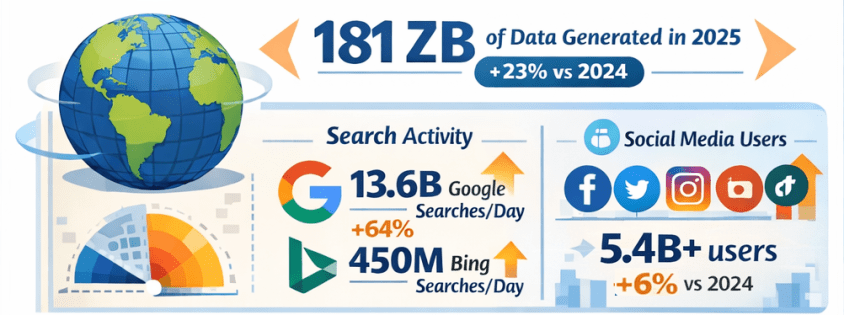
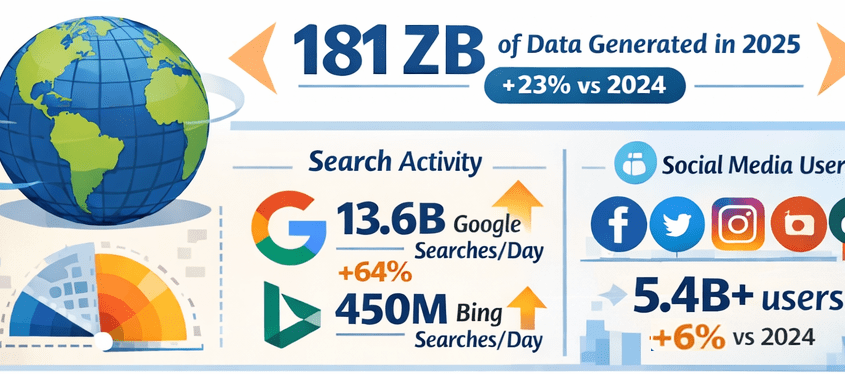
  • In 2025, the total volume of data created, captured, copied, and consumed globally is forecast to reach approximately 181 zettabytes (ZB) — up from about 147 ZB in 2024, representing roughly 23% year-over-year growth. Gitnux+1
  • That equates to an astonishing ~402 million terabytes of data generated daily. Exploding Topics

Growth Comparison: 2024 vs 2025

  • Data is growing at a compound rate: from roughly 120 ZB in 2023 to 147 ZB in 2024, then to about 181 ZB in 2025 — illustrating an ongoing surge of data creation driven by digital adoption and connected devices. Exploding Topics+1

🔍 Internet Users & Search Behavior

Number of People Online

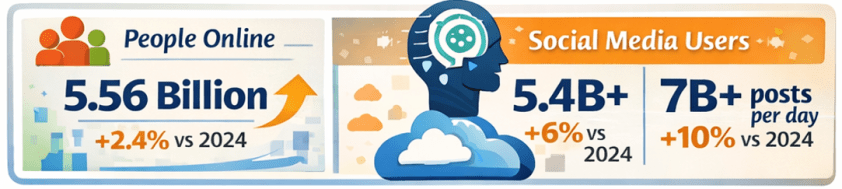
  • As of early 2025, around 5.56 billion people are active internet users, accounting for nearly 68% of the global population — up from approximately 5.43 billion in 2024. DemandSage

Search Engine Activity

  • Google alone handles roughly 13.6 billion searches per day in 2025, totaling almost 5 trillion searches annually — a significant increase from the estimated 8.3 billion daily searches in 2024. Exploding Topics
  • Bing, while much smaller in scale, processes around 450+ million searches per day (~13–14 billion per month). Nerdynav

Market Share Snapshot

  • Google continues to dominate search with approximately 90% global market share, while Bing remains one of the top alternatives. StatCounter Global Stats

📱 Social Media Usage & Content Creation

User Numbers

  • There are roughly 5.4–5.45 billion social media users worldwide in 2025 — up from prior years and covering about 65–67% of the global population. XtendedView+1

Time Spent & Trends

  • Users spend on average about 2 hours and 20+ minutes per day on social platforms. SQ Magazine
  • AI plays a central role in content recommendations and creation, with 80%+ of social feeds relying on algorithms, and an increasing share of generated images and posts assisted by AI tools. SQ Magazine

📊 The Explosion of AI: LLMs & Tools

LLM Adoption

  • Large language models and AI assistants like ChatGPT have become globally pervasive:
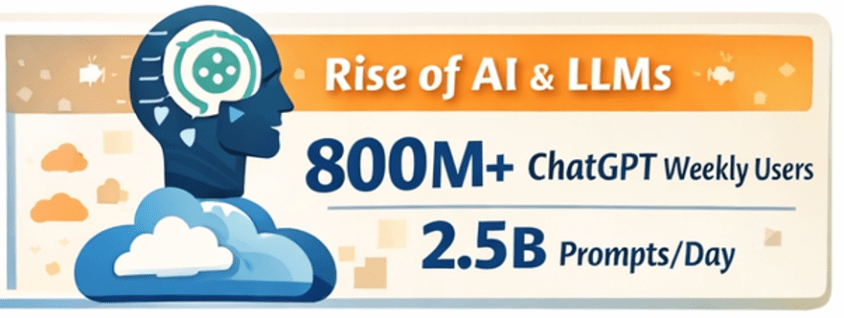
    • ChatGPT alone has around 800 million weekly active users as of late 2025. First Page Sage
    • Daily usage figures exceed 2.5 billion user prompts globally, highlighting a massive shift toward direct AI interaction. Exploding Topics
  • Studies have shown that LLM-assisted writing and content creation are now embedded across formal and informal communication channels, indicating broad adoption beyond curiosity use cases. arXiv

AI Tools Everywhere

  • Generative AI is now a staple across industries — from content creation to customer service, data analytics to software development. Investments and usage in AI-powered analytics and automation tools continue to rise rapidly. layerai.org

💡 Trends in Data Collection & Analytics

Real-Time & Edge Processing

  • In 2025, more than half of corporate data processing is happening at the edge, closer to the source of data generation, enabling real-time insights. Pennsylvania Institute of Technology

Data Democratization

  • Data access and analytics tools have become more user-friendly, with low-code/no-code platforms enabling broader organizational participation in data insight generation. postlo.com

☁️ Cloud & Data Infrastructure

Cloud Data Growth

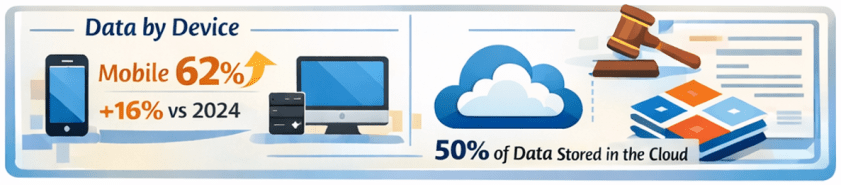
  • An ever-increasing portion of global data is stored in the cloud, with estimates suggesting around half of all data resides in cloud environments by 2025. Axis Intelligence

Data Centers & Energy

  • Data centers, particularly those supporting AI workloads, are expanding rapidly. This infrastructure surge is driving both innovation and concerns — including power consumption and sustainability challenges. TIME

📜 Data Laws & Regulation

New Legal Frameworks

  • In the UK, the Data (Use and Access) Act of 2025 was enacted, updating data protection and access rules related to UK-specific GDPR implementations. Wikipedia
  • Elsewhere, data regulation remains a focal point globally, with ongoing debates around privacy, governance, AI accountability, and cross–border data flows.

🛠️ Top Data Tools/Platforms of 2025

While specific rankings vary by industry and use case, 2025’s data ecosystem centers around:

  • Cloud data platforms: Snowflake, BigQuery, Redshift, Databricks
  • BI & visualization: Tableau, Power BI
  • AI/ML frameworks: TensorFlow, PyTorch, scalable LLM platforms
  • Automation & low-code analytics: dbt, Airflow, no-code toolchains
  • Real-time streaming: Kafka, ksqlDB

Ongoing trends emphasize integration between AI tooling and traditional analytics pipelines — blurring the lines between data engineering, analytics, and automation.

Note: specific tool adoption percentages vary by firm size and sector, but cloud-native and AI-augmented tools dominate enterprise workflows. Reddit


🌟 Novel Uses of Data in 2025

2025 saw innovative applications such as:

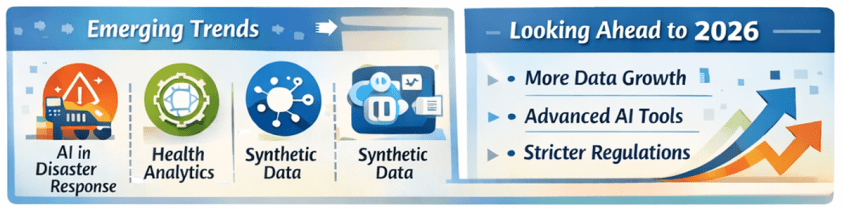
  • AI-powered disaster response using real-time social data streams.
  • Conversational assistants embedded into everyday workflows (search, writing, decision support).
  • Predictive analytics in health, finance, logistics, accelerated by real-time IoT feeds.
  • Synthetic datasets for simulation, security research, and model training. arXiv

🔮 What’s Expected in 2026

Continued Growth

  • Data volumes are projected to keep rising — potentially doubling every few years with the proliferation of AI, IoT, and immersive technologies.
  • LLM adoption will likely hit deeper integration into enterprise processes, customer experience workflows, and consumer tech.
  • AI governance and data privacy regulation will intensify globally, balancing innovation with accountability.

Emerging Frontiers

  • Multimodal AI blending text, vision, and real-time sensor data.
  • Federated learning and privacy-preserving analytics gaining traction.
  • Data meshes and decentralized data infrastructures challenging traditional monolithic systems.
  • Unified data platforms with AI-focused features and AI-focused business-ready data models are becoming common place.

📌 Final Thoughts

2025 has been another banner year for data — not just in sheer scale, but in how data powers decision-making, AI capabilities, and digital interactions across society. From trillions of searches to billions of social interactions, from zettabytes of oceans of data to democratized analytics tools, the data world continues to evolve at breakneck speed. And for data professionals and leaders, the next year promises even more opportunities to harness data for insight, innovation, and impact. Exciting stuff!

Thanks for reading!

AI in Human Resources: From Administrative Support to Strategic Workforce Intelligence

“AI in …” series

Human Resources has always been about people—but it’s also about data: skills, performance, engagement, compensation, and workforce planning. As organizations grow more complex and talent markets tighten, HR teams are being asked to move faster, be more predictive, and deliver better employee experiences at scale.

AI is increasingly the engine enabling that shift. From recruiting and onboarding to learning, engagement, and workforce planning, AI is transforming how HR operates and how employees experience work.


How AI Is Being Used in Human Resources Today

AI is now embedded across the end-to-end employee lifecycle:

Talent Acquisition & Recruiting

  • LinkedIn Talent Solutions uses AI to match candidates to roles based on skills, experience, and career intent.
  • Workday Recruiting and SAP SuccessFactors apply machine learning to rank candidates and surface best-fit applicants.
  • Paradox (Olivia) uses conversational AI to automate candidate screening, scheduling, and frontline hiring at scale.

Resume Screening & Skills Matching

  • Eightfold AI and HiredScore use deep learning to infer skills, reduce bias, and match candidates to open roles and future opportunities.
  • AI shifts recruiting from keyword matching to skills-based hiring.

Employee Onboarding & HR Service Delivery

  • ServiceNow HR Service Delivery uses AI chatbots to answer employee questions, guide onboarding, and route HR cases.
  • Microsoft Copilot for HR scenarios help managers draft job descriptions, onboarding plans, and performance feedback.

Learning & Development

  • Degreed and Cornerstone AI recommend personalized learning paths based on role, skills gaps, and career goals.
  • AI-driven content curation adapts as employee skills evolve.

Performance Management & Engagement

  • Betterworks and Lattice use AI to analyze feedback, goal progress, and engagement signals.
  • Sentiment analysis helps HR identify burnout risks or morale issues early.

Workforce Planning & Attrition Prediction

  • Visier applies AI to predict attrition risk, model workforce scenarios, and support strategic planning.
  • HR leaders use AI insights to proactively retain key talent.

Those are just a few examples of AI tools and scenarios in use. There are a lot more AI solutions for HR out there!


Tools, Technologies, and Forms of AI in Use

HR AI platforms combine people data with advanced analytics:

  • Machine Learning & Predictive Analytics
    Used for attrition prediction, candidate ranking, and workforce forecasting.
  • Natural Language Processing (NLP)
    Powers resume parsing, sentiment analysis, chatbots, and document generation.
  • Generative AI & Large Language Models (LLMs)
    Used to generate job descriptions, interview questions, learning content, and policy summaries.
    • Examples: Workday AI, Microsoft Copilot, Google Duet AI, ChatGPT for HR workflows
  • Skills Ontologies & Graph AI
    Used by platforms like Eightfold AI to map skills across roles and career paths.
  • HR AI Platforms
    • Workday AI
    • SAP SuccessFactors Joule
    • Oracle HCM AI
    • UKG Bryte AI

And there are AI tools being used across the entire employee lifecycle.


Benefits Organizations Are Realizing

Companies using AI effectively in HR are seeing meaningful benefits:

  • Faster Time-to-Hire and reduced recruiting costs
  • Improved Candidate and Employee Experience
  • More Objective, Skills-Based Decisions
  • Higher Retention through proactive interventions
  • Scalable HR Operations without proportional headcount growth
  • Better Strategic Workforce Planning

AI allows HR teams to spend less time on manual tasks and more time on high-impact, people-centered work.


Pitfalls and Challenges

AI in HR also carries significant risks if not implemented carefully:

Bias and Fairness Concerns

  • Poorly designed models can reinforce historical bias in hiring, promotion, or pay decisions.

Transparency and Explainability

  • Employees and regulators increasingly demand clarity on how AI-driven decisions are made.

Data Privacy and Trust

  • HR data is deeply personal; misuse or breaches can erode employee trust quickly.

Over-Automation

  • Excessive reliance on AI can make HR feel impersonal, especially in sensitive situations.

Failed AI Projects

  • Some initiatives fail because they focus on automation without aligning to HR strategy or culture.

Where AI Is Headed in Human Resources

The future of AI in HR is more strategic, personalized, and collaborative:

  • AI as an HR Copilot
    Assisting HR partners and managers with decisions, documentation, and insights in real time.
  • Skills-Centric Organizations
    AI continuously mapping skills supply and demand across the enterprise.
  • Personalized Employee Journeys
    Tailored learning, career paths, and engagement strategies.
  • Predictive Workforce Strategy
    AI modeling future talent needs based on business scenarios.
  • Responsible and Governed AI
    Stronger emphasis on ethics, explainability, and compliance.

How Companies Can Gain an Advantage with AI in HR

To use AI as a competitive advantage, organizations should:

  1. Start with High-Trust Use Cases
    Recruiting efficiency, learning recommendations, and HR service automation often deliver fast wins.
  2. Invest in Clean, Integrated People Data
    AI effectiveness depends on accurate and well-governed HR data.
  3. Design for Fairness and Transparency
    Bias testing and explainability should be built in from day one.
  4. Keep Humans in the Loop
    AI should inform decisions—not make them in isolation.
  5. Upskill HR Teams
    AI-literate HR professionals can better interpret insights and guide leaders.
  6. Align AI with Culture and Values
    Technology should reinforce—not undermine—the employee experience.

Final Thoughts

AI is reshaping Human Resources from a transactional function into a strategic engine for talent, culture, and growth. The organizations that succeed won’t be those that automate HR the most—but those that use AI to make work more human, more fair, and more aligned with business outcomes.

In HR, AI isn’t about replacing people—it’s about improving efficiency, elevating the candidate and employee experiences, and helping employees thrive.

AI in Manufacturing: From Smart Factories to Self-Optimizing Operations

“AI in …” series

Manufacturing has always been about efficiency, quality, and scale. What’s changed is the speed and intelligence with which manufacturers can now operate. AI is moving factories beyond basic automation into adaptive, data-driven systems that can predict problems, optimize production, and continuously improve outcomes.

Across discrete manufacturing, process manufacturing, automotive, electronics, and industrial equipment, AI is becoming a core pillar of digital transformation.


How AI Is Being Used in Manufacturing Today

AI is embedded across the manufacturing value chain:

Predictive Maintenance

  • Siemens uses AI models within its MindSphere platform to predict equipment failures before they happen, reducing unplanned downtime.
  • GE Aerospace applies machine learning to sensor data from jet engines to predict maintenance needs and extend asset life.

Quality Inspection & Defect Detection

  • BMW uses computer vision and deep learning to inspect welds, paint finishes, and component alignment on production lines.
  • Foxconn applies AI-powered visual inspection to detect microscopic defects in electronics manufacturing.

Production Planning & Scheduling

  • AI optimizes production schedules based on demand forecasts, machine availability, and supply constraints.
  • Bosch uses AI-driven planning systems to dynamically adjust production based on real-time conditions.

Robotics & Intelligent Automation

  • Collaborative robots (“cobots”) powered by AI adapt to human movements and changing tasks.
  • ABB integrates AI into robotics for flexible assembly and material handling.

Supply Chain & Inventory Optimization

  • Procter & Gamble uses AI to predict demand shifts and optimize global supply chains.
  • Manufacturers apply AI to identify supplier risks, logistics bottlenecks, and inventory imbalances.

Energy Management & Sustainability

  • AI systems optimize energy consumption across plants, helping manufacturers reduce costs and carbon emissions.

Tools, Technologies, and Forms of AI in Use

Manufacturing AI typically blends operational technology (OT) with advanced analytics:

  • Machine Learning & Deep Learning
    Used for predictive maintenance, forecasting, quality control, and anomaly detection.
  • Computer Vision
    Core to automated inspection, safety monitoring, and process verification.
  • Industrial IoT (IIoT) + AI
    Sensor data from machines feeds AI models in near real time.
  • Digital Twins
    Virtual models of factories, production lines, or equipment simulate scenarios and optimize performance.
    • Siemens Digital Twin and Dassault Systèmes 3DEXPERIENCE are widely used platforms.
  • AI Platforms & Manufacturing Suites
    • Siemens MindSphere
    • PTC ThingWorx
    • Rockwell Automation FactoryTalk Analytics
    • Azure AI and AWS IoT Greengrass for scalable AI deployment
  • Edge AI
    AI models run directly on machines or local devices to reduce latency and improve reliability.

Benefits Manufacturers Are Realizing

Manufacturers that deploy AI effectively are seeing clear advantages:

  • Reduced Downtime through predictive maintenance
  • Higher Product Quality and fewer defects
  • Lower Operating Costs via optimized processes
  • Improved Throughput and Yield
  • Greater Flexibility in responding to demand changes
  • Enhanced Worker Safety through AI-based monitoring

In capital-intensive environments, even small efficiency gains can translate into significant financial impact.


Pitfalls and Challenges

AI adoption in manufacturing is not without obstacles:

Data Readiness Issues

  • Legacy equipment often lacks sensors or produces inconsistent data, limiting AI effectiveness.

Integration Complexity

  • Bridging IT systems with OT environments is technically and organizationally challenging.

Skills Gaps

  • Manufacturers often struggle to find talent that understands both AI and industrial processes.

High Upfront Costs

  • Computer vision systems, sensors, and edge devices require capital investment.

Over-Ambitious Projects

  • Some AI initiatives fail because they attempt full “smart factory” transformations instead of targeted improvements.

Where AI Is Headed in Manufacturing

The next phase of AI in manufacturing is focused on autonomy and adaptability:

  • Self-Optimizing Factories
    AI systems that automatically adjust production parameters without human intervention.
  • Generative AI for Engineering and Operations
    Used to generate process documentation, maintenance instructions, and design alternatives.
  • More Advanced Digital Twins
    Real-time, continuously updated simulations of entire plants and supply networks.
  • Human–AI Collaboration on the Shop Floor
    AI copilots assisting operators, engineers, and maintenance teams.
  • AI-Driven Sustainability
    Optimization of materials, energy use, and waste reduction to meet ESG goals.

How Manufacturers Can Gain an Advantage

To compete effectively in this rapidly evolving landscape, manufacturers should:

  1. Start with High-Value, Operational Use Cases
    Predictive maintenance and quality inspection often deliver fast ROI.
  2. Invest in Data Infrastructure and IIoT
    Reliable, high-quality sensor data is foundational.
  3. Adopt a Phased Approach
    Scale proven pilots rather than pursuing all-encompassing transformations.
  4. Bridge IT and OT Teams
    Cross-functional collaboration is critical for success.
  5. Upskill the Workforce
    Engineers and operators who understand AI amplify its impact.
  6. Design for Explainability and Trust
    Especially important in safety-critical and regulated environments.

Final Thoughts

AI is reshaping manufacturing from the factory floor to the global supply chain. The most successful manufacturers aren’t chasing AI for its own sake—they’re using it to solve concrete operational problems, empower workers, and build more resilient, intelligent operations.

In manufacturing, AI isn’t just about automation—it’s about continuous learning at industrial scale.

AI Career Options for Early-Career Professionals and New Graduates

Artificial Intelligence is shaping nearly every industry, but breaking into AI right out of college can feel overwhelming. The good news is that you don’t need a PhD or years of experience to start a successful AI-related career. Many AI roles are designed specifically for early-career talent, blending technical skills with problem-solving, communication, and business understanding.

This article outlines excellent AI career options for people just entering the workforce, explaining what each role involves, why it’s a strong choice, and how to prepare with the right skills, tools, and learning resources.


1. AI / Machine Learning Engineer (Junior)

What It Is & What It Involves

Machine Learning Engineers build, train, test, and deploy machine learning models. Junior roles typically focus on:

  • Implementing existing models
  • Cleaning and preparing data
  • Running experiments
  • Supporting senior engineers

Why It’s a Good Option

  • High demand and strong salary growth
  • Clear career progression
  • Central role in AI development

Skills & Preparation Needed

Technical Skills

  • Python
  • SQL
  • Basic statistics & linear algebra
  • Machine learning fundamentals
  • Libraries: scikit-learn, TensorFlow, PyTorch

Where to Learn

  • Coursera (Andrew Ng ML specialization)
  • Fast.ai
  • Kaggle projects
  • University CS or data science coursework

Difficulty Level: ⭐⭐⭐⭐ (Moderate–High)


2. Data Analyst (AI-Enabled)

What It Is & What It Involves

Data Analysts use AI tools to analyze data, generate insights, and support decision-making. Tasks often include:

  • Data cleaning and visualization
  • Dashboard creation
  • Using AI tools to speed up analysis
  • Communicating insights to stakeholders

Why It’s a Good Option

  • Very accessible for new graduates
  • Excellent entry point into AI
  • Builds strong business and technical foundations

Skills & Preparation Needed

Technical Skills

  • SQL
  • Excel
  • Python (optional but helpful)
  • Power BI / Tableau
  • AI tools (ChatGPT, Copilot, AutoML)

Where to Learn

  • Microsoft Learn
  • Google Data Analytics Certificate
  • Kaggle datasets
  • Internships and entry-level analyst roles

Difficulty Level: ⭐⭐ (Low–Moderate)


3. Prompt Engineer / AI Specialist (Entry Level)

What It Is & What It Involves

Prompt Engineers design, test, and optimize instructions for AI systems to get reliable and accurate outputs. Entry-level roles focus on:

  • Writing prompts
  • Testing AI behavior
  • Improving outputs for business use cases
  • Supporting AI adoption across teams

Why It’s a Good Option

  • Low technical barrier
  • High demand across industries
  • Great for strong communicators and problem-solvers

Skills & Preparation Needed

Key Skills

  • Clear writing and communication
  • Understanding how LLMs work
  • Logical thinking
  • Domain knowledge (marketing, analytics, HR, etc.)

Where to Learn

  • OpenAI documentation
  • Prompt engineering guides
  • Hands-on practice with ChatGPT, Claude, Gemini
  • Real-world experimentation

Difficulty Level: ⭐⭐ (Low–Moderate)


4. AI Product Analyst / Associate Product Manager

What It Is & What It Involves

This role sits between business, engineering, and AI teams. Responsibilities include:

  • Defining AI features
  • Translating business needs into AI solutions
  • Analyzing product performance
  • Working with data and AI engineers

Why It’s a Good Option

  • Strong career growth
  • Less coding than engineering roles
  • Excellent mix of strategy and technology

Skills & Preparation Needed

Key Skills

  • Basic AI/ML concepts
  • Data analysis
  • Product thinking
  • Communication and stakeholder management

Where to Learn

  • Product management bootcamps
  • AI fundamentals courses
  • Internships or associate PM roles
  • Case studies and product simulations

Difficulty Level: ⭐⭐⭐ (Moderate)


5. AI Research Assistant / Junior Data Scientist

What It Is & What It Involves

These roles support AI research and experimentation, often in academic, healthcare, or enterprise environments. Tasks include:

  • Running experiments
  • Analyzing model performance
  • Data exploration
  • Writing reports and documentation

Why It’s a Good Option

  • Strong foundation for advanced AI careers
  • Exposure to real-world research
  • Great for analytical thinkers

Skills & Preparation Needed

Technical Skills

  • Python or R
  • Statistics and probability
  • Data visualization
  • ML basics

Where to Learn

  • University coursework
  • Research internships
  • Kaggle competitions
  • Online ML/statistics courses

Difficulty Level: ⭐⭐⭐⭐ (Moderate–High)


6. AI Operations (AIOps) / ML Operations (MLOps) Associate

What It Is & What It Involves

AIOps/MLOps professionals help deploy, monitor, and maintain AI systems. Entry-level work includes:

  • Model monitoring
  • Data pipeline support
  • Automation
  • Documentation

Why It’s a Good Option

  • Growing demand as AI systems scale
  • Strong alignment with data engineering
  • Less math-heavy than research roles

Skills & Preparation Needed

Technical Skills

  • Python
  • SQL
  • Cloud basics (Azure, AWS, GCP)
  • CI/CD concepts
  • ML lifecycle understanding

Where to Learn

  • Cloud provider learning paths
  • MLOps tutorials
  • GitHub projects
  • Entry-level data engineering roles

Difficulty Level: ⭐⭐⭐ (Moderate)


7. AI Consultant / AI Business Analyst (Entry Level)

What It Is & What It Involves

AI consultants help organizations understand and implement AI solutions. Entry-level roles focus on:

  • Use-case analysis
  • AI tool evaluation
  • Process improvement
  • Client communication

Why It’s a Good Option

  • Exposure to multiple industries
  • Strong soft-skill development
  • Fast career progression

Skills & Preparation Needed

Key Skills

  • Business analysis
  • AI fundamentals
  • Presentation and communication
  • Problem-solving

Where to Learn

  • Business analytics programs
  • AI fundamentals courses
  • Consulting internships
  • Case study practice

Difficulty Level: ⭐⭐⭐ (Moderate)


8. AI Content & Automation Specialist

What It Is & What It Involves

This role focuses on using AI to automate content, workflows, and internal processes. Tasks include:

  • Building automations
  • Creating AI-generated content
  • Managing tools like Zapier, Notion AI, Copilot

Why It’s a Good Option

  • Very accessible for non-technical graduates
  • High demand in marketing and operations
  • Rapid skill acquisition

Skills & Preparation Needed

Key Skills

  • Workflow automation
  • AI tools usage
  • Creativity and organization
  • Basic scripting (optional)

Where to Learn

  • Zapier and Make tutorials
  • Hands-on projects
  • YouTube and online courses
  • Real business use cases

Difficulty Level: ⭐⭐ (Low–Moderate)


How New Graduates Should Prepare for AI Careers

1. Build Foundations

  • Python or SQL
  • Data literacy
  • AI concepts (not just tools)

2. Practice with Real Projects

  • Personal projects
  • Internships
  • Freelance or volunteer work
  • Kaggle or GitHub portfolios

3. Learn AI Tools Early

  • ChatGPT, Copilot, Gemini
  • AutoML platforms
  • Visualization and automation tools

4. Focus on Communication

AI careers, and careers in general, reward those who can explain complex ideas simply.


Final Thoughts

AI careers are no longer limited to researchers or elite engineers. For early-career professionals, the best path is often a hybrid role that combines AI tools, data, and business understanding. Starting in these roles builds confidence, experience, and optionality—allowing you to grow into more specialized AI positions over time.
And the advice that many professionals give for gaining knowledge and breaking into the space is to “get your hands dirty”.

Good luck on your data journey!

The 20 Best AI Tools to Learn for 2026

Artificial intelligence is no longer a niche skill reserved for researchers and engineers—it has become a core capability across nearly every industry. From data analytics and software development to marketing, design, and everyday productivity, AI tools are reshaping how work gets done. As we move into 2026, the pace of innovation continues to accelerate, making it essential to understand not just what AI can do, but which tools are worth learning and why.

This article highlights 20 of the most important AI tools to learn for 2026, spanning general-purpose AI assistants, developer frameworks, creative platforms, automation tools, and autonomous agents. For each tool, you’ll find a clear description, common use cases, reasons it matters, cost considerations, learning paths, and an estimated difficulty level—helping you decide where to invest your time and energy in the rapidly evolving AI landscape. However, even if you don’t learn any of these tools, you should spend the time to learn one or more other AI tool(s) this year.


1. ChatGPT (OpenAI)

Description: A versatile large language model (LLM) that can write, research, code, summarize, and more. Often used for general assistance, content creation, dialogue systems, and prototypes.
Why It Matters: It’s the Swiss Army knife of AI — foundational in productivity, automation, and AI literacy.
Cost: Free tier; Plus/Pro tiers ~$20+/month with faster models and priority access.
How to Learn: Start by using the official tutorials, prompt engineering guides, and building integrations via the OpenAI API.
Difficulty: Beginner


2. Google Gemini / Gemini 3

Description: A multimodal AI from Google that handles text, image, and audio queries, and integrates deeply with Google Workspace. Latest versions push stronger reasoning and creative capabilities. Android Central
Why It Matters: Multimodal capabilities are becoming standard; integration across tools makes it essential for workflows.
Cost: Free tier with paid Pro/Ultra levels for advanced models.
How to Learn: Use Google AI Studio, experiment with prompts, and explore the API.
Difficulty: Beginner–Intermediate


3. Claude (Anthropic)

Description: A conversational AI with long-context handling and enhanced safety features. Excellent for deep reasoning, document analysis, and coding. DataNorth AI
Why It Matters: It’s optimized for enterprise and technical tasks where accuracy over verbosity is critical.
Cost: Free and subscription tiers (varies by use case).
How to Learn: Tutorials via Anthropic’s docs, hands-on in Claude UI/API, real projects like contract analysis.
Difficulty: Intermediate


4. Microsoft Copilot (365 + Dev)

Description: AI assistant built into Microsoft 365 apps and developer tools, helping automate reports, summaries, and code generation.
Why It Matters: It brings AI directly into everyday productivity tools at enterprise scale.
Cost: Included with M365 and GitHub subscriptions; Copilot versions vary by plan.
How to Learn: Microsoft Learn modules and real workflows inside Office apps.
Difficulty: Beginner


5. Adobe Firefly

Description: A generative AI suite focused on creative tasks, from text-to-image/video to editing workflows across Adobe products. Wikipedia
Why It Matters: Creative AI is now essential for design and branding work at scale.
Cost: Included in Adobe Creative Cloud subscriptions (varies).
How to Learn: Adobe tutorials + hands-on in Firefly Web and apps.
Difficulty: Beginner–Intermediate


6. TensorFlow

Description: Open-source deep learning framework from Google used to build and deploy neural networks. Wikipedia
Why It Matters: Core tool for anyone building machine learning models and production systems.
Cost: Free/open source.
How to Learn: TensorFlow courses, hands-on projects, and official tutorials.
Difficulty: Intermediate


7. PyTorch

Description: Another dominant open-source deep learning framework, favored for research and flexibility.
Why It Matters: Central for prototyping new models and customizing architectures.
Cost: Free.
How to Learn: Official tutorials, MOOCs, and community notebooks (e.g., Fast.ai).
Difficulty: Intermediate


8. Hugging Face Transformers

Description: A library of pre-trained models for language and multimodal tasks.
Why It Matters: Makes state-of-the-art models accessible with minimal coding.
Cost: Free; paid tiers for hosted inference.
How to Learn: Hugging Face courses, hands-on fine-tuning tasks.
Difficulty: Intermediate


9. LangChain

Description: Framework to build chain-based, context-aware LLM applications and agents.
Why It Matters: Foundation for building smart workflows and agent applications.
Cost: Free (open-source).
How to Learn: LangChain docs and project tutorials.
Difficulty: Intermediate–Advanced


10. Google Antigravity IDE

Description: AI-first coding environment where AI agents assist development workflows. Wikipedia
Why It Matters: Represents the next step in how developers interact with code — AI as partner.
Cost: Free preview; may move to paid models.
How to Learn: Experiment with projects, follow Google documentation.
Difficulty: Intermediate


11. Perplexity AI

Description: AI research assistant combining conversational AI with real-time web citations.
Why It Matters: Trusted research tool that avoids hallucinations by providing sources. The Case HQ
Cost: Free; Pro versions exist.
How to Learn: Use for query tasks, explore research workflows.
Difficulty: Beginner


12. Notion AI

Description: AI features embedded inside the Notion workspace for notes, automation, and content.
Why It Matters: Enhances organization and productivity in individual and team contexts.
Cost: Notion plans with AI add-ons.
How to Learn: In-app experimentation and productivity courses.
Difficulty: Beginner


13. Runway ML

Description: AI video and image creation/editing platform.
Why It Matters: Brings generative visuals to creators without deep technical skills.
Cost: Free tier with paid access to advanced models.
How to Learn: Runway tutorials and creative projects.
Difficulty: Beginner–Intermediate


14. Synthesia

Description: AI video generation with realistic avatars and multi-language support.
Why It Matters: Revolutionizes training and marketing video creation with low cost. The Case HQ
Cost: Subscription.
How to Learn: Platform tutorials, storytelling use cases.
Difficulty: Beginner


15. Otter.ai

Description: AI meeting transcription, summarization, and collaborative notes.
Why It Matters: Boosts productivity and meeting intelligence in remote/hybrid work. The Case HQ
Cost: Free + Pro tiers.
How to Learn: Use in real meetings; explore integrations.
Difficulty: Beginner


16. ElevenLabs

Description: High-quality voice synthesis and cloning for narration and media.
Why It Matters: Audio content creation is growing — podcasts, games, accessibility, and voice UX require this skill. TechRadar
Cost: Free + paid credits.
How to Learn: Experiment with voice models and APIs.
Difficulty: Beginner


17. Zapier / Make (Automation)

Description: Tools to connect apps and automate workflows with AI triggers.
Why It Matters: Saves time by automating repetitive tasks without code.
Cost: Free + paid plans.
How to Learn: Zapier/Make learning paths and real automation projects.
Difficulty: Beginner


18. MLflow

Description: Open-source ML lifecycle tool for tracking experiments and deploying models. Whizzbridge
Why It Matters: Essential for managing AI workflows in real projects.
Cost: Free.
How to Learn: Hands-on with ML projects and tutorials.
Difficulty: Intermediate


19. NotebookLM

Description: Research assistant for long-form documents and knowledge work.
Why It Matters: Ideal for digesting research papers, books, and technical documents. Reddit
Cost: Varies.
How to Learn: Use cases in academic and professional workflows.
Difficulty: Beginner


20. Manus (Autonomous Agent)

Description: A next-gen autonomous AI agent designed to reason, plan, and execute complex tasks independently. Wikipedia
Why It Matters: Represents the frontier of agentic AI — where models act with autonomy rather than just respond.
Cost: Web-based plans.
How to Learn: Experiment with agent workflows and task design.
Difficulty: Advanced


🧠 How to Get Started With Learning

1. Foundational Concepts:
Begin with basics: prompt engineering, AI ethics, and data fundamentals.

2. Hands-On Practice:
Explore tool documentation, build mini projects, and integrate APIs.

3. Structured Courses:
Platforms like Coursera, Udemy, and official provider academies offer guided paths.

4. Community & Projects:
Join GitHub projects, forums, and Discord groups focused on AI toolchains.


📊 Difficulty Levels (General)

LevelWhat It Means
BeginnerNo coding needed; great for general productivity/creators
IntermediateSome programming or technical concepts required
AdvancedDeep technical skills — frameworks, models, agents

Summary:
2026 will see AI tools become even more integrated into creativity, productivity, research, and automated workflows. Mastery over a mix of general-purpose assistants, developer frameworks, automation platforms, and creative AI gives you both breadth and depth in the evolving AI landscape. It’s going to be another exciting year.
Good luck on your data journey in 2026!

AI in Retail and eCommerce: Personalization at Scale Meets Operational Intelligence

“AI in …” series

Retail and eCommerce sit at the intersection of massive data volume, thin margins, and constantly shifting customer expectations. From predicting what customers want to buy next to optimizing global supply chains, AI has become a core capability—not a nice-to-have—for modern retailers.

What makes retail especially interesting is that AI touches both the customer-facing experience and the operational backbone of the business, often at the same time.


How AI Is Being Used in Retail and eCommerce Today

AI adoption in retail spans the full value chain:

Personalized Recommendations & Search

  • Amazon uses machine learning models to power its recommendation engine, driving a significant portion of total sales through “customers also bought” and personalized homepages.
  • Netflix-style personalization, but for shopping: retailers tailor product listings, pricing, and promotions in real time.

Demand Forecasting & Inventory Optimization

  • Walmart applies AI to forecast demand at the store and SKU level, accounting for seasonality, local events, and weather.
  • Target uses AI-driven forecasting to reduce stockouts and overstocks, improving both customer satisfaction and margins.

Dynamic Pricing & Promotions

  • Retailers use AI to adjust prices based on demand, competitor pricing, inventory levels, and customer behavior.
  • Amazon is the most visible example, adjusting prices frequently using algorithmic pricing models.

Customer Service & Virtual Assistants

  • Shopify merchants use AI-powered chatbots for order tracking, returns, and product questions.
  • H&M and Sephora deploy conversational AI for styling advice and customer support.

Fraud Detection & Payments

  • AI models detect fraudulent transactions in real time, especially important for eCommerce and buy-now-pay-later (BNPL) models.

Computer Vision in Physical Retail

  • Amazon Go stores use computer vision, sensors, and deep learning to enable cashierless checkout.
  • Zara (Inditex) uses computer vision to analyze in-store traffic patterns and product engagement.

Tools, Technologies, and Forms of AI in Use

Retailers typically rely on a mix of foundational and specialized AI technologies:

  • Machine Learning & Deep Learning
    Used for forecasting, recommendations, pricing, and fraud detection.
  • Natural Language Processing (NLP)
    Powers chatbots, sentiment analysis of reviews, and voice-based shopping.
  • Computer Vision
    Enables cashierless checkout, shelf monitoring, loss prevention, and in-store analytics.
  • Generative AI & Large Language Models (LLMs)
    Used for product description generation, marketing copy, personalized emails, and internal copilots.
  • Retail AI Platforms
    • Salesforce Einstein for personalization and customer insights
    • Adobe Sensei for content, commerce, and marketing optimization
    • Shopify Magic for product descriptions, FAQs, and merchant assistance
    • AWS, Azure, and Google Cloud AI for scalable ML infrastructure

Benefits Retailers Are Realizing

Retailers that have successfully adopted AI report measurable benefits:

  • Higher Conversion Rates through personalization
  • Improved Inventory Turns and reduced waste
  • Lower Customer Service Costs via automation
  • Faster Time to Market for campaigns and promotions
  • Better Customer Loyalty through more relevant, consistent experiences

In many cases, AI directly links customer experience improvements to revenue growth.


Pitfalls and Challenges

Despite widespread adoption, AI in retail is not without risk:

Bias and Fairness Issues

  • Recommendation and pricing algorithms can unintentionally disadvantage certain customer groups or reinforce biased purchasing patterns.

Data Quality and Fragmentation

  • Poor product data, inconsistent customer profiles, or siloed systems limit AI effectiveness.

Over-Automation

  • Some retailers have over-relied on AI-driven customer service, frustrating customers when human support is hard to reach.

Cost vs. ROI Concerns

  • Advanced AI systems (especially computer vision) can be expensive to deploy and maintain, making ROI unclear for smaller retailers.

Failed or Stalled Pilots

  • AI initiatives sometimes fail because they focus on experimentation rather than operational integration.

Where AI Is Headed in Retail and eCommerce

Several trends are shaping the next phase of AI in retail:

  • Hyper-Personalization
    Experiences tailored not just to the customer, but to the moment—context, intent, and channel.
  • Generative AI at Scale
    Automated creation of product content, marketing campaigns, and even storefront layouts.
  • AI-Driven Merchandising
    Algorithms suggesting what products to carry, where to place them, and how to price them.
  • Blended Physical + Digital Intelligence
    More retailers combining in-store computer vision with online behavioral data.
  • AI as a Copilot for Merchants and Marketers
    Helping teams plan assortments, campaigns, and promotions faster and with more confidence.

How Retailers Can Gain an Advantage

To compete effectively in this fast-moving environment, retailers should:

  1. Focus on Data Foundations First
    Clean product data, unified customer profiles, and reliable inventory systems are essential.
  2. Start with Customer-Critical Use Cases
    Personalization, availability, and service quality usually deliver the fastest ROI.
  3. Balance Automation with Human Oversight
    AI should augment merchandisers, marketers, and store associates—not replace them outright.
  4. Invest in Responsible AI Practices
    Transparency, fairness, and explainability build trust with customers and regulators.
  5. Upskill Retail Teams
    Merchants and marketers who understand AI can use it more creatively and effectively.

Final Thoughts

AI is rapidly becoming the invisible engine behind modern retail and eCommerce. The winners won’t necessarily be the companies with the most advanced algorithms—but those that combine strong data foundations, thoughtful AI governance, and a relentless focus on customer experience.

In retail, AI isn’t just about selling more—it’s about selling smarter, at scale.

AI in Healthcare: Transforming Patient Care and Clinical Operations

Artificial Intelligence (AI) is redefining healthcare at every level—speeding and improving patient care, enhancing diagnostic accuracy, personalizing treatments, speeding drug delivery, and streamlining hospital operations. As global health systems grapple with rising costs, staff shortages, and complex patient needs, AI has emerged as a critical force for innovation. From radiology to drug discovery, AI is no longer experimental; it is becoming a cornerstone of modern medicine.

AI in healthcare is expected to exceed a whopping $600B by 2034, according to one forecast. The explosion of digital healthcare records has created vast opportunities for AI to uncover and use patterns and insights across the spectrum of healthcare.

How AI Is Being Used in Healthcare

AI’s applications in healthcare are vast and growing. Here are a few examples:

  • Medical Imaging and Diagnostics: AI algorithms can analyze X-rays, MRIs, and other medical images to detect diseases, such as cancer and heart conditions.
  • Virtual Health Assistants: As in every industry, AI chatbots and symptom checkers (e.g., Ada Health, Babylon Health) provide patients with 24/7 support proving information and answers to questions, triage guidance, medication refills, and appointment scheduling.
  • Predictive Analytics: Hospitals use AI to forecast patient admissions, identify those at risk for readmission, and anticipate Emergency / ICU demand. AI can predict the risk of developing certain diseases based on patient data, such as medical history, lifestyle, and genetic information.
  • Personalized Medicine: AI will help to develop with better precision personalized treatment plans and medications/supplements for patients.
  • General Research & Development: AI is being used in medical research to analyze massive datasets in order to develop new treatments and improve patient care and outcomes.
  • Drug Discovery and Development: AI models from companies like BenevolentAI and Insilico Medicine accelerate the identification of potential compounds, reducing the timeline from years to months.
  • Robotic Surgery: AI-powered robotic systems can assist surgeons with complex procedures, improving precision and minimizing invasiveness. Systems like the da Vinci Surgical System use AI-assisted robotics to improve surgical precision and minimize recovery times.
  • Administrative Automation: AI streamlines billing, coding, and claims management to reduce paperwork and human error. AI-powered systems can also automate appointment scheduling and reminders. This will help with staff shortages and reduce staff burnout.
  • Billing, coding and health insurance processing: AI can analyze medical records and automate insurance processing and billing, thus improving efficiency, reducing errors, and reducing staff hours.
  • Fraud detection: AI algorithms can identify suspicious patterns in healthcare claims, leading to reducing in fraud.
  • Pregnancy Management: AI applications are used to monitor the health of both mother and fetus through wearable devices and monitored data.

And the healthcare use cases go on and on.

Tools, Technologies, and Methods Behind AI in Healthcare

Healthcare AI encompasses a wide variety of solutions and, therefore, draws on a mix of advanced technologies and methods:

  • Machine Learning (ML) for patient risk stratification, disease progression modeling, and outcome prediction.
  • Natural Language Processing (NLP) to analyze unstructured clinical notes, extract insights from medical records, and power conversational interfaces.
    • for example: Healthcare Text Analysis: In the healthcare sector, Azure’s language solutions are used to extract clinical information from unstructured medical documents. Features like entity recognition and text analytics for health help identify symptoms, medications, and diagnoses, supporting faster and more accurate decision-making.
  • Computer Vision in radiology, pathology, and dermatology for image-based diagnostics.
  • Robotics for surgeries, rehabilitation support, and hospital logistics (e.g., delivery robots for medications).
  • Cloud AI Platforms such as Microsoft Azure Health Data Services, AWS HealthLake, and Google Cloud Healthcare API for data integration and analysis.
  • Generative AI for drug molecule design, synthetic medical data creation, and personalized patient communication.
  • Google’s DeepMind and IBM Watson Health assist radiologists in detecting conditions such as cancer, stroke, and heart disease earlier and with higher precision.
  • IDx-DR, an FDA-approved AI tool, diagnoses diabetic retinopathy by analyzing eye images, helping to prevent irreversible damage through early detection.
  • AI-powered drug discovery tool, Atomwise, has successfully identified potential treatments for diseases like Ebola within a day.
  • Aidoc, an AI-driven radiology platform, prioritizes critical cases and detects abnormalities in medical images, significantly enhancing diagnosis and treatment.
  • Dragon Medical One uses speech recognition and speech-to-text features to assist healthcare providers with documenting patient notes, leading to time savings and better accuracy.

Benefits of AI in Healthcare

The adoption of AI has brought measurable benefits across the sector:

  • Improved Diagnostics: AI-powered imaging tools have demonstrated higher sensitivity in detecting certain conditions than human experts alone.
  • Personalized Care: AI helps tailor treatment plans to individual patient profiles, improving outcomes.
  • Operational Efficiency: Predictive analytics optimize staffing, reduce wait times, and cut costs.
  • Faster Drug Development: AI-driven discovery platforms shorten the drug development cycle, lowering costs and improving pipeline success.
  • Accessibility: Virtual assistants extend care access to underserved populations by providing round-the-clock guidance.

Pitfalls and Challenges of AI in Healthcare

Despite the proven results and huge promise, several challenges and risks persist:

  • Data Quality: While significant amounts of data are available, not all of it is of high quality, and significant efforts are needed to ensure that the data driving AI solutions is clean and accurate.
  • Data Bias and Inequality: AI models trained on non-diverse datasets may produce biased outcomes, particularly for underrepresented populations.
  • Regulatory Hurdles: The FDA and other agencies require rigorous testing and approval, slowing AI adoption.
  • Failed Projects: IBM Watson Health, once hyped as a revolutionary tool, failed to meet expectations in oncology due to overpromising and underdelivering.
  • Data Privacy Concerns: With vast amounts of sensitive data, breaches or misuse pose serious risks.
  • Integration Challenges: Many hospitals face difficulties embedding AI into legacy systems and workflows.
  • High AI Costs: AI solutions are rarely cheap, and not all healthcare companies can afford what they desire. Companies need to carefully and strategically choose which solutions to implement.
  • Overreliance on AI: Excessive trust in algorithms could lead to errors if not combined with human oversight.

The Future of AI in Healthcare

The trajectory of AI points toward deeper integration into healthcare delivery:

  • Precision Medicine at Scale: AI will increasingly guide genomics-driven treatments, tailoring care to a patient’s DNA profile.
  • Real-Time Monitoring: Wearables and IoT devices paired with AI will continuously track patient health and alert clinicians to early warning signs.
  • Generative AI in Research: AI will help simulate clinical trials and accelerate hypothesis generation.
  • Holistic Care Platforms: AI-powered systems will unify patient data from hospitals, clinics, and home devices into seamless health records.
  • Ethical AI Frameworks: Future AI systems will be built with fairness, accountability, and transparency at their core.

How Healthcare Organizations Can Gain an Advantage

To stay competitive and maximize AI’s potential, healthcare providers and companies should:

  1. Invest in High-Quality Data: Ensure datasets are diverse, representative, and securely stored.
  2. Adopt AI Incrementally: Start with specific use cases—such as imaging, scheduling, or claims processing—before scaling enterprise-wide.
  3. Prioritize Human-AI Collaboration: Position AI as a support tool to augment, not replace, clinicians.
  4. Strengthen Compliance and Ethics: Build governance frameworks around data privacy, bias mitigation, and transparency.
  5. Train and Upskill Staff: Equip medical professionals and administrators with the skills to effectively use AI.
  6. Foster Partnerships: Collaborate with AI startups, academic research labs, and technology providers for faster innovation.

Conclusion

AI in healthcare represents both extraordinary promise and complex challenges. It is already improving patient outcomes, optimizing hospital operations, and reducing the time and cost of drug development. Yet, for every breakthrough, there are lessons in bias, regulation, and integration that remind us AI is not a silver bullet. However, its adoption and success rates in healthcare, and across the board, is expected to grow significantly. Not using AI is not an option. The future belongs to healthcare organizations that use AI responsibly and effectively—balancing innovation with ethics, automation with compassion, and efficiency with equity.

This article is a part of an “AI in …” series that shares information about AI in various industries and business functions. Be on the lookout for future (and past) articles in the series.

Thanks for reading and good luck on your data (AI) journey!

Other “AI in …” articles in the series:

AI in the Hospitality Industry: Transforming Guest Experiences and Operations

AI in Gaming: How Artificial Intelligence is Powering Game Production and Player Experience

AI in Gaming: How Artificial Intelligence is Powering Game Production and Player Experience

The gaming industry isn’t just about fun and entertainment – it’s one of the largest and fastest-growing industries in the world. Valued at over $250 billion in 2024, it’s expected to surge past $300 billion by 2030. And at the center of this explosive growth? Artificial Intelligence (AI). From streamlining game development to building creative assets faster to shaping immersive and personalized player experiences, AI is transforming how games are built and how they are played. Let’s explore how.

1. AI in Gaming Today

AI is showing up both behind the scenes (in development studios and in technology devices) and inside the games themselves.

  • AI Agents & Workflow Tools: A recent survey found that 87% of game developers already incorporate AI agents into development workflows, using them for tasks such as playtesting, balancing, localization, and code generation PC GamerReuters. For bug detection, Ubisoft developed Commit Assistant, an AI tool that analyzes millions of lines of past code and bug fixes to predict where new errors are likely to appear. This has cut down debugging time and improved code quality, helping teams focus more on creative development rather than repetitive QA.
  • Content & Narrative: Over one-third of developers utilize AI for creative tasks like dynamic level design, animation, dialogue writing, and experimenting with gameplay or story concepts PC Gamer. Games like Minecraft and No Man’s Sky use AI to dynamically create worlds, keeping the player experience fresh.
  • Rapid Concept Ideation: Concept artists use AI to generate dozens of initial style options—then pick a few to polish with humans. Way faster than hand-sketching everything Reddit.
  • AI-Powered Game Creation: Roblox recently announced generative AI tools that let creators use natural language prompts to generate code and 3D assets for their games. This lowers the barrier for new developers and speeds up content creation for the platform’s massive creator community.
  • Generative AI in Games: On Steam, roughly 20% of games released in 2025 use generative AI—up 681% year-on-year—and 7% of the entire library now discloses usage of GenAI assets like art, audio, and text Tom’s Hardware.
  • Immersive NPCs: Studios like Jam & Tea, Ubisoft, and Nvidia are deploying AI for more dynamic, responsive NPCs that adapt in real time—creating more immersive interactions AP News. These smarter, more adaptive NPCs react more realistically to player actions.
  • AI-Driven Tools from Tech Giants: Microsoft’s Muse model generates gameplay based on player interaction; Activision sim titles in Call of Duty reportedly use AI-generated content The Verge.
  • Playtesting Reinvented: Brands like Razer now embed AI into playtesting: gamers can test pre-alpha builds, and AI tools analyze gameplay to help QA teams—claiming up to 80% reduction in playtesting cost Tom’s Guide. EA has been investing heavily in AI-driven automated game testing, where bots simulate thousands of gameplay scenarios. This reduces reliance on human testers for repetitive tasks and helps identify balance issues and bugs much faster.
  • Personalized Player Engagement: Platforms like Tencent, the largest gaming company in the world, and Zynga leverage AI to predict player behavior and keep them engaged with tailored quests, events, offers, and challenges. This increases retention while also driving monetization.
  • AI Upscaling and Realism
    While not a game producer, NVIDIA’s DLSS (Deep Learning Super Sampling) has transformed how games are rendered. By using AI to upscale graphics in real time, it delivers high-quality visuals at faster frame rates—giving players a smoother, more immersive experience.
  • Responsible AI for Fair Play and Safety: Microsoft is using AI to detect toxic behavior and cheating across Xbox Live. Its AI models can flag harassment or unfair play patterns, keeping the gaming ecosystem healthier for both casual and competitive gamers.

2. Tools, Technologies, and Platforms

Let’s take a look at things from the technology type standpoint. As you may expect, the gaming industry uses several AI technologies:

  • AI Algorithms: AI algorithms dynamically produce game content—levels, dialogue, music—based on developer input, on the fly. This boosts replayability and reduces production time Wikipedia. And tools like DeepMotion’s animation generator and IBM Watson integrations are already helping studios prototype faster and more creatively Market.us
  • Asset Generation Tools: Indie studios like Krafton are exploring AI to convert 2D images into 3D models, powering character and world creation with minimal manual sculptingReddit.
  • AI Agents: AI agents run thousands of tests, spot glitches, analyze frame drops, and flag issues—helping devs ship cleaner builds fasterReelmindVerified Market Reports. This type of AI-powered testing reduces bug detection time by up to 50%, accelerates quality assurance, and simulates gameplay scenarios on a massive scale Gitnux+1.
  • Machine Learning Models: AI tools, typically ML models, analyze player behavior to optimize monetization, reduce churn, tailor offers, balance economies, anticipate player engagement and even adjust difficulty dynamically – figures range from 56% of studios using analytics, to 77% for player engagement, and 63% using AI for economy and balance modeling Gitnux+1.
  • Natural Language Processing (NLP): NLPs are used to power conversational NPCs or AI-driven storytelling. Platforms like Roblox’s Cube 3D and Ubisoft’s experimenting with AI to generate dialogue and 3D assets—making NPCs more believable and story elements more dynamic Wikipedia.
  • Generative AI: Platforms like Roblox are enabling creators to generate code and 3D assets from text prompts, lowering barriers to entry. AI tools now support voice synthesis, environmental effects, and music generation—boosting realism and reducing production costs GitnuxZipDoWifiTalents
  • Computer Vision: Used in quality assurance and automated gameplay testing, especially at studios like Electronic Arts (EA).
  • AI-Enhanced Graphics: NVIDIA’s DLSS uses AI upscaling to deliver realistic graphics without slowing down performance.
  • GitHub Copilot for Code: Devs increasingly rely on tools like Copilot to speed coding. AI helps write repetitive code, refactor, or even spark new logic ideas Reddit.
  • Project Scoping Tools: AI tools can forecast delays and resource bottlenecks. Platforms like Tara AI use machine learning to forecast engineering tasks, timelines, and resources—helping game teams plan smarter Wikipedia. Also, by analyzing code commits and communication patterns, AI can flag when teams are drifting off track. This “AI project manager” approach is still in its early days, but it’s showing promise.

3. Benefits and Advantages

Companies adopting AI are seeing significant advantages:

  • Efficiency Gains & Cost Savings: AI reduces development time significantly—some estimates include 30–50% faster content creation or bug testing WifiTalents+1Gitnux. Ubisoft’s Commit Assistant reduces debugging time by predicting where code errors may occur.
  • Rapid Concept Ideation: Concept artists use AI to generate dozens of initial style options—then pick a few to polish with humans. Way faster than hand-sketching everything Reddit.
  • Creative Enhancement: Developers can shift time from repetitive tasks to innovation—allowing deeper storytelling and workflows PC GamerReddit.
  • Faster Testing Cycles: Automated QA, asset generation, and playtesting can slash both time and costs (some developers report half the animation workload gone) PatentPCVerified Market Reports. For example, EA’s automated bots simulate thousands of gameplay scenarios, accelerating testing.
  • Increased Player Engagement & Retention: AI keeps things fresh and fun with AI-driven adaptive difficulty, procedural content, and responsive NPCs boost immersion and retention—users report enhanced realism and engagement by 35–45% Gitnux+2Gitnux+2. Zynga uses AI to identify at-risk players and intervene with tailored offers to reduce churn.
  • Immersive Experiences: DLSS and AI-driven NPC behavior make games look better and feel more alive.
  • Revenue & Monetization: AI analytics enhance monetization strategies, increase ad effectiveness, and optimize in-game economies—improvements around 15–25% are reported Gitnux+1.
  • Global Reach & Accessibility: Faster localization and AI chat support reduce response times and broaden global player reach ZipDoGitnux+1.

For studios, these benefits and advantages translate to lower costs, faster release cycles, and stronger player engagement metrics, resulting in less expenses and more revenues.

4. Pitfalls and Challenges

Of course, it’s not all smooth sailing. Some issues include:

  • Bias in AI Systems: Poorly trained AI can unintentionally discriminate—for example, failing to fairly moderate online communities.
  • Failed Investments: AI tools can be expensive to build and maintain, and some studios have abandoned experiments when returns weren’t immediate.
  • Creativity vs. Automation: Overreliance on AI-generated content risks creating bland, formulaic games. There’s worry about AI replacing human creators or flooding the market with generic, AI-crafted content Financial Times.
  • Legal Risks, Ethics & Originality: Issues around data ownership, creative rights, and transparency are raising developer anxiety ReutersFinancial Times. Is AI stealing from artists? Activision’s Black Ops 6 faced backlash over generative assets, and Fortnite’s Vader stirred labor concerns WikipediaBusiness Insider.
  • Technical Limitations: Not all AI tools hit the mark technically. Early versions of NVIDIA’s G-Assist (now patched) had performance problems – it froze and tanked frame rates – but is a reminder that AI isn’t magic yet and comes with risks, especially for early integrators of new tools/solutions. Windows Central.
  • Speed vs. Quality: Rushing AI-generated code without proper QA can result in outages or bugs—human oversight still matters TechRadar.
  • Cost & Content Quality Concerns: While 94% of developers expect long-term cost reductions, upfront costs and measuring ROI remain challenges—especially given concerns over originality in AI-generated content ReutersPC Gamer.

In general, balancing innovation with human creativity remains a challenge.

5. The Future of AI in Gaming

Looking ahead, we can expect:

  • More Personalized Gameplay: Games that adapt in real-time to individual player styles.
  • Generative Storytelling: Entire narratives that shift based on player choices, powered by large language models.
  • AI Co-Creators: Game development may become a hybrid of human creativity and AI-assisted asset generation.
  • Smarter Communities: AI will help moderate toxic behavior at scale, creating safer online environments.
  • Games Created from Prompts: Imagine generating a mini-game just by describing it. That future is teased in surveys, though IP and ethics may slow adoption PC Gamer.
  • Fully Dynamic Games: AI-generated experiences based on user prompts may become a reality, enabling personalized game creation—but IP concerns may limit certain uses PC Gamer.
  • NPCs That Remember and Grow: AI characters that adapt, remember player choices, and evolve—like living game companions WIREDFinancial Times.
  • Cloud & AR/VR Boost Growth: AI will optimize streaming, drive immersive data-driven VR/AR experiences, and power e-sports analytics Verified Market ReportsGrand View Research.
  • Advanced NPCs & Narrative Systems: Expect smarter, emotionally adaptive NPCs and branching narratives shaped by AI AP NewsGitnux.
  • Industry Expansion: The AI in gaming market is projected to swell—from ~$1.2 billion in 2022 to anywhere between $5–8 billion by 2028, and up to $25 billion by 2030 GitnuxWifiTalents+1ZipDo.
  • Innovation Across Studios: Smaller indie developers continue experimenting freely with AI, while larger studios take a cautious, more curated approach Financial TimesThe Verge.
  • Streaming, VR/AR & E-sports Integration: AI-driven features—matching, avatar behavior, and live content moderation—will grow more sophisticated in live and virtual formats Gitnux+2Gitnux+2Windows Central.

With over 80% of gaming companies already investing in AI in some form, it’s clear that AI adoption is accelerating and will continue to grow. Survival without it will become impossible.

6. How Companies Can Stay Ahead

To thrive in this fast-changing environment, gaming companies should:

  • Invest in R&D: Experiment with generative AI, NPC intelligence, and new personalization engines. Become proficient in the key tools and technologies.
  • Focus on Ethics: Build AI responsibly, with safeguards against bias and toxicity.
  • Upskill Teams: Developers and project managers need to understand and use AI tools, not just traditional game engines.
  • Adopt Incrementally: Start with AI in QA and testing (low-risk, high-reward) before moving into core gameplay mechanics.
  • Start with High-ROI Use Cases: Begin with AI applications like testing, balancing, localization, and analytics—where benefits are most evident.
  • Blend AI with Human Creativity: Use AI to augment—not replace—human designers and writers. Leverage it to iterate faster, then fine-tune for quality.
  • Ensure IP and Ethical Compliance: Clearly disclose AI use, respect IP boundaries, and integrate transparency and ethics into development pipelines.
  • Monitor Tools & Stay Agile: AI tools evolve fast—stay informed, and be ready to pivot as platforms and capabilities shift.
  • Train Dev Teams: Encourage developers to explore AI assistants, generative tools, and optimization models so they can use them responsibly and creatively.
  • Focus on Player Trust: Transparently communicating AI usage helps mitigate player concerns around authenticity and originality.
  • Scale Intelligently: Use AI-powered analytics to understand player behavior—then refine content, economy, and retention strategies based on real data.

There will be some trial and error as companies move into the new landscape and try/adopt new technologies, but companies must adopt AI and become good at using it to stay competitive.

Final Word

AI isn’t replacing creativity in gaming—it’s amplifying it. From Ubisoft’s AI bug detection to Roblox’s generative tools and NVIDIA’s AI-enhanced graphics, the industry is already seeing massive gains. As studios continue blending human ingenuity with machine intelligence, the games of the future will be more immersive, personalized, and dynamic than anything we’ve seen before. But it’s clear, AI will not be an option for game development, it is a must. Companies will need to become proficient with the AI tools they choose and how they integrate them into the overall production cycle. They will also need to carefully choose partners that help them with AI implementations that are not done with in-house personnel.

This article is a part of an “AI in …” series that shares information about AI in various industries and business functions. Be on the lookout for future (and past) articles in the series.

Thanks for reading and good luck on your data (AI) journey!

Other “AI in …” articles in the series:

AI in Hospitality

AI in the Hospitality Industry: Transforming Guest Experiences and Operations

Artificial Intelligence (AI) is reshaping the hospitality industry from guest-facing interactions to back-office optimization and revolutionizing guest experiences and operational efficiency. As hotels, resorts, and travel companies compete in an increasingly digital-first world, AI has become more than just a buzz – despite its challenges and failures – it is a strategic necessity. AI in hospitality is expected to grow 60% per year over the next decade (from 2023 to 2033), going from $90M in 2023 to $8B in 2033. In this article, I will share how AI is being used in hospitality and the benefits being derived or expected from those solutions. I will also touch on some of the challenges. This article is the first of a series that cover AI in various industries and business functions.

How AI Is Being Used in Hospitality

AI applications in hospitality span both guest-facing and operational functions. Examples include:

  • Chatbots and Virtual Assistants: This is one of the most highly used AI tools in hospitality. Many hotel chains use AI-powered chatbots (such as Hilton’s “Connie,” powered by IBM Watson) to handle booking requests, answer FAQs, and provide concierge services.
  • Personalized Marketing and Recommendations: Platforms like Booking.com and Airbnb use AI algorithms to recommend accommodations, activities, and promotions tailored to guests’ preferences.
  • Automated Check-ins: Hotels are rolling out solutions that allow for automated/mobile guest check-ins, sometimes with facial recognition, and digital room keys.
  • Dynamic Pricing: Revenue management systems leverage AI to adjust room rates in real time, based on demand, competition, and historical data.
  • Voice-Controlled Rooms: Smart assistants (Alexa for Hospitality, Google Nest Hub) allow guests to control lighting, temperature, and entertainment hands-free.
  • Predictive Maintenance: AI monitors hotel equipment (elevators, HVAC, kitchen appliances) to predict and prevent failures before they disrupt service.
  • Facial Recognition: Some hotels in Asia use AI-powered check-in systems that identify guests quickly and securely, reducing wait times.
  • Staff Scheduling: AI platforms are being used to optimize staffing across teams and sometimes locations, to allow companies to do more with less people while improving guests’ experiences.

Tools, Technologies, and Methods Behind AI in Hospitality

The AI ecosystem in hospitality is powered by several key technologies and platforms. Here are just a few examples:

  • Machine Learning (ML) for demand forecasting, dynamic pricing, and guest behavior prediction.
  • Natural Language Processing (NLP) for chatbots, voice assistants, and multilingual guest support.
  • Computer Vision for facial recognition check-ins and enhanced security.
  • Robotics for room service delivery (e.g., robot butlers in select Marriott and Yotel properties).
  • Cloud-Based Platforms like Microsoft Azure AI, AWS AI Services, and Google Cloud AI for scalable data processing.
  • AI-Powered CRMs (e.g., Salesforce Einstein, Zoho Zia) for personalized marketing campaigns and guest engagement.

Benefits of AI in Hospitality

Companies that have adopted AI report significant improvements. Some of the known benefits include, but are not limited to:

  • Enhanced Customer Service: 24/7 chatbots provide support and answer guests’ questions instantly. Also, surveys have indicated that a high percentage of guests are comfortable with automated front desks/self-check-ins, indicating their readiness for AI powered guest services.
  • Enhanced Guest Experiences: AI-driven personalization leads to higher satisfaction and loyalty.
  • Operational Efficiency: Predictive analytics and automation reduce costs by optimizing staffing, inventory, and maintenance.
  • Revenue Growth and Management: Dynamic pricing algorithms increase occupancy rates and maximize revenue per available room (RevPAR).
  • Cost Management/Reduction: Through AI Assisted solutions like smart building and equipment systems, staffing optimization, automated supply chain, food management systems, and more, hospitality companies can significantly reduce costs.
  • 24/7 Availability: Chatbots and virtual assistants ensure guests receive support around the clock without adding staffing overhead.

Pitfalls and Challenges of AI in Hospitality

Despite its promise, AI adoption is not without hurdles. In addition to technology or tool challenges, there are also people challenges that impact the implementation and adoption of AI tools. Here are a few challenges, and they are not isolated to the hospitality industry.

  • Failed Implementations: Some hotels have abandoned chatbots due to poor user experiences when systems couldn’t handle complex queries.
  • Bias in AI Systems: Recommendation engines risk unintentionally favoring certain vendors or property types, creating fairness and trust issues.
  • Data Privacy Concerns: Collecting and analyzing guest data for personalization raises regulatory and ethical concerns, especially under GDPR and CCPA.
  • High Implementation Costs: Smaller operators often struggle with the initial investment required for advanced AI systems.
  • Overreliance on Automation: Excessive use of AI can diminish the “human touch” that many guests still value.

The Future of AI in Hospitality

The next phase of AI in hospitality is likely to include:

  • Hyper-Personalization: AI systems will go beyond booking preferences to tailor entire experiences—from menu suggestions to curated itineraries.
  • Generative AI: Personalized travel content (itineraries, local recommendations, even promotional materials) will increasingly be AI-generated.
  • Seamless Multimodal Interfaces: Guests will interact with hotels through integrated combinations of text, voice, and even gesture recognition.
  • Sustainability Optimization: AI will be used to minimize energy consumption and waste, appealing to environmentally conscious travelers.
  • Immersive Experiences: Integration of AI with augmented reality (AR) and virtual reality (VR) to offer “preview stays” or guided tours before booking.

How Hospitality Companies Can Gain an Advantage

To thrive in this rapidly evolving AI landscape, hospitality businesses should:

  1. Start Small, Scale Fast: Pilot AI tools (e.g., chatbots, predictive analytics) in controlled settings before rolling them out property-wide.
  2. Invest in Data Infrastructure: High-quality, integrated data systems are essential for effective AI.
  3. Balance AI with Human Service: Use AI to enhance—not replace—the human element that defines hospitality.
  4. Prioritize Ethical AI: Ensure AI systems are transparent, unbiased, and compliant with privacy regulations.
  5. Foster a Culture of Innovation: Train staff to work alongside AI tools, and encourage adoption through upskilling and change management.
  6. Partner Strategically: Collaborate with AI technology providers, startups, and academic institutions to stay ahead of the curve.

Conclusion

AI is not just a tool for the hospitality industry—it’s a catalyst for reimagining the guest journey and the operational efficiency. While challenges exist, companies that harness AI responsibly and strategically stand to unlock new levels of personalization, efficiency, and growth. Those who hesitate may find themselves outpaced by competitors who use AI to transform service from reactive to predictive, and from transactional to truly memorable. And its adoption and effectiveness are expected to continue to grow with an estimated 60% to 70% of hotels, travel agencies, and short-term rentals planning to adopt or expand their use of AI.

As mentioned earlier, this article is one of a series of many articles that share information on AI in various industries and business functions. Be on the lookout for the future articles in the series. Thanks for reading! Good luck on your data journey!