Category: Data Integration

Configure Direct Lake, including default fallback and refresh behavior

This post is a part of the DP-600: Implementing Analytics Solutions Using Microsoft Fabric Exam Prep Hub; and this topic falls under these sections: 
Implement and manage semantic models (25-30%)
--> Optimize enterprise-scale semantic models
--> Configure Direct Lake, including default fallback and refresh behavior

Overview

Direct Lake is a storage and connectivity mode in Microsoft Fabric semantic models that enables Power BI to query data directly from OneLake without importing data into VertiPaq or sending queries back to the data source (as in DirectQuery). It is designed to deliver near–Import performance with DirectQuery-like freshness, making it a key feature for enterprise-scale analytics.

For the DP-600 exam, you are expected to understand:

  • How Direct Lake works
  • When and why fallback occurs
  • How default fallback behavior is configured
  • How refresh behaves in Direct Lake models
  • Common performance and design considerations

How Direct Lake Works

In Direct Lake mode:

  • Data resides in Delta tables stored in OneLake (typically from a Lakehouse or Warehouse).
  • The semantic model reads Parquet/Delta files directly, bypassing data import.
  • Metadata and file statistics are cached to optimize query performance.
  • Queries are executed without duplicating data into VertiPaq storage.

This architecture reduces data duplication while still enabling fast, interactive analytics.


Default Fallback Behavior

What Is Direct Lake Fallback?

Fallback occurs when a query or operation cannot be executed using Direct Lake. In these cases, the semantic model automatically falls back to another mode to ensure the query still returns results.

Depending on configuration, fallback may occur to:

  • DirectQuery, or
  • Import (VertiPaq), if data is available

Fallback is automatic and transparent to report users unless explicitly restricted.


Common Causes of Fallback

Direct Lake fallback can be triggered by:

  • Unsupported DAX functions or expressions
  • Unsupported data types in Delta tables
  • Complex model features (certain calculation patterns, security scenarios)
  • Queries that cannot be resolved efficiently using file-based access
  • Temporary unavailability of OneLake files

Understanding these triggers is important for diagnosing performance issues.


Configuring Default Fallback Behavior

In Fabric semantic model settings, you can configure:

  • Allow fallback (default) – Ensures queries continue to work even when Direct Lake is not supported.
  • Disable fallback – Queries fail instead of falling back, which is useful for enforcing performance expectations or testing Direct Lake compatibility.

From an exam perspective:

  • Allowing fallback prioritizes reliability
  • Disabling fallback prioritizes predictability and performance validation

Refresh Behavior in Direct Lake Models

Do Direct Lake Models Require Refresh?

Unlike Import mode:

  • Direct Lake does not require scheduled data refresh to reflect new data in OneLake.
  • New or updated Delta files are automatically visible to the semantic model.

However, metadata refreshes are still relevant.


Types of Refresh in Direct Lake

  1. Metadata Refresh
    • Updates table schemas, partitions, and statistics
    • Required when:
      • Columns are added or removed
      • Table structures change
    • Lightweight compared to Import refresh
  2. Hybrid Scenarios
    • If fallback to Import is enabled and used, those imported parts do require refresh
    • Mixed behavior may exist in composite or fallback-heavy models

Impact of Refresh on Performance

  • No large-scale data movement during refresh
  • Faster model readiness after schema changes
  • Reduced refresh windows compared to Import models
  • Lower memory pressure in capacity

This makes Direct Lake especially suitable for large, frequently updated datasets.


Performance and Design Considerations

To optimize Direct Lake usage:

  • Use supported Delta table features and data types
  • Keep models simple and star-schema based
  • Avoid unnecessary bidirectional relationships
  • Monitor fallback behavior using performance tools
  • Test critical DAX measures for Direct Lake compatibility

From an exam standpoint, expect scenario-based questions asking you to choose Direct Lake and configure fallback appropriately for scale, freshness, and reliability.


When to Use Direct Lake

Direct Lake is best suited for:

  • Large datasets stored in OneLake
  • Near-real-time analytics
  • Enterprise models that need both performance and freshness
  • Organizations standardizing on Fabric Lakehouse or Warehouse architectures

Key DP-600 Takeaways

  • Direct Lake queries Delta tables directly in OneLake
  • Default fallback ensures query continuity when Direct Lake isn’t supported
  • Fallback behavior can be enabled or disabled
  • Data refresh is not required, but metadata refresh still matters
  • Understanding fallback and refresh behavior is critical for enterprise-scale optimization

DP-600 Exam Tip 💡

Expect scenario-based questions where you must decide:

  • Whether to enable or disable fallback
  • How refresh behaves after schema changes
  • Why a query is falling back unexpectedly

Practice Questions:

Here are 10 questions to test and help solidify your learning and knowledge. As you review these and other questions in your preparation, make sure to …

  • Identifying and understand why an option is correct (or incorrect) — not just which one
  • Look for and understand the usage scenario of keywords in exam questions to guide you
  • Expect scenario-based questions rather than direct definitions

1. What is the primary benefit of using Direct Lake mode in a Fabric semantic model?

A. It fully imports data into VertiPaq for maximum compression
B. It queries Delta tables in OneLake directly without data import
C. It sends all queries back to the source system
D. It eliminates the need for semantic models

Correct Answer: B

Explanation:
Direct Lake reads Delta/Parquet files directly from OneLake, avoiding both data import (Import mode) and source query execution (DirectQuery), enabling near-Import performance with fresher data.


2. When does a Direct Lake semantic model fall back to another query mode?

A. When scheduled refresh fails
B. When unsupported features or queries are encountered
C. When the dataset exceeds 1 GB
D. When row-level security is enabled

Correct Answer: B

Explanation:
Fallback occurs when a query or model feature is not supported by Direct Lake, such as certain DAX expressions or unsupported data types.


3. What is the default behavior of Direct Lake when a query cannot be executed in Direct Lake mode?

A. The query fails immediately
B. The query retries using Import mode only
C. The query automatically falls back to another supported mode
D. The semantic model is disabled

Correct Answer: C

Explanation:
By default, Direct Lake allows fallback to ensure query reliability. This allows reports to continue functioning even if Direct Lake cannot handle a specific request.


4. Why might an organization choose to disable fallback in a Direct Lake semantic model?

A. To reduce OneLake storage costs
B. To enforce consistent Direct Lake performance and detect incompatibilities
C. To allow automatic data imports
D. To improve data refresh frequency

Correct Answer: B

Explanation:
Disabling fallback ensures queries only run in Direct Lake mode. This is useful for performance validation and preventing unexpected query behavior.


5. Which action typically requires a metadata refresh in a Direct Lake semantic model?

A. Adding new rows to a Delta table
B. Updating existing fact table values
C. Adding a new column to a Delta table
D. Running a Power BI report

Correct Answer: C

Explanation:
Schema changes such as adding or removing columns require a metadata refresh so the semantic model can recognize structural changes.


6. How does Direct Lake handle new data written to Delta tables in OneLake?

A. Data is visible only after a scheduled refresh
B. Data is visible automatically without data refresh
C. Data is visible only after manual import
D. Data is cached permanently

Correct Answer: B

Explanation:
Direct Lake reads data directly from OneLake, so new or updated data becomes available without needing a traditional Import refresh.


7. Which scenario is MOST likely to cause Direct Lake fallback?

A. Simple SUM aggregation on a fact table
B. Querying a supported Delta table
C. Using unsupported DAX functions in a measure
D. Filtering data using slicers

Correct Answer: C

Explanation:
Certain complex or unsupported DAX functions can force fallback because Direct Lake cannot execute them efficiently using file-based access.


8. What happens if fallback is disabled and a query cannot be executed in Direct Lake mode?

A. The query automatically switches to DirectQuery
B. The query fails and returns an error
C. The semantic model imports the data
D. The model switches to Import mode permanently

Correct Answer: B

Explanation:
When fallback is disabled, unsupported queries fail instead of switching modes, making incompatibilities more visible during testing.


9. Which statement about refresh behavior in Direct Lake models is TRUE?

A. Full data refresh is always required
B. Direct Lake models do not support refresh
C. Only metadata refresh may be required
D. Refresh behaves the same as Import mode

Correct Answer: C

Explanation:
Direct Lake does not require full data refreshes because it reads data directly from OneLake. Metadata refresh is needed only for structural changes.


10. Why is Direct Lake well suited for enterprise-scale semantic models?

A. It eliminates the need for Delta tables
B. It supports unlimited bidirectional relationships
C. It combines near-Import performance with fresh data access
D. It forces all data into memory

Correct Answer: C

Explanation:
Direct Lake offers high performance without importing data, making it ideal for large datasets that require frequent updates and scalable analytics.

Choose Between Direct Lake on OneLake and Direct Lake on SQL Endpoints

This post is a part of the DP-600: Implementing Analytics Solutions Using Microsoft Fabric Exam Prep Hub; and this topic falls under these sections: 
Implement and manage semantic models (25-30%)
--> Optimize enterprise-scale semantic models
--> Choose between Direct Lake on OneLake and Direct Lake on SQL endpoints

In Microsoft Fabric, Direct Lake is a high-performance semantic model storage mode that allows Power BI and Fabric semantic models to query data directly from OneLake without importing it into VertiPaq. When implementing Direct Lake, you must choose where the semantic model reads from, either:

  • Direct Lake on OneLake
  • Direct Lake on SQL endpoints

Understanding the differences, trade-offs, and use cases for each option is critical for optimizing enterprise-scale semantic models, and this topic appears explicitly in the DP-600 exam blueprint.


Direct Lake on OneLake

What It Is

Direct Lake on OneLake connects the semantic model directly to Delta tables stored in OneLake, bypassing SQL engines entirely. Queries operate directly on Parquet/Delta files using the Fabric Direct Lake engine.

Key Characteristics

  • Reads Delta tables directly from OneLake
  • No dependency on a SQL query engine
  • Near-Import performance with zero data duplication
  • Minimal latency between data ingestion and reporting
  • Requires supported Delta table structures and data types

Advantages

  • Best performance for large-scale analytics
  • Always reflects the latest data written to OneLake
  • Eliminates Import refresh overhead
  • Ideal for lakehouse-centric architectures

Limitations

  • Some complex DAX patterns may cause fallback
  • Requires schema compatibility with Direct Lake
  • Less flexibility for SQL-based transformations

Typical Use Cases

  • Enterprise lakehouse analytics
  • High-volume fact tables
  • Near-real-time reporting
  • Fabric-native data pipelines

Direct Lake on SQL Endpoints

What It Is

Direct Lake on SQL endpoints connects the semantic model to the SQL analytics endpoint of a Lakehouse or Warehouse, while still using Direct Lake storage mode behind the scenes.

Instead of reading files directly, the semantic model relies on the SQL endpoint to expose the data.

Key Characteristics

  • Queries go through the SQL endpoint
  • Still benefits from Direct Lake storage
  • Enables SQL views and transformations
  • Slightly higher latency than pure OneLake access

Advantages

  • Supports SQL-based modeling (views, joins, calculated columns)
  • Easier integration with existing SQL logic
  • Familiar experience for SQL-first teams
  • Useful when business logic is already defined in SQL

Limitations

  • Additional query layer may impact performance
  • Less efficient than direct file access
  • SQL endpoint availability becomes a dependency

Typical Use Cases

  • Organizations with strong SQL development practices
  • Reuse of existing SQL views and transformations
  • Gradual migration from Warehouse or SQL models
  • Mixed BI and ad-hoc SQL workloads

Key Comparison Summary

AspectDirect Lake on OneLakeDirect Lake on SQL Endpoint
Data accessDirect file accessVia SQL analytics endpoint
PerformanceHighestSlightly lower
SQL dependencyNoneRequired
Schema flexibilityLowerHigher
Transformation styleLakehouse / SparkSQL-based
Ideal forScale & performanceSQL reuse & flexibility

Choosing Between the Two (Exam-Focused Guidance)

On the DP-600 exam, questions typically focus on architectural intent and performance optimization:

Choose Direct Lake on OneLake when:

  • Performance is the top priority
  • Data is already modeled in Delta tables
  • You want the simplest, most scalable architecture
  • Near-real-time analytics are required

Choose Direct Lake on SQL endpoints when:

  • You need SQL views or transformations
  • Existing logic already exists in SQL
  • Teams are more comfortable with SQL than Spark
  • Some flexibility is preferred over maximum performance

Exam Tip 💡

If a question emphasizes:

  • Maximum performance, minimal latency, or scalability/large-scale analyticsDirect Lake on OneLake
  • SQL views, SQL transformations, or SQL reuseDirect Lake on SQL endpoints

Expect scenario-based questions where both options are technically valid, but only one best aligns with the business and performance requirements.


Practice Questions:

Here are 10 questions to test and help solidify your learning and knowledge. As you review these and other questions in your preparation, make sure to …

  • Identifying and understand why an option is correct (or incorrect) — not just which one
  • Look for and understand the usage scenario of keywords in exam questions to guide you
  • Expect scenario-based questions rather than direct definitions

Question 1

A company has Delta tables stored in OneLake and wants the lowest possible query latency for Power BI reports without using SQL views. Which option should they choose?

A. Import mode
B. DirectQuery on SQL endpoint
C. Direct Lake on SQL endpoint
D. Direct Lake on OneLake

Correct Answer: D

Explanation:
Direct Lake on OneLake reads Delta tables directly from OneLake without a SQL layer, delivering the best performance and lowest latency.


Question 2

Which requirement would most strongly favor Direct Lake on SQL endpoints over Direct Lake on OneLake?

A. Maximum performance
B. Real-time data visibility
C. Use of SQL views for business logic
D. Minimal infrastructure dependencies

Correct Answer: C

Explanation:
Direct Lake on SQL endpoints allows semantic models to consume SQL views and transformations, making it ideal when business logic is defined in SQL.


Question 3

What is a key architectural difference between Direct Lake on OneLake and Direct Lake on SQL endpoints?

A. Only OneLake supports Delta tables
B. SQL endpoints require data import
C. OneLake access bypasses the SQL engine
D. SQL endpoints cannot be used with semantic models

Correct Answer: C

Explanation:
Direct Lake on OneLake reads Delta files directly from storage, while SQL endpoints introduce an additional SQL query layer.


Question 4

A Fabric semantic model uses Direct Lake on OneLake. Under which condition might it fallback to DirectQuery?

A. The model contains calculated columns
B. The dataset exceeds 1 TB
C. The Delta table schema is unsupported
D. The SQL endpoint is unavailable

Correct Answer: C

Explanation:
If the Delta table schema or data types are not supported by Direct Lake, Fabric automatically falls back to DirectQuery.


Question 5

Which scenario is best suited for Direct Lake on SQL endpoints?

A. High-volume streaming telemetry
B. SQL-first team reusing existing warehouse views
C. Near-real-time dashboards on raw lake data
D. Large fact tables optimized for scan performance

Correct Answer: B

Explanation:
Direct Lake on SQL endpoints is ideal when teams rely on SQL views and want to reuse existing SQL logic.


Question 6

Which statement about performance is most accurate?

A. SQL endpoints always outperform OneLake
B. OneLake always requires Import mode
C. Direct Lake on OneLake typically offers better performance
D. Direct Lake on SQL endpoints does not use Direct Lake

Correct Answer: C

Explanation:
Direct Lake on OneLake avoids the SQL layer, resulting in faster query execution in most scenarios.


Question 7

A Power BI model must reflect new data immediately after ingestion into OneLake. Which option best supports this requirement?

A. Import mode
B. DirectQuery
C. Direct Lake on SQL endpoint
D. Direct Lake on OneLake

Correct Answer: D

Explanation:
Direct Lake on OneLake reads data directly from Delta tables and reflects changes immediately without refresh.


Question 8

Which dependency exists when using Direct Lake on SQL endpoints that does not exist with Direct Lake on OneLake?

A. Delta Lake support
B. VertiPaq compression
C. SQL analytics endpoint availability
D. Semantic model compatibility

Correct Answer: C

Explanation:
Direct Lake on SQL endpoints depends on the SQL analytics endpoint being available, while OneLake access does not.


Question 9

From a DP-600 exam perspective, which factor most often determines the correct choice between these two options?

A. Dataset size alone
B. Whether SQL transformations are required
C. Number of report users
D. Power BI license type

Correct Answer: B

Explanation:
Exam questions typically focus on whether SQL logic (views, joins, transformations) is needed, which drives the choice.


Question 10

You are designing an enterprise semantic model focused on scalability and minimal complexity. The data is already curated as Delta tables. What is the best choice?

A. Import mode
B. DirectQuery on SQL endpoint
C. Direct Lake on SQL endpoint
D. Direct Lake on OneLake

Correct Answer: D

Explanation:
Direct Lake on OneLake offers the simplest architecture with the highest scalability and performance when Delta tables are already prepared.


Implement Incremental Refresh for Semantic Models

This post is a part of the DP-600: Implementing Analytics Solutions Using Microsoft Fabric Exam Prep Hub; and this topic falls under these sections: 
Implement and manage semantic models (25-30%)
--> Optimize enterprise-scale semantic models
--> Implement Incremental Refresh for Semantic Models

Overview

Incremental refresh is a key optimization technique for enterprise-scale semantic models in Microsoft Fabric and Power BI. Instead of fully refreshing all data during each refresh cycle, incremental refresh allows you to refresh only new or changed data, significantly improving refresh performance, reducing resource consumption, and enabling scalability for large datasets.

In the DP-600 exam, this topic appears under Optimize enterprise-scale semantic models and focuses on when, why, and how to configure incremental refresh correctly.


What Is Incremental Refresh?

Incremental refresh is a feature for Import mode and Hybrid (Import + DirectQuery) semantic models that:

  • Partitions data based on date/time columns
  • Refreshes only a recent portion of data
  • Retains historical data without reprocessing it
  • Optionally supports real-time data using DirectQuery

Incremental refresh is not applicable to:

  • Direct Lake–only semantic models
  • Pure DirectQuery models

Key Benefits

Incremental refresh provides several enterprise-level advantages:

  • Faster refresh times for large datasets
  • Reduced memory and CPU usage
  • Improved reliability of scheduled refreshes
  • Better scalability for growing fact tables
  • Enables near-real-time analytics when combined with DirectQuery

Core Configuration Components

1. Date/Time Column Requirement

Incremental refresh requires a column that:

  • Is of type Date, DateTime, or DateTimeZone
  • Represents a monotonically increasing timeline (for example, OrderDate or TransactionDate)

This column is used to define data partitions.


2. RangeStart and RangeEnd Parameters

Incremental refresh relies on two Power Query parameters:

  • RangeStart – Beginning of the refresh window
  • RangeEnd – End of the refresh window

These parameters:

  • Must be of type Date/Time
  • Are used in a filter step in Power Query
  • Are evaluated dynamically during refresh

Exam tip: These parameters are required, not optional.


3. Refresh and Storage Policies

When configuring incremental refresh, you define two key time windows:

PolicyPurpose
Store rows from the pastDefines how much historical data is retained
Refresh rows from the pastDefines how much recent data is refreshed

Example:

  • Store data for 5 years
  • Refresh data from the last 7 days

Only the refresh window is reprocessed during each refresh.


4. Optional: Detect Data Changes

Incremental refresh can optionally use a change detection column (for example, LastModifiedDate):

  • Only refreshes partitions where data has changed
  • Reduces unnecessary refresh operations
  • Column must be reliably updated when records change

This is especially useful for slowly changing dimensions.


Incremental Refresh with Real-Time Data (Hybrid Tables)

Incremental refresh can be combined with DirectQuery to support real-time data:

  • Historical data → Import mode
  • Recent data → DirectQuery

This configuration:

  • Uses the “Get the latest data in real time” option
  • Is commonly referred to as a Hybrid table
  • Balances performance with freshness

Deployment and Execution Behavior

  • Incremental refresh is defined in Power BI Desktop
  • Partitions are created only after publishing
  • Refresh execution happens in the Fabric service
  • Desktop refresh does not create partitions

Exam tip: Many questions test the difference between design-time configuration and service-side execution.


Limitations and Considerations

  • Requires Import or Hybrid mode
  • Date column must exist in the fact table
  • Cannot be configured directly in Fabric service
  • Schema changes may require full refresh
  • Partition count should be managed to avoid excessive overhead

Common DP-600 Exam Scenarios

You may be asked to:

  • Choose incremental refresh to solve long refresh times
  • Identify missing requirements (RangeStart/RangeEnd)
  • Decide between full refresh vs incremental refresh
  • Configure refresh windows for historical vs recent data
  • Combine incremental refresh with real-time analytics

When to Use Incremental Refresh (Exam Heuristic)

Choose incremental refresh when:

  • Fact tables are large and growing
  • Only recent data changes
  • Full refresh times are too long
  • Import mode is required for performance

Avoid it when:

  • Data volume is small
  • Real-time access is required for all data
  • Using Direct Lake–only models

Exam Tips

For DP-600, remember:

  • RangeStart / RangeEnd are mandatory
  • Incremental refresh = Import or Hybrid
  • Partitions are service-side
  • Refresh window ≠ storage window
  • Hybrid tables enable real-time + performance

Summary

Incremental refresh is a foundational optimization technique for large semantic models in Microsoft Fabric. For the DP-600 exam, focus on:

  • Required parameters (RangeStart, RangeEnd)
  • Refresh vs storage windows
  • Import and Hybrid model compatibility
  • Real-time and change detection scenarios
  • Service-side execution behavior

Practice Questions:

Here are 10 questions to test and help solidify your learning and knowledge. As you review these and other questions in your preparation, make sure to …

  • Identifying and understand why an option is correct (or incorrect) — not just which one
  • Look for and understand the usage scenario of keywords in exam questions to guide you
  • Expect scenario-based questions rather than direct definitions

Question 1

You have a large fact table with 5 years of historical data. Only the most recent data changes daily. Which feature should you implement to reduce refresh time?

A. DirectQuery mode
B. Incremental refresh
C. Calculated tables
D. Composite models

Correct Answer: B

Explanation:
Incremental refresh is designed to refresh only recent data while retaining historical partitions, significantly improving refresh performance for large datasets.


Question 2

Which two Power Query parameters are required to configure incremental refresh?

A. StartDate and EndDate
B. MinDate and MaxDate
C. RangeStart and RangeEnd
D. RefreshStart and RefreshEnd

Correct Answer: C

Explanation:
Incremental refresh requires RangeStart and RangeEnd parameters of type Date/Time to define partition boundaries.


Question 3

Where are incremental refresh partitions actually created?

A. Power BI Desktop during data load
B. Fabric Data Factory
C. Microsoft Fabric service after publishing
D. SQL endpoint

Correct Answer: C

Explanation:
Partitions are created and managed only in the Fabric service after the model is published. Desktop refresh does not create partitions.


Question 4

Which storage mode is required to use incremental refresh?

A. DirectQuery only
B. Direct Lake only
C. Import or Hybrid
D. Dual only

Correct Answer: C

Explanation:
Incremental refresh works with Import mode and Hybrid tables. It is not supported for DirectQuery-only or Direct Lake–only models.


Question 5

You configure incremental refresh to store 5 years of data and refresh the last 7 days. What happens during a scheduled refresh?

A. All data is fully refreshed
B. Only the last 7 days are refreshed
C. Only the last year is refreshed
D. Only new rows are loaded

Correct Answer: B

Explanation:
The refresh window defines how much data is reprocessed. Historical partitions outside that window are retained without refresh.


Question 6

Which column type is required for incremental refresh filtering?

A. Text
B. Integer
C. Boolean
D. Date/DateTime

Correct Answer: D

Explanation:
Incremental refresh requires a Date, DateTime, or DateTimeZone column to define time-based partitions.


Question 7

What is the purpose of the Detect data changes option?

A. To refresh all partitions automatically
B. To detect schema changes
C. To refresh only partitions where data has changed
D. To enable real-time DirectQuery

Correct Answer: C

Explanation:
Detect data changes uses a change-tracking column (e.g., LastModifiedDate) to avoid refreshing partitions when no data has changed.


Question 8

Which scenario best fits a Hybrid incremental refresh configuration?

A. All data must be queried in real time
B. Small dataset refreshed once per day
C. Historical data rarely changes, but recent data must be real time
D. Streaming data only

Correct Answer: C

Explanation:
Hybrid tables combine Import for historical data and DirectQuery for recent data, providing real-time access where needed.


Question 9

What happens if the date column used for incremental refresh contains null values?

A. Incremental refresh is automatically disabled
B. Only historical partitions fail
C. Refresh may fail or produce incorrect partitions
D. Null values are ignored safely

Correct Answer: C

Explanation:
The date column must be reliable. Null or invalid values can break partition logic and cause refresh failures.


Question 10

When should you avoid using incremental refresh?

A. When the dataset is large
B. When only recent data changes
C. When using Direct Lake–only semantic models
D. When refresh duration is long

Correct Answer: C

Explanation:
Incremental refresh is not supported for Direct Lake–only models, as Direct Lake handles freshness differently through OneLake access.


Create and configure deployment pipelines

This post is a part of the DP-600: Implementing Analytics Solutions Using Microsoft Fabric Exam Prep Hub; and this topic falls under these sections: 
Maintain a data analytics solution
--> Maintain the analytics development lifecycle
--> Create and configure deployment pipelines

Development pipelines in Microsoft Fabric provide a structured, governed way to promote analytics content across environments—typically Development, Test, and Production. They are a core lifecycle management feature that helps teams deploy changes safely, consistently, and with minimal risk. For the DP-600 exam, you should understand what development pipelines are, how they are configured, what they support, and how they differ from Git-based version control.

What Are Development Pipelines?

A development pipeline is a Fabric feature that:

  • Connects multiple workspaces into an ordered promotion flow
  • Enables controlled deployment of items between environments
  • Supports validation and testing before production release

Pipelines are especially important for enterprise-scale analytics solutions.

Typical Pipeline Structure

A standard Fabric pipeline consists of three stages:

  1. Development
    • Active development
    • Frequent changes
    • Used by engineers and analysts
  2. Test
    • Validation and user acceptance testing
    • Data and logic verification
    • Limited access
  3. Production
    • Certified, trusted content
    • Broad consumer access
    • Minimal direct changes

Each stage is linked to a separate Fabric workspace.

Creating a Development Pipeline

At a high level, the process is:

  1. Create a deployment pipeline in Microsoft Fabric
  2. Assign a workspace to each stage:
    • Dev workspace
    • Test workspace
    • Prod workspace
  3. Configure pipeline settings
  4. Control who can deploy between stages

Once created, the pipeline provides a visual interface showing item differences across stages.

What Items Can Be Deployed Through Pipelines?

Development pipelines support deployment of many Fabric items, including:

  • Semantic models
  • Reports and dashboards
  • Dataflows Gen2
  • Lakehouses and Warehouses (supported scenarios)
  • Other supported analytics artifacts

Exam note:
Not every Fabric item supports pipeline deployment equally—expect questions to focus on Power BI and core analytics items.

How Deployment Works

Comparing Changes

  • Pipelines show differences between stages
  • You can review what will change before deploying

Deploying Content

  • Deploy from Dev → Test
  • Validate
  • Deploy from Test → Prod

Deployments:

  • Copy item definitions
  • Can update existing items or create new ones
  • Do not automatically move workspace permissions

Deployment Rules and Parameters

Pipelines support deployment rules, such as:

  • Changing data source connections per environment
  • Switching parameters between Dev, Test, and Prod
  • Avoiding hard-coded environment values

This is critical for:

  • Separating development and production data
  • Supporting safe testing

Pipelines vs Git Integration (Exam Comparison)

This distinction is frequently tested.

FeatureDevelopment PipelinesGit Integration
PurposeEnvironment promotionSource control
FocusDeploymentVersioning
Tracks historyNoYes
Supports branchingNoYes
Typical useDev → Test → ProdCode collaboration

Key insight:
They are complementary, not competing features.

Permissions and Governance

To use pipelines:

  • Users need appropriate pipeline permissions
  • Workspace access is still required
  • Production deployments are often restricted to a small group

Pipelines support governance by:

  • Reducing direct changes in production
  • Enforcing controlled release processes
  • Improving auditability

Common Exam Scenarios

You may be asked to:

  • Choose pipelines for controlled promotion of reports
  • Identify when pipelines are preferable to manual publishing
  • Combine pipelines with Git and PBIP
  • Configure different data sources per environment
  • Prevent accidental production changes

Example:

A report must be tested before being released to executives.
Correct concept: Use a development pipeline with Dev, Test, and Prod stages.

Best Practices to Remember

  • Use separate workspaces per environment
  • Restrict production deployment permissions
  • Combine pipelines with:
    • PBIP projects
    • Git integration
    • Endorsements and certification
  • Avoid direct editing in production

Key Exam Takeaways

  • Development pipelines manage content promotion across environments
  • They connect multiple Fabric workspaces
  • Pipelines support comparison, validation, and controlled deployment
  • They do not replace Git-based version control
  • A core feature of the Fabric analytics lifecycle

Exam Tips

  • If a question focuses on moving content safely from development to production, the correct answer is development pipelines.
  • If it focuses on tracking changes or collaboration, the answer is Git or PBIP.
  • Know how pipelines support:
    • Dev/Test/Prod lifecycle
    • Governance & change control
    • Environment-specific configuration
    • Enterprise-scale BI practices
  • Common exam traps:
    • Confusing workspace roles with deploy permissions
    • Assuming pipelines manage security or performance
    • Forgetting deployment rules

Practice Questions

Question 1 (Single choice)

What is the PRIMARY purpose of a deployment pipeline in Microsoft Fabric?

A. Schedule dataset refreshes
B. Promote content across lifecycle environments
C. Enable row-level security
D. Optimize DAX performance

Correct Answer: B

Explanation:
Deployment pipelines are designed to promote content across environments (for example, Development → Test → Production) in a controlled and governed manner.

  • ❌ A: Refresh scheduling is handled separately
  • ❌ C: Security is not the primary purpose
  • ❌ D: Performance tuning is unrelated

Question 2 (Multi-select)

Which stages are available by default in a Fabric deployment pipeline? (Select all that apply.)

A. Development
B. Test
C. Production
D. Sandbox

Correct Answers: A, B, C

Explanation:
Fabric deployment pipelines use a three-stage lifecycle:

  • Development
  • Test
  • Production

There is no default Sandbox stage.


Question 3 (Scenario-based)

A team wants analysts to freely modify reports, while only approved changes reach production. Which pipeline stage should analysts primarily work in?

A. Production
B. Test
C. Development
D. Any stage

Correct Answer: C

Explanation:
The Development stage is intended for:

  • Frequent changes
  • Experimentation
  • Initial validation

Higher stages are more controlled.


Question 4 (Single choice)

Which permission is required to deploy content from one stage to the next in a deployment pipeline?

A. Viewer
B. Contributor
C. Admin
D. Pipeline deploy permission

Correct Answer: D

Explanation:
Deploying content requires explicit pipeline deployment permissions, not just workspace roles.

  • ❌ Admin alone is not sufficient
  • ❌ Contributor may edit but not deploy

Question 5 (Scenario-based)

You deploy a semantic model from Test to Production. What happens to data source connections by default?

A. They are deleted
B. They remain unchanged
C. They can be overridden per stage
D. They must be manually reconfigured

Correct Answer: C

Explanation:
Deployment pipelines support parameter and data source rules, allowing environment-specific connections.


Question 6 (Multi-select)

Which items can be deployed using deployment pipelines? (Select all that apply.)

A. Reports
B. Semantic models
C. Dashboards
D. Notebooks

Correct Answers: A, B, C

Explanation:
Deployment pipelines support Power BI artifacts, including:

  • Reports
  • Semantic models
  • Dashboards

❌ Notebooks are Fabric artifacts but are not deployed via Power BI deployment pipelines.


Question 7 (Scenario-based)

A deployment shows warnings that some items are skipped. What is the MOST likely cause?

A. The workspace is full
B. Unsupported artifacts exist
C. The dataset is too large
D. Git integration is disabled

Correct Answer: B

Explanation:
Unsupported or incompatible artifacts (for example, unsupported report types) may be skipped during deployment.


Question 8 (Single choice)

Which feature allows different environments to use different data sources during deployment?

A. Row-level security
B. Dynamic format strings
C. Deployment rules
D. Incremental refresh

Correct Answer: C

Explanation:
Deployment rules allow:

  • Data source switching
  • Parameter overrides
  • Environment-specific configuration

Question 9 (Scenario-based)

You want production users to access only certified content. How do deployment pipelines help?

A. By enforcing sensitivity labels
B. By promoting tested content only
C. By encrypting production reports
D. By disabling edit access

Correct Answer: B

Explanation:
Deployment pipelines ensure:

  • Content is validated in Test
  • Only approved changes reach Production

They support trust and governance, not encryption or labeling.


Question 10 (Multi-select)

Which best practices apply when configuring deployment pipelines? (Select all that apply.)

A. Restrict deploy permissions
B. Use separate data sources per stage
C. Allow all users to deploy to Production
D. Validate content in Test before Production

Correct Answers: A, B, D

Explanation:
Best practices include:

  • Limited deploy access
  • Environment-specific configurations
  • Mandatory testing before production

❌ Allowing everyone to deploy defeats governance.


Perform impact analysis of downstream dependencies from lakehouses, data warehouses, dataflows, and semantic models in Microsoft Fabric

This post is a part of the DP-600: Implementing Analytics Solutions Using Microsoft Fabric Exam Prep Hub; and this topic falls under these sections: 
Maintain a data analytics solution
--> Maintain the analytics development lifecycle
--> Perform impact analysis of downstream dependencies from lakehouses,
data warehouses, dataflows, and semantic models

Impact analysis in Microsoft Fabric helps analytics engineers understand how changes to upstream data assets affect downstream items such as datasets, reports, dashboards, notebooks, and pipelines. It is a critical lifecycle practice that reduces the risk of breaking analytics solutions when making schema, logic, or data changes.

For the DP-600 exam, you should understand what impact analysis is, which Fabric tools support it, what dependencies are tracked, and how to use it in real-world lifecycle scenarios.

What Is Impact Analysis?

Impact analysis answers the question:

“If I change or delete this item, what else will be affected?”

It allows you to:

  • Identify downstream dependencies
  • Assess risk before making changes
  • Communicate potential impacts to stakeholders
  • Support safe development and deployment practices

Impact analysis is observational and informational—it does not enforce controls.

Where Impact Analysis Is Used in Fabric

Impact analysis applies across many Fabric items, including:

  • Lakehouses
  • Data Warehouses
  • Dataflows Gen2
  • Semantic models
  • Reports and dashboards
  • Notebooks and pipelines

These items form a connected analytics graph, which Fabric can visualize.

Lineage View: The Core Tool for Impact Analysis

The primary tool for impact analysis in Fabric is Lineage View.

What Lineage View Shows

  • Upstream data sources
  • Transformations and processing steps
  • Downstream consumers
  • Relationships between items

Lineage view provides a visual map of dependencies across workloads.

Impact Analysis by Asset Type

Lakehouses

Changing a Lakehouse can impact:

  • Notebooks reading tables
  • Semantic models using Direct Lake
  • Dataflows writing or reading data
  • Reports built on dependent models

Common risk: Dropping or renaming a column.

Data Warehouses

Warehouse changes may affect:

  • Views and SQL queries
  • Semantic models using DirectQuery
  • Reports and dashboards
  • External tools

Exam insight: Schema changes are a common source of downstream failures.

Dataflows Gen2

Dataflows often sit between raw data and analytics.

Changes can impact:

  • Lakehouses or Warehouses they load into
  • Semantic models consuming curated tables
  • Pipelines orchestrating refreshes

Semantic Models

Semantic models are among the most sensitive assets.

Changes may affect:

  • Reports and dashboards
  • Excel workbooks
  • Composite models
  • End-user self-service analytics

Exam note: Removing measures or renaming fields is high risk.

How to Perform Impact Analysis (High Level)

  1. Select the item (Lakehouse, Warehouse, Dataflow, or Semantic Model)
  2. Open Lineage view
  3. Review downstream dependencies
  4. Identify:
    • Reports
    • Datasets
    • Pipelines
    • Other dependent items
  5. Communicate or mitigate risk before making changes

Impact Analysis in the Development Lifecycle

Impact analysis is typically performed:

  • Before deploying changes
  • Before modifying schemas
  • Before deleting items
  • During troubleshooting

It supports:

  • Safe Git commits
  • Controlled pipeline deployments
  • Production stability

Common Exam Scenarios

You may see questions such as:

  • A column change breaks multiple reports → impact analysis was skipped
  • An engineer needs to know which reports use a dataset → lineage view
  • A Lakehouse schema update affects downstream models → review dependencies
  • A dataset should not be modified due to executive reports → high downstream impact

Example:

Before removing a table from a semantic model, what should you do?
Correct concept: Perform impact analysis using lineage view.

Impact Analysis vs Deployment Pipelines

These concepts are related but distinct.

FeatureImpact AnalysisDeployment Pipelines
PurposeRisk assessmentControlled promotion
EnforcedNoYes
TimingBefore changesDuring deployment
ToolLineage viewPipeline UI

Best Practices to Remember

  • Always check lineage before schema changes
  • Pay extra attention to semantic models and certified items
  • Communicate impacts to report owners
  • Pair impact analysis with:
    • Version control
    • Development pipelines
    • Endorsements and certification

Key Exam Takeaways

  • Impact analysis identifies downstream dependencies
  • Lineage view is the primary tool in Fabric
  • Applies to Lakehouses, Warehouses, Dataflows, and Semantic Models
  • Supports safe lifecycle and governance practices
  • A common scenario-based exam topic

Final Exam Tip

  • If a question asks what will break if I change this, the answer is impact analysis via lineage view.
  • If it asks how to safely move changes, the answer is pipelines or Git.
  • Expect questions that test:
    • When to perform impact analysis
    • Which items are affected by changes
    • Operational decision-making before deployments
  • Common traps:
    • Confusing impact analysis with lineage documentation
    • Assuming Fabric blocks breaking changes automatically
    • Forgetting semantic models are often the most impacted layer

Practice Questions

Question 1 (Single choice)

What is the PRIMARY purpose of impact analysis in Microsoft Fabric?

A. Improve query performance
B. Identify downstream objects affected by a change
C. Enforce data security policies
D. Reduce data refresh frequency

Correct Answer: B

Explanation:
Impact analysis helps you understand what items depend on a given artifact, so you can assess the risk of changes.

  • ❌ A: Performance tuning is separate
  • ❌ C: Security is not the focus
  • ❌ D: Refresh tuning is unrelated

Question 2 (Multi-select)

Which Fabric items can be analyzed for downstream dependencies? (Select all that apply.)

A. Lakehouses
B. Data warehouses
C. Dataflows
D. Semantic models

Correct Answers: A, B, C, D

Explanation:
Microsoft Fabric supports dependency tracking across all major analytical artifacts, enabling end-to-end lineage visibility.


Question 3 (Scenario-based)

You plan to rename a column in a lakehouse table. Which Fabric feature should you use FIRST?

A. Version control
B. Deployment pipeline
C. Impact analysis
D. Incremental refresh

Correct Answer: C

Explanation:
Renaming a column may break:

  • Semantic models
  • SQL queries
  • Reports

Impact analysis identifies what will be affected before the change.


Question 4 (Single choice)

Where do you access impact analysis for an item in Fabric?

A. Power BI Desktop
B. Microsoft Purview portal
C. Item settings in the Fabric workspace
D. Azure DevOps

Correct Answer: C

Explanation:
Impact analysis is accessible directly from the item context or settings within a Fabric workspace.

  • ❌ Purview focuses on governance/catalog
  • ❌ DevOps is not used for lineage

Question 5 (Scenario-based)

A dataflow loads data into a lakehouse that feeds multiple semantic models. What does impact analysis show?

A. Only the lakehouse
B. Only the semantic models
C. All downstream dependencies
D. Only refresh schedules

Correct Answer: C

Explanation:
Impact analysis provides a full dependency graph, showing all downstream items affected by changes.


Question 6 (Multi-select)

Which changes typically REQUIRE impact analysis before execution? (Select all that apply.)

A. Dropping columns
B. Renaming tables
C. Changing data types
D. Adding a new report page

Correct Answers: A, B, C

Explanation:
Structural changes can break dependencies. Adding a report page does not affect downstream items.


Question 7 (Scenario-based)

A semantic model is used by several reports and dashboards. What happens if you delete the model without impact analysis?

A. Nothing; reports are cached
B. Reports automatically reconnect
C. Reports and dashboards break
D. Fabric blocks the deletion

Correct Answer: C

Explanation:
Deleting a semantic model removes the data source for:

  • Reports
  • Dashboards

Impact analysis helps prevent such disruptions.


Question 8 (Single choice)

Which view best represents impact analysis results?

A. Tabular grid
B. SQL execution plan
C. Dependency graph
D. DAX query view

Correct Answer: C

Explanation:
Impact analysis is presented as a visual dependency graph, showing upstream and downstream relationships.


Question 9 (Scenario-based)

Which role MOST benefits from performing impact analysis regularly?

A. Report consumers
B. Workspace admins and data engineers
C. End-user analysts
D. External auditors

Correct Answer: B

Explanation:
Admins and engineers are responsible for:

  • Schema changes
  • Deployments
  • Stability

Impact analysis supports safe operational changes.


Question 10 (Multi-select)

Which best practices apply when using impact analysis? (Select all that apply.)

A. Perform before structural changes
B. Use in conjunction with deployment pipelines
C. Skip for minor schema updates
D. Communicate findings to stakeholders

Correct Answers: A, B, D

Explanation:
Impact analysis should:

  • Precede schema changes
  • Inform deployment decisions
  • Be communicated to stakeholders

❌ “Minor” changes can still break dependencies.


Deploy and Manage Semantic Models Using the XMLA Endpoint

This post is a part of the DP-600: Implementing Analytics Solutions Using Microsoft Fabric Exam Prep Hub; and this topic falls under these sections: 
Maintain a data analytics solution
--> Implement security and governance
--> Deploy and manage semantic models by using the XMLA endpoint

The XMLA endpoint enables advanced, enterprise-grade management of Power BI semantic models in Microsoft Fabric. It allows analytics engineers to deploy, modify, automate, and govern semantic models using external tools and scripts—bringing full ALM (Application Lifecycle Management) capabilities to analytics solutions.

For the DP-600 exam, you should understand what the XMLA endpoint is, when to use it, what it enables, and how it fits into the analytics development lifecycle.

What Is the XMLA Endpoint?

The XMLA (XML for Analysis) endpoint is a programmatic interface that exposes semantic models in Fabric as Analysis Services-compatible models.

Through the XMLA endpoint, you can:

  • Deploy semantic models
  • Modify model metadata
  • Manage partitions and refreshes
  • Automate changes across environments
  • Integrate with DevOps workflows

Exam note:
The XMLA endpoint is enabled by default in Fabric workspaces backed by appropriate capacity.

When to Use the XMLA Endpoint

The XMLA endpoint is used when you need:

  • Advanced model editing beyond Power BI Desktop
  • Automated deployments
  • Bulk changes across models
  • Integration with CI/CD pipelines
  • Scripted refresh and partition management

It is commonly used in enterprise and large-scale deployments.

Tools That Use the XMLA Endpoint

Several tools connect to Fabric semantic models through XMLA:

  • Tabular Editor
  • SQL Server Management Studio (SSMS)
  • PowerShell scripts
  • Azure DevOps pipelines
  • Custom automation tools

These tools operate directly on the semantic model metadata.

Common XMLA-Based Management Tasks

Deploying Semantic Models

  • Push model definitions from source control
  • Promote models across Dev, Test, and Prod
  • Align models with environment-specific settings

Managing Model Metadata

  • Create or modify:
    • Measures
    • Calculated columns
    • Relationships
    • Perspectives
  • Apply bulk changes efficiently

Managing Refresh and Partitions

  • Configure incremental refresh
  • Trigger or monitor refresh operations
  • Manage large models efficiently

XMLA Endpoint and the Development Lifecycle

XMLA plays a key role in:

  • CI/CD pipelines for analytics
  • Automated model validation
  • Environment promotion
  • Controlled production updates

It complements:

  • PBIP projects
  • Git integration
  • Development pipelines

Permissions and Requirements

To use the XMLA endpoint:

  • The workspace must be on supported capacity
  • The user must have sufficient permissions:
    • Workspace Admin or Member
  • Access is governed by Fabric and Entra ID

Exam insight:
Viewers cannot use XMLA to modify models.

XMLA Endpoint vs Power BI Desktop

FeaturePower BI DesktopXMLA Endpoint
Visual modelingYesNo
Scripted changesNoYes
AutomationLimitedStrong
Bulk editsNoYes
CI/CD integrationLimitedYes

Key takeaway:
Power BI Desktop is for design; XMLA is for enterprise management and automation.

Common Exam Scenarios

Expect questions such as:

  • Automating semantic model deployment → XMLA
  • Making bulk changes to measures → XMLA
  • Managing partitions for large models → XMLA
  • Integrating Power BI models into DevOps → XMLA
  • Editing a production model without Desktop → XMLA

Example:

A company needs to automate semantic model deployments across environments.
Correct concept: Use the XMLA endpoint.

Best Practices to Remember

  • Use XMLA for production changes and automation
  • Combine XMLA with:
    • Git repositories
    • Tabular Editor
    • Deployment pipelines
  • Limit XMLA access to trusted roles
  • Avoid manual production edits when automation is available

Key Exam Takeaways

  • XMLA enables advanced semantic model management
  • Supports automation, scripting, and CI/CD
  • Used with tools like Tabular Editor and SSMS
  • Requires appropriate permissions and capacity
  • A core ALM feature for DP-600

Exam Tips

  • If a question mentions automation, scripting, bulk model changes, or CI/CD, the answer is almost always the XMLA endpoint.
  • If it mentions visual report design, the answer is Power BI Desktop.
  • Expect questions that test:
    • When to use XMLA vs Power BI Desktop
    • Tool selection (Tabular Editor vs pipelines)
    • Security and permissions
    • Enterprise deployment scenarios
  • High-value keywords to remember:
    • XMLA • TMSL • External tools • CI/CD • Metadata management

Practice Questions

Question 1 (Single choice)

What is the PRIMARY purpose of the XMLA endpoint in Microsoft Fabric?

A. Enable SQL querying of lakehouses
B. Provide programmatic management of semantic models
C. Secure data using row-level security
D. Schedule data refreshes

Correct Answer: B

Explanation:
The XMLA endpoint enables advanced management and deployment of semantic models using tools such as:

  • Tabular Editor
  • SQL Server Management Studio (SSMS)
  • Power BI REST APIs

Question 2 (Multi-select)

Which tools can connect to a Fabric semantic model via the XMLA endpoint? (Select all that apply.)

A. Tabular Editor
B. SQL Server Management Studio (SSMS)
C. Power BI Desktop
D. Azure Data Studio

Correct Answers: A, B

Explanation:

  • Tabular Editor and SSMS use XMLA to manage models.
  • ❌ Power BI Desktop uses a local model, not XMLA.
  • ❌ Azure Data Studio does not manage semantic models via XMLA.

Question 3 (Scenario-based)

You want to deploy a semantic model from Development to Production while preserving model metadata. What is the BEST approach?

A. Export and re-import a PBIX file
B. Use deployment pipelines only
C. Use XMLA with model scripting
D. Rebuild the model manually

Correct Answer: C

Explanation:
XMLA enables:

  • Model scripting (TMSL)
  • Metadata-preserving deployments
  • Controlled promotion across environments

Question 4 (Single choice)

Which capability requires the XMLA endpoint to be enabled?

A. Creating reports
B. Editing DAX measures outside Power BI Desktop
C. Viewing model lineage
D. Applying sensitivity labels

Correct Answer: B

Explanation:
Editing measures, calculation groups, and partitions using external tools requires XMLA connectivity.


Question 5 (Scenario-based)

An enterprise team wants to automate semantic model deployment through CI/CD pipelines. Which XMLA-based artifact is MOST commonly used?

A. PBIP project file
B. TMSL scripts
C. DAX Studio queries
D. SQL views

Correct Answer: B

Explanation:
Tabular Model Scripting Language (TMSL) is the standard XMLA-based format for:

  • Creating
  • Updating
  • Deploying semantic models programmatically

Question 6 (Multi-select)

Which operations can be performed through the XMLA endpoint? (Select all that apply.)

A. Create and modify measures
B. Configure partitions and refresh policies
C. Apply row-level security
D. Build report visuals

Correct Answers: A, B, C

Explanation:
XMLA supports model-level operations. Report visuals are created in Power BI reports, not via XMLA.


Question 7 (Scenario-based)

You attempt to connect to a semantic model via XMLA but the connection fails. What is the MOST likely cause?

A. XMLA endpoint is disabled for the workspace
B. Dataset refresh is in progress
C. Data source credentials are missing
D. The report is unpublished

Correct Answer: A

Explanation:
XMLA must be:

  • Enabled at the capacity or workspace level
  • Supported by the Fabric SKU

Question 8 (Single choice)

Which security requirement applies when using the XMLA endpoint?

A. Viewer permissions are sufficient
B. Read permission only
C. Contributor or higher workspace role
D. Report Builder permissions

Correct Answer: C

Explanation:
Managing semantic models via XMLA requires Contributor, Member, or Admin roles.


Question 9 (Scenario-based)

A developer edits calculation groups using Tabular Editor via XMLA. What happens after saving changes?

A. Changes remain local only
B. Changes are immediately published to the semantic model
C. Changes require a dataset refresh to apply
D. Changes are stored in the PBIX file

Correct Answer: B

Explanation:
Edits made via XMLA tools apply directly to the deployed semantic model in Fabric.


Question 10 (Multi-select)

Which are BEST practices when managing semantic models using XMLA? (Select all that apply.)

A. Use source control for TMSL scripts
B. Limit XMLA access to production workspaces
C. Make direct changes in production without testing
D. Combine XMLA with deployment pipelines

Correct Answers: A, B, D

Explanation:
Best practices include:

  • Version control
  • Controlled access
  • Structured deployments

❌ Direct production changes without testing increase risk.


Merging Two Excel Files or Sheets Using Power Query (with the merge based on Multiple Columns)

Excel Power Query is a powerful, no-code/low-code tool that allows you to combine and transform data from multiple sources in a repeatable and refreshable way. One common use case is merging two Excel files or worksheets based on multiple matching columns, similar to a SQL join. Power Query is a major part of Power BI, but it can be used in Excel.

When to Use Power Query for Merging

Power Query is ideal when:

  • You receive recurring Excel files with the same structure
  • You need a reliable, refreshable merge process
  • You want to avoid complex formulas like VLOOKUP or XLOOKUP across many columns

Step-by-Step Overview

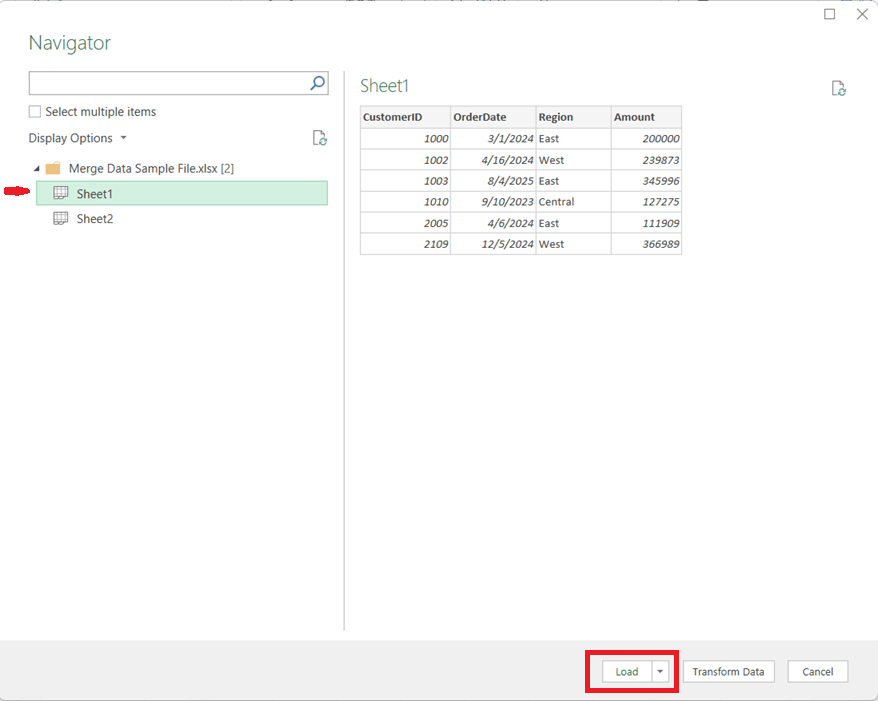
1. Load Both Data Sources into Power Query

  • Open Excel and go to Data → Get Data
  • Choose From Workbook (for separate files) or From Table/Range (for sheets in the same file)

Tip: Ensure the columns you plan to merge on have the same data types (e.g., text vs. number).


  • Load each dataset into Power Query as a separate query

2. Start the Merge Operation

  • In Power Query, select the primary table
  • Go to Query → Merge Queries
  • Choose the secondary table from the dropdown

3. Select Multiple Matching Columns

  • Click the first matching column in the primary table
  • Hold Ctrl (or Cmd on Mac) and select additional matching columns
  • Repeat the same column selections in the secondary table, in the same order

For example, if you needed to perform the merge on CustomerID, OrderDate, and Region, you would click Customer ID, then hold the Ctrl key and click OrderDate, then (while still holding down the Ctrl key) click Region.

Power Query treats this as a composite key, and all selected columns must match for rows from both tables to merge.


4. Choose the Join Type

Select the appropriate join kind:

  • Left Outer – Keep all rows from the first table (most common) and brings in the values for the matching rows from the second table
  • Inner – Keep only matching rows from both tables
  • Full Outer – Keep all rows from both tables, merging the table where there is a match and having just the values from the respective tables when there is no match

Click OK to complete the merge.


5. Expand the Merged Data

  • A new column appears containing nested tables
  • Click the expand icon to select which columns to bring in
  • Remove unnecessary columns to keep the dataset clean

6. Load and Refresh

  • Click Close & Load
  • The merged dataset is now available in Excel
  • When source files change, simply click Refresh to update everything automatically

Key Benefits

  • Handles multi-column joins cleanly and reliably
  • Eliminates fragile lookup formulas
  • Fully refreshable and auditable
  • Scales well as data volume grows

In Summary

Using Power Query to merge Excel data on multiple columns brings database-style joins into Excel, making your workflows more robust, maintainable, and professional. Once set up, it saves time and reduces errors—especially for recurring reporting and analytics tasks.

Thanks for reading!

Power BI load error: load was cancelled by error in loading a previous table

You may run into this error when loading Power BI:

"load was cancelled by error in loading a previous table"

If you do get this error, keep scrolling down to see what the “inducing” error is. This message is an indication that there was an error previous to getting to the current table in the process. The real, initial error will be more descriptive. Start with resolving that error(s), and then this one will go away.

I hope you found this helpful.

Understanding Microsoft Fabric Shortcuts

Microsoft Fabric is a central platform for data and analytics, and one of its powerful features that supports it being an all-in-one platform is Shortcuts. Shortcuts provide a simple way to unify data across multiple locations without duplicating or moving it. This is a big deal because it saves a LOT of time and effort that is usually involved in moving data around.

What Are Shortcuts?

Shortcuts are references (or “pointers”) to data that resides in another storage location. Instead of copying the data into Fabric, a shortcut lets you access and query it as if it were stored locally.

This is especially valuable in today’s data landscape, where data often spans OneLake, Azure Data Lake Storage (ADLS), Amazon S3, or other environments.

Types of Shortcuts

There are 2 types of shortcuts: table shortcuts and file shortcuts

  1. Table Shortcuts
    • Point to existing tables in other Fabric workspaces or external sources.
    • Allow you to query and analyze the table without physically moving it.
  2. File Shortcuts
    • Point to files (e.g., Parquet, CSV, Delta Lake) stored in OneLake or other supported storage systems.
    • Useful for scenarios where files are your system of record, but you want to use them in Fabric experiences like Power BI, Data Engineering, or Data Science.

Benefits of Shortcuts

Shortcuts is a really useful feature, and here are some of its benefits:

  • No Data Duplication: Saves storage costs and avoids data sprawl.
  • Single Source of Truth: Data stays in its original location while being usable across Fabric.
  • Speed and Efficiency: Query and analyze external data in place, without lengthy ETL processes.
  • Flexibility: Works across different storage platforms and Fabric workspaces.

How and Where Shortcuts Can Be Created

  • In OneLake: You can create shortcuts directly in OneLake to link to data from ADLS Gen2, Amazon S3, or other OneLake workspaces.
  • In Fabric Experiences: Whether working in Data Engineering, Data Science, Real-Time Analytics, or Power BI, shortcuts can be created in lakehouses or KQL (Kusto Query Language) databases, and you can use them directly as data in OneLake. Any Fabric service will be able to use them without copying data from the data source.
  • In Workspaces: Shortcuts make it possible to connect across lakehouses stored in different workspaces, breaking down silos within an organization. The shortcuts can be generated from a lakehouse, warehouse, or KQL database.
  • Note that warehouses do not support the creation of shortcuts. However, you can query data stored within other warehouses and lakehouses.

How Shortcuts Can Be Used

  • Cross-Workspace Data Access: Analysts can query data in another team’s workspace without requesting a copy.
  • Data Virtualization: Data scientists can work with files stored in ADLS without having to move them into Fabric.
  • BI and Reporting: Power BI models can use shortcuts to reference external files or tables, enabling consistent reporting without duplication.
  • ETL Simplification: Instead of moving raw files into Fabric, engineers can create shortcuts and build transformations directly on the source.

Common Scenarios

  • A finance team wants to build Power BI reports on data stored by the operations team without moving the data.
  • A data scientist needs access to parquet files in Amazon S3 but prefers to analyze them within Fabric.
  • A company with multiple Fabric workspaces wants to centralize access to shared reference data (like customer or product master data) without replication.

In summary: Microsoft Fabric Shortcuts simplify data access across locations and workspaces. Whether table-based or file-based, they allow organizations to unify data without duplication, streamline analytics, and improve collaboration.

Here is a link to the Microsoft Learn OneLake documentation about Shortcuts. From there you will be able to explore all the Shortcut topics shown in the image below:

Thanks for reading! I hope you found this information useful.

Understanding UNION, INTERSECT, and EXCEPT in Power BI DAX

When working with data in Power BI, it’s common to need to combine, compare, or filter tables based on their rows. DAX provides three powerful table / set functions for this: UNION, INTERSECT, and EXCEPT.

These functions are especially useful in advanced calculations, comparative analysis, and custom table creation in reports. If you have used these functions in SQL, the concepts here will be familiar.

Sample Dataset

We’ll use the following two tables throughout our examples:

Table: Sales_2024

The above table (Sales_2024) was created using the following DAX code utilizing the DATATABLE function (or you could enter the data directly using the Enter Data feature in Power BI):

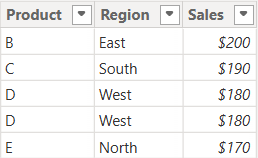
Table: Sales_2025

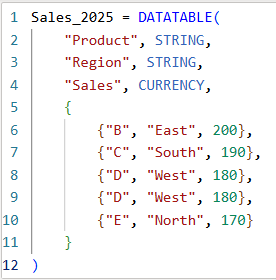
The above table (Sales_2025) was created using the following DAX code utilizing the DATATABLE function (or you could enter the data directly using the Enter Data feature in Power BI):

Now that we have our two test tables, we can now use them to explore the 3 table / set functions – Union, Intersect, and Except.

1. UNION – Combine Rows from Multiple Tables

The UNION function returns all rows from both tables, including duplicates. It requires the same number of columns and compatible data types in corresponding columns in the the tables being UNION’ed. The column names do not have to match, but the number of columns and datatypes need to match.

DAX Syntax:

UNION(<Table1>, <Table2>)

For our example, here is the syntax and resulting dataset:

UnionTable = UNION(Sales_2024, Sales_2025)

As you can see, the UNION returns all rows from both tables, including duplicates.

If you were to reverse the order of the tables (in the function call), the result remains the same (as shown below):

To remove duplicates, you can wrap the UNION inside a DISTINCT() function call, as shown below:

2. INTERSECT – Returns Rows Present in Both Tables

The INTERSECT function returns only the rows that appear in both tables (based on exact matches across all columns).

DAX Syntax:

INTERSECT(<Table1>, <Table2>)

For our example, here is the syntax and resulting dataset:

IntersectTable = INTERSECT(Sales_2024, Sales_2025)

Only the rows in Sales_2024 that are also found in Sales_2025 are returned.

If you were to reverse the order of the tables, you would get the following result:

IntersectTableReverse = INTERSECT(Sales_2025, Sales_2024)

In this case, it returns only the rows in Sales_2025 that are also found in Sales_2024. Since the record with “D – West – $180” exists twice in Sales_2025, and also exists in Sales_2024, then both records are returned. So, while it might not be relevant for all datasets, order does matter when using INTERSECT.

3. EXCEPT – Returns Rows in One Table but Not the Other

The EXCEPT function returns rows from the first table that do not exist in the second.

DAX Syntax:

EXCEPT(<Table1>, <Table2>)

For our example, here is the syntax and resulting dataset:

ExceptTable = EXCEPT(Sales_2024, Sales_2025)

Only the rows in Sales_2024 that are not in Sales_2025 are returned.

If you were to reverse the order of the tables, you would get the following result:

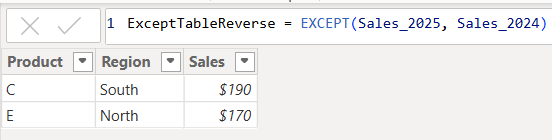
ExceptTableReverse = EXCEPT(Sales_2025, Sales_2024)

Only the rows in Sales_2025 that are not in Sales_2024 are returned. Therefore, as you have seen, since it pulls data from the first table that does not exist in the second, order does matter when using EXCEPT.

Comparison table summarizing the 3 functions:

FunctionUNIONINTERSECTEXCEPT
Purpose & OutputReturns all rows from both tablesReturns rows that appear in both tables (i.e., rows that match across all columns in both tables)Returns rows from the first table that do not exist in the second
Match CriteriaColumn position (number of columns) and datatypesColumn position (number of columns) and datatypes and valuesColumn position (number of columns) and datatypes must match and values must not match
Order Sensitivityorder does not matterorder matters if you want duplicates returned when they exist in the first tableorder matters
Duplicate HandlingKeeps duplicates. They can be removed by using DISTINCT()Returns duplicates only if they exist in the first tableReturns duplicates only if they exist in the first table

Additional Notes for your consideration:

  • Column Names: Only the column names from the first table are kept; the second table’s columns must match in count and data type.
  • Performance: On large datasets, these functions can be expensive, so you should consider filtering the data before using them.
  • Case Sensitivity: String comparisons are generally case-insensitive in DAX.
  • Real-World Use Cases:
    • UNION – Combining a historical dataset and a current dataset for analysis.
    • INTERSECT – Finding products sold in both years.
    • EXCEPT – Identifying products discontinued or newly introduced.

Thanks for reading!