
Category: Data Analysis

Choose Between a Lakehouse, Warehouse, or Eventhouse

This post is a part of the DP-600: Implementing Analytics Solutions Using Microsoft Fabric Exam Prep Hub; and this topic falls under these sections: 
Prepare data
--> Get data
--> Choose Between a Lakehouse, Warehouse, or Eventhouse

One of the most important architectural decisions a Microsoft Fabric Analytics Engineer must make is selecting the right analytical store for a given workload. For the DP-600 exam, this topic tests your ability to choose between a Lakehouse, Warehouse, or Eventhouse based on data type, query patterns, latency requirements, and user personas.

Overview of the Three Options

Microsoft Fabric provides three primary analytics storage and query experiences:

OptionPrimary Purpose
LakehouseFlexible analytics on files and tables using Spark and SQL
WarehouseEnterprise-grade SQL analytics and BI reporting
EventhouseReal-time and near-real-time analytics on streaming data

Understanding why and when to use each is critical for DP-600 success.

Lakehouse

What Is a Lakehouse?

A Lakehouse combines the flexibility of a data lake with the structure of a data warehouse. Data is stored in Delta Lake format in OneLake and can be accessed using both Spark and SQL.

When to Choose a Lakehouse

Choose a Lakehouse when you need:

  • Flexible schema (schema-on-read or schema-on-write)
  • Support for data engineering and data science
  • Access to raw, curated, and enriched data
  • Spark-based transformations and notebooks
  • Mixed workloads (batch analytics, exploration, ML)

Key Characteristics

  • Supports files and tables
  • Uses Spark SQL and T-SQL endpoints
  • Ideal for ELT and advanced transformations
  • Easy integration with notebooks and pipelines

Exam signal words: flexible, raw data, Spark, data science, experimentation

Warehouse

What Is a Warehouse?

A Warehouse is a fully managed, SQL-first analytical store optimized for business intelligence and reporting. It enforces schema-on-write and provides a traditional relational experience.

When to Choose a Warehouse

Choose a Warehouse when you need:

  • Strong SQL-based analytics
  • High-performance reporting
  • Well-defined schemas and governance
  • Centralized enterprise BI
  • Compatibility with Power BI Import or DirectQuery

Key Characteristics

  • T-SQL only (no Spark)
  • Optimized for structured data
  • Best for star/snowflake schemas
  • Familiar experience for SQL developers

Exam signal words: enterprise BI, reporting, structured, governed, SQL-first

Eventhouse

What Is an Eventhouse?

An Eventhouse is optimized for real-time and streaming analytics, built on KQL (Kusto Query Language). It is designed to handle high-velocity event data.

When to Choose an Eventhouse

Choose an Eventhouse when you need:

  • Near-real-time or real-time analytics
  • Streaming data ingestion
  • Operational or telemetry analytics
  • Event-based dashboards and alerts

Key Characteristics

  • Uses KQL for querying
  • Integrates with Eventstreams
  • Handles massive ingestion rates
  • Optimized for time-series data

Exam signal words: streaming, telemetry, IoT, real-time, events

Choosing the Right Option (Exam-Critical)

The DP-600 exam often presents scenarios where multiple options could work, but only one best fits the requirements.

Decision Matrix

RequirementBest Choice
Raw + curated dataLakehouse
Complex Spark transformationsLakehouse
Enterprise BI reportingWarehouse
Strong governance and schemasWarehouse
Streaming or telemetry dataEventhouse
Near-real-time dashboardsEventhouse
SQL-only usersWarehouse
Data science workloadsLakehouse

Common Exam Scenarios

You may be asked to:

  • Choose a storage type for a new analytics solution
  • Migrate from traditional systems to Fabric
  • Support both engineers and analysts
  • Enable real-time monitoring
  • Balance governance with flexibility

Always identify:

  1. Data type (batch vs streaming)
  2. Latency requirements
  3. User personas
  4. Query language
  5. Governance needs

Best Practices to Remember

  • Use Lakehouse as a flexible foundation for analytics
  • Use Warehouse for polished, governed BI solutions
  • Use Eventhouse for real-time operational insights
  • Avoid forcing one option to handle all workloads
  • Let business requirements—not familiarity—drive the choice

Key Takeaway
For the DP-600 exam, choosing between a Lakehouse, Warehouse, or Eventhouse is about aligning data characteristics and access patterns with the right Fabric experience. Lakehouses provide flexibility, Warehouses deliver enterprise BI performance, and Eventhouses enable real-time analytics. The correct answer is almost always the one that best fits the scenario constraints.

Practice Questions:

Here are 10 questions to test and help solidify your learning and knowledge. As you review these and other questions in your preparation, make sure to …

  • Identifying and understand why an option is correct (or incorrect) — not just which one
  • Look for and understand the usage scenario of keywords in exam questions, with the below possible association:
    • Spark, raw, experimentationLakehouse
    • Enterprise BI, governed, SQL reportingWarehouse
    • Streaming, telemetry, real-timeEventhouse
  • Expect scenario-based questions rather than direct definitions

1. Which Microsoft Fabric component is BEST suited for flexible analytics on both files and tables using Spark and SQL?

A. Warehouse
B. Eventhouse
C. Lakehouse
D. Semantic model

Correct Answer: C

Explanation:
A Lakehouse stores data in Delta format in OneLake and supports both Spark and SQL, making it ideal for flexible analytics across files and tables.

2. A team of data scientists needs to experiment with raw and curated data using notebooks. Which option should they choose?

A. Warehouse
B. Eventhouse
C. Semantic model
D. Lakehouse

Correct Answer: D

Explanation:
Lakehouses are designed for data engineering and data science workloads, offering Spark-based notebooks and flexible schema handling.

3. Which option is MOST appropriate for enterprise BI reporting with well-defined schemas and strong governance?

A. Lakehouse
B. Warehouse
C. Eventhouse
D. OneLake

Correct Answer: B

Explanation:
Warehouses are SQL-first, schema-on-write systems optimized for structured data, governance, and high-performance BI reporting.

4. A solution must support near-real-time analytics on streaming IoT telemetry data. Which Fabric component should be used?

A. Lakehouse
B. Warehouse
C. Eventhouse
D. Dataflow Gen2

Correct Answer: C

Explanation:
Eventhouses are optimized for high-velocity streaming data and real-time analytics using KQL.

5. Which query language is primarily used to analyze data in an Eventhouse?

A. T-SQL
B. Spark SQL
C. DAX
D. KQL

Correct Answer: D

Explanation:
Eventhouses are built on KQL (Kusto Query Language), which is optimized for querying event and time-series data.

6. A business analytics team requires fast dashboard performance and is familiar only with SQL. Which option best meets this requirement?

A. Lakehouse
B. Warehouse
C. Eventhouse
D. Spark notebook

Correct Answer: B

Explanation:
Warehouses provide a traditional SQL experience optimized for BI dashboards and reporting performance.

7. Which characteristic BEST distinguishes a Lakehouse from a Warehouse?

A. Lakehouses support Power BI
B. Warehouses store data in OneLake
C. Lakehouses support Spark-based processing
D. Warehouses cannot be governed

Correct Answer: C

Explanation:
Lakehouses uniquely support Spark-based processing, enabling advanced transformations and data science workloads.

8. A solution must store structured batch data and unstructured files in the same analytical store. Which option should be selected?

A. Warehouse
B. Eventhouse
C. Semantic model
D. Lakehouse

Correct Answer: D

Explanation:
Lakehouses support both structured tables and unstructured or semi-structured files within the same environment.

9. Which scenario MOST strongly indicates the need for an Eventhouse?

A. Monthly financial reporting
B. Slowly changing dimension modeling
C. Real-time operational monitoring
D. Ad hoc SQL analysis

Correct Answer: C

Explanation:
Eventhouses are designed for real-time analytics on streaming data, making them ideal for operational monitoring scenarios.

10. When choosing between a Lakehouse, Warehouse, or Eventhouse on the DP-600 exam, which factor is MOST important?

A. Personal familiarity with the tool
B. The default Fabric option
C. Data characteristics and latency requirements
D. Workspace size

Correct Answer: C

Explanation:
DP-600 emphasizes selecting the correct component based on data type (batch vs streaming), latency needs, user personas, and governance—not personal preference.

Ingest or Access Data as Needed

This post is a part of the DP-600: Implementing Analytics Solutions Using Microsoft Fabric Exam Prep Hub; and this topic falls under these sections: 
Prepare data
--> Get data
--> Ingest or access data as needed

A core responsibility of a Microsoft Fabric Analytics Engineer is deciding how data should be brought into Fabric—or whether it should be brought in at all. For the DP-600 exam, this topic focuses on selecting the right ingestion or access pattern based on performance, freshness, cost, and governance requirements.

Ingest vs. Access: Key Concept

Before choosing a tool or method, understand the distinction:

  • Ingest data: Physically copy data into Fabric-managed storage (OneLake)
  • Access data: Query or reference data where it already lives, without copying

The exam frequently tests your ability to choose the most appropriate option—not just a working one.

Common Data Ingestion Methods in Microsoft Fabric

1. Dataflows Gen2

Best for:

  • Low-code ingestion and transformation
  • Reusable ingestion logic
  • Business-friendly data preparation

Key characteristics:

  • Uses Power Query Online
  • Supports scheduled refresh
  • Stores results in OneLake (Lakehouse or Warehouse)
  • Ideal for centralized, governed ingestion

Exam tip:
Use Dataflows Gen2 when reuse, transformation, and governance are priorities.

2. Data Pipelines (Copy Activity)

Best for:

  • High-volume or frequent ingestion
  • Orchestration across multiple sources
  • ELT-style workflows

Key characteristics:

  • Supports many source and sink types
  • Enables scheduling, dependencies, and retries
  • Minimal transformation (primarily copy)

Exam tip:
Choose pipelines when performance and orchestration matter more than transformation.

3. Notebooks (Spark)

Best for:

  • Complex transformations
  • Data science or advanced engineering
  • Custom ingestion logic

Key characteristics:

  • Full control using Spark (PySpark, Scala, SQL)
  • Suitable for large-scale processing
  • Writes directly to OneLake

Exam tip:
Notebooks are powerful but require engineering skills—don’t choose them for simple ingestion scenarios.

Accessing Data Without Ingesting

1. OneLake Shortcuts

Best for:

  • Avoiding data duplication
  • Reusing data across workspaces
  • Accessing external storage

Key characteristics:

  • Logical reference only (no copy)
  • Supports ADLS Gen2 and Amazon S3
  • Appears native in Lakehouse tables or files

Exam tip:
Shortcuts are often the best answer when the question mentions avoiding duplication or reducing storage cost.

2. DirectQuery

Best for:

  • Near-real-time data access
  • Large datasets that cannot be imported
  • Centralized source-of-truth systems

Key characteristics:

  • Queries run against the source system
  • Performance depends on source
  • Limited modeling flexibility compared to Import

Exam tip:
Expect trade-off questions involving DirectQuery vs. Import.

3. Real-Time Access (Eventstreams / KQL)

Best for:

  • Streaming and telemetry data
  • Operational and real-time analytics

Key characteristics:

  • Event-driven ingestion
  • Supports near-real-time dashboards
  • Often discovered via Real-Time hub

Exam tip:
Use real-time ingestion when freshness is measured in seconds, not hours.

Choosing the Right Approach (Exam-Critical)

You should be able to decide based on these factors:

RequirementBest Option
Reusable ingestion logicDataflows Gen2
High-volume copyData pipelines
Complex transformationsNotebooks
Avoid duplicationOneLake shortcuts
Near real-time reportingDirectQuery / Eventstreams
Governance and trustIngestion + endorsement

Governance and Security Considerations

  • Ingested data can inherit sensitivity labels
  • Access-based methods rely on source permissions
  • Workspace roles determine who can ingest or access data
  • Endorsed datasets should be preferred for reuse

DP-600 often frames ingestion questions within a governance context.

Common Exam Scenarios

You may be asked to:

  • Choose between ingesting data or accessing it directly
  • Identify when shortcuts are preferable to ingestion
  • Select the right tool for a specific ingestion pattern
  • Balance data freshness vs. performance
  • Reduce duplication across workspaces

Best Practices to Remember

  • Ingest when performance and modeling flexibility are required
  • Access when freshness, cost, or duplication is a concern
  • Centralize ingestion logic for reuse
  • Prefer Fabric-native patterns over external tools
  • Let business requirements drive architectural decisions

Key Takeaway
For the DP-600 exam, “Ingest or access data as needed” is about making intentional, informed choices. Microsoft Fabric provides multiple ways to bring data into analytics solutions, and the correct approach depends on scale, freshness, reuse, governance, and cost. Understanding why one method is better than another is far more important than memorizing features.

Practice Questions:

Here are 10 questions to test and help solidify your learning and knowledge. As you review these and other questions in your preparation, make sure to …

  • Identifying and understand why an option is correct (or incorrect) — not just which one
  • Look for and understand the usage scenario of keywords in exam questions (for example, low code/no code, large dataset, high-volume data, reuse, complex transformations)
  • Expect scenario-based questions rather than direct definitions

Also, keep in mind that …

  • DP-600 questions often include multiple valid options, but only one that best aligns with the scenario’s constraints. Always identify and consider factors such as:
    • Data volume
    • Freshness requirements
    • Reuse and duplication concerns
    • Transformation complexity

1. What is the primary difference between ingesting data and accessing data in Microsoft Fabric?

A. Ingested data cannot be secured
B. Accessed data is always slower
C. Ingesting copies data into OneLake, while accessing queries data in place
D. Accessed data requires a gateway

Correct Answer: C

Explanation:
Ingestion physically copies data into Fabric-managed storage (OneLake), while access-based approaches query or reference data where it already exists.

2. Which option is BEST when the goal is to avoid duplicating large datasets across multiple workspaces?

A. Import mode
B. Dataflows Gen2
C. OneLake shortcuts
D. Notebooks

Correct Answer: C

Explanation:
OneLake shortcuts allow data to be referenced without copying it, making them ideal for reuse and cost control.

3. A team needs reusable, low-code ingestion logic with scheduled refresh. Which Fabric feature should they use?

A. Spark notebooks
B. Data pipelines
C. Dataflows Gen2
D. DirectQuery

Correct Answer: C

Explanation:
Dataflows Gen2 provide Power Query–based ingestion with refresh scheduling and reuse across Fabric items.

4. Which ingestion method is MOST appropriate for complex transformations requiring custom logic?

A. Dataflows Gen2
B. Copy activity in pipelines
C. OneLake shortcuts
D. Spark notebooks

Correct Answer: D

Explanation:
Spark notebooks offer full control over transformation logic and are suited for complex, large-scale processing.

5. When should DirectQuery be preferred over Import mode?

A. When the dataset is small
B. When data freshness is critical
C. When transformations are complex
D. When performance must be maximized

Correct Answer: B

Explanation:
DirectQuery is preferred when near-real-time access to data is required, even though performance depends on the source system.

6. Which Fabric component is BEST suited for orchestrating high-volume data ingestion with dependencies and retries?

A. Dataflows Gen2
B. Data pipelines
C. Semantic models
D. Power BI Desktop

Correct Answer: B

Explanation:
Data pipelines are designed for orchestration, handling large volumes of data, scheduling, and dependency management.

7. A dataset is queried infrequently but must support advanced modeling features. Which approach is most appropriate?

A. DirectQuery
B. Access via shortcut
C. Import into OneLake
D. Eventstream ingestion

Correct Answer: C

Explanation:
Import mode supports full modeling capabilities and high query performance, making it suitable even for infrequently accessed data.

8. Which scenario best fits the use of real-time ingestion methods such as Eventstreams or KQL databases?

A. Monthly financial reporting
B. Static reference data
C. IoT telemetry and operational monitoring
D. Slowly changing dimensions

Correct Answer: C

Explanation:
Real-time ingestion is designed for continuous, event-driven data such as IoT telemetry and operational metrics.

9. Why might ingesting data be preferred over accessing it directly?

A. It always reduces storage costs
B. It eliminates the need for security
C. It improves performance and modeling flexibility
D. It avoids data refresh

Correct Answer: C

Explanation:
Ingesting data into OneLake enables faster query performance and full support for modeling features.

10. Which factor is MOST important when deciding between ingesting data and accessing it?

A. The color of the dashboard
B. The number of reports
C. Business requirements such as freshness, scale, and governance
D. The Fabric region

Correct Answer: C

Explanation:
The decision to ingest or access data should be driven by business needs, including performance, freshness, cost, and governance—not technical convenience alone.

Discover Data by Using OneLake Catalog and Real-Time Hub

This post is a part of the DP-600: Implementing Analytics Solutions Using Microsoft Fabric Exam Prep Hub; and this topic falls under these sections: 
Prepare data
--> Get data
--> Discover data by using OneLake catalog and Real-Time hub

Discovering existing data assets efficiently is a critical capability for a Microsoft Fabric Analytics Engineer. For the DP-600 exam, this topic emphasizes how to find, understand, and evaluate data sources using Fabric’s built-in discovery experiences: OneLake catalog and Real-Time hub.

Purpose of Data Discovery in Microsoft Fabric

In large Fabric environments, data already exists across:

  • Lakehouses
  • Warehouses
  • Semantic models
  • Streaming and event-based sources

The goal of data discovery is to:

  • Avoid duplicate ingestion
  • Promote reuse of trusted data
  • Understand data ownership, sensitivity, and freshness
  • Accelerate analytics development

OneLake Catalog

What Is the OneLake Catalog?

The OneLake catalog is a centralized metadata and discovery experience that allows users to browse and search data assets stored in OneLake, Fabric’s unified data lake.

It provides visibility into:

  • Lakehouses and Warehouses
  • Tables, views, and files
  • Shortcuts to external data
  • Endorsement and sensitivity metadata

Key Capabilities of the OneLake Catalog

For the exam, you should understand that the OneLake catalog enables users to:

  • Search and filter data assets across workspaces
  • View schema details (columns, data types)
  • Identify endorsed (Certified or Promoted) assets
  • See sensitivity labels applied to data
  • Discover data ownership and location
  • Reuse existing data rather than re-ingesting it

This supports both governance and efficiency.

Endorsement and Trust Signals

Within the OneLake catalog, users can quickly identify:

  • Certified items (approved and governed)
  • Promoted items (recommended but not formally certified)

These trust signals are important in exam scenarios that ask how to guide users toward reliable data sources.

Shortcuts and External Data

The catalog also exposes OneLake shortcuts, which allow data from:

  • Azure Data Lake Storage Gen2
  • Amazon S3
  • Other Fabric workspaces

to appear as native OneLake data without duplication. This is a key discovery mechanism tested in DP-600.

Real-Time Hub

What Is the Real-Time Hub?

The Real-Time hub is a discovery experience focused on streaming and event-driven data sources in Microsoft Fabric.

It centralizes access to:

  • Eventstreams
  • Azure Event Hubs
  • Azure IoT Hub
  • Azure Data Explorer (KQL databases)
  • Other real-time data producers

Key Capabilities of the Real-Time Hub

For exam purposes, understand that the Real-Time hub allows users to:

  • Discover available streaming data sources
  • Preview live event data
  • Subscribe to or reuse existing event streams
  • Understand data velocity and schema
  • Reduce duplication of real-time ingestion pipelines

This is especially important in architectures involving operational analytics or near real-time reporting.

OneLake Catalog vs. Real-Time Hub

FeatureOneLake CatalogReal-Time Hub
Primary focusStored dataStreaming / event data
Data typesTables, files, shortcutsEvents, streams, telemetry
Use caseAnalytical and historical dataReal-time and operational analytics
Governance signalsEndorsement, sensitivityOwnership, stream metadata

Understanding when to use each is a common exam theme.

Security and Governance Considerations

Data discovery respects Fabric security:

  • Users only see items they have permission to access
  • Sensitivity labels are visible in discovery views
  • Workspace roles control discovery depth

This ensures compliance while still promoting self-service analytics.

Exam-Relevant Scenarios

On the DP-600 exam, you may be asked to:

  • Identify how users can discover existing datasets before ingesting new data
  • Choose between OneLake catalog and Real-Time hub based on data type
  • Locate endorsed or certified data assets
  • Reduce duplication by reusing existing tables or streams
  • Enable self-service discovery while maintaining governance

Best Practices (Aligned to DP-600)

  • Use OneLake catalog first before creating new data connections
  • Encourage use of endorsed and certified assets
  • Use Real-Time hub to discover existing event streams
  • Leverage shortcuts to reuse data without copying
  • Combine discovery with proper labeling and endorsement

Key Takeaway
For the DP-600 exam, discovering data in Microsoft Fabric is about visibility, trust, and reuse. The OneLake catalog helps users find and understand stored analytical data, while the Real-Time hub enables discovery of live streaming sources. Together, they reduce redundancy, improve governance, and accelerate analytics development.

Practice Questions:

Here are 10 questions to test and help solidify your learning and knowledge. As you review these and other questions in your preparation, make sure to …

  • Identifying and understand why an option is correct (or incorrect) — not just which one
  • Pay close attention to when to use OneLake catalog vs. Real-Time hub
  • Look for and understand the usage scenario of keywords in exam questions (for example, discover, reuse, streaming, endorsed, shortcut)
  • Expect scenario-based questions that test architecture choices, rather than direct definitions

1. What is the primary purpose of the OneLake catalog in Microsoft Fabric?

A. To ingest streaming data
B. To schedule data refreshes
C. To discover and explore data stored in OneLake
D. To manage workspace permissions

Correct Answer: C

Explanation:
The OneLake catalog is a centralized discovery and metadata experience that helps users find, understand, and reuse data stored in OneLake across Fabric workspaces.

2. Which type of data is the Real-Time hub primarily designed to help users discover?

A. Historical data in Lakehouses
B. Structured warehouse tables
C. Streaming and event-driven data sources
D. Power BI semantic models

Correct Answer: C

Explanation:
The Real-Time hub focuses on streaming and event-based data such as Eventstreams, Azure Event Hubs, IoT Hub, and KQL databases.

3. A user wants to avoid re-ingesting data that already exists in another workspace. Which Fabric feature best supports this goal?

A. Data pipelines
B. OneLake shortcuts
C. Import mode
D. DirectQuery

Correct Answer: B

Explanation:
OneLake shortcuts allow data stored externally or in another workspace to appear as native OneLake data without physically copying it.

4. Which metadata element in the OneLake catalog helps users identify trusted and approved data assets?

A. Workspace name
B. File size
C. Endorsement status
D. Refresh schedule

Correct Answer: C

Explanation:
Endorsements (Promoted and Certified) act as trust signals, helping users quickly identify reliable and governed data assets.

5. Which statement about data visibility in the OneLake catalog is true?

A. All users can see all data across the tenant
B. Only workspace admins can see catalog entries
C. Users can only see items they have permission to access
D. Sensitivity labels hide data from discovery

Correct Answer: C

Explanation:
The OneLake catalog respects Fabric security boundaries—users only see data assets they are authorized to access.

6. A team is building a real-time dashboard and wants to see what streaming data already exists. Where should they look first?

A. OneLake catalog
B. Power BI Service
C. Dataflows Gen2
D. Real-Time hub

Correct Answer: D

Explanation:
The Real-Time hub centralizes discovery of streaming and event-based data sources, making it the best starting point for real-time analytics scenarios.

7. Which of the following items is most likely discovered through the Real-Time hub?

A. Parquet files in OneLake
B. Lakehouse Delta tables
C. Azure Event Hub streams
D. Warehouse SQL views

Correct Answer: C

Explanation:
Azure Event Hubs and other event-driven sources are exposed through the Real-Time hub, not the OneLake catalog.

8. What advantage does data discovery provide in large Fabric environments?

A. Faster Power BI rendering
B. Reduced licensing costs
C. Reduced data duplication and improved reuse
D. Automatic data modeling

Correct Answer: C

Explanation:
Discovering existing data assets helps teams reuse trusted data, reducing redundant ingestion and improving governance.

9. Which information is commonly visible when browsing an asset in the OneLake catalog?

A. User passwords
B. Column-level schema details
C. Tenant-wide permissions
D. Gateway configuration

Correct Answer: B

Explanation:
The OneLake catalog exposes metadata such as table schemas, column names, and data types to help users evaluate suitability before use.

10. Which scenario best demonstrates correct use of OneLake catalog and Real-Time hub together?

A. Using DirectQuery for all reports
B. Creating a new pipeline for every dataset
C. Discovering historical data in OneLake and live events in Real-Time hub
D. Applying sensitivity labels to dashboards

Correct Answer: C

Explanation:
OneLake catalog is optimized for discovering stored analytical data, while Real-Time hub is designed for discovering live streaming sources. Using both ensures comprehensive data discovery.

Create a Data Connection in Microsoft Fabric

This post is a part of the DP-600: Implementing Analytics Solutions Using Microsoft Fabric Exam Prep Hub; and this topic falls under these sections: 
Prepare data
--> Get data
--> Create a data connection

Creating data connections is a foundational skill for a Microsoft Fabric Analytics Engineer. In the DP-600 exam, this topic focuses on how to securely and efficiently connect Fabric workloads—such as Lakehouses, Warehouses, Dataflows Gen2, and semantic models—to a wide variety of data sources.

What a Data Connection Means in Microsoft Fabric

A data connection defines how Fabric authenticates to, accesses, and retrieves data from a source system. It includes:

  • The data source type
  • Connection details (server, database, endpoint, file path, etc.)
  • Authentication method
  • Optional privacy and credential reuse settings

Once created, a data connection can often be reused across multiple items within a workspace.

Common Data Sources in Fabric

For the exam, you should be familiar with connecting to the following categories of data sources:

1. Azure and Microsoft Data Sources

  • Azure SQL Database
  • Azure Synapse (dedicated and serverless pools)
  • Azure Data Lake Storage Gen2
  • Azure Blob Storage
  • OneLake (Fabric-native storage)
  • Power BI semantic models (DirectQuery)

2. On-Premises Data Sources

  • SQL Server
  • Oracle
  • Other relational databases

These typically require an On-premises Data Gateway.

3. Files and Semi-Structured Data

  • CSV, JSON, Parquet, Excel
  • Files stored in OneLake, ADLS Gen2, SharePoint, or local file systems

Where Data Connections Are Created

In Microsoft Fabric, data connections can be created from several entry points:

  • Lakehouse: Add data via shortcuts or ingestion
  • Warehouse: Connect external data or ingest via pipelines
  • Dataflows Gen2: Define connections as part of Power Query Online
  • Pipelines: Configure source connections in copy activities
  • Semantic models: Connect via Import or DirectQuery

Understanding where the connection is configured is important for exam scenarios.

Authentication Methods

The DP-600 exam commonly tests authentication concepts. Be familiar with:

  • Microsoft Entra ID (OAuth) – Recommended and most secure
  • Service principal – Common for automation and CI/CD
  • Account key / Shared Access Signature (SAS) – Often used for storage
  • Username and password – Less secure, sometimes legacy

You should also understand when credentials are:

  • Stored at the connection level
  • Managed per workspace
  • Reused across multiple items

Gateways and Connectivity Modes

On-Premises Data Gateway

Required when connecting Fabric to on-premises sources. Key points:

  • Can be standard or personal (standard is preferred)
  • Must be online for refresh and query operations
  • Uses outbound connections only

Connectivity Modes

  • Import: Data is loaded into Fabric storage
  • DirectQuery: Queries run against the source system
  • Shortcut-based access: Data remains external but appears native in OneLake

Security and Governance Considerations

When creating data connections, Fabric enforces governance through:

  • Workspace roles (Viewer, Contributor, Member, Admin)
  • Credential isolation per workspace
  • Sensitivity labels inherited from data sources (when applicable)

Exam questions may test your ability to choose the most secure and scalable connection method.

Best Practices (Exam-Relevant)

  • Prefer Entra ID authentication over credentials or keys
  • Use OneLake shortcuts to avoid unnecessary data duplication
  • Centralize connections in Dataflows Gen2 for reuse
  • Validate gateway availability for on-premises sources
  • Align connection methods with performance needs (Import vs DirectQuery)

How This Appears on the DP-600 Exam

You may be asked to:

  • Identify the correct data connection method for a scenario
  • Choose the appropriate authentication type
  • Determine when a gateway is required
  • Decide where to create a connection for reuse and governance
  • Troubleshoot refresh or connectivity issues

Key Takeaway
Creating data connections in Microsoft Fabric is about more than just accessing data—it’s about security, performance, reusability, and governance. For the DP-600 exam, focus on understanding source types, authentication options, gateways, and where connections are defined within the Fabric ecosystem.

Practice Questions:

Here are 10 questions to test and help solidify your learning and knowledge. As you review these and other questions in your preparation, make sure to …

  • Identifying and understand why an option is correct (or incorrect) — not just which one
  • Look for and understand the usage scenario of keywords in exam questions (for example, gateway, authentication, reuse, DirectQuery vs Import)
  • Expect scenario-based questions rather than direct definitions

1. Which authentication method is generally recommended when creating data connections in Microsoft Fabric?

A. Username and password
B. Shared Access Signature (SAS)
C. Microsoft Entra ID (OAuth)
D. Account key

Correct Answer: C

Explanation:
Microsoft Entra ID (OAuth) is the recommended authentication method because it provides centralized identity management, better security, support for conditional access, and easier credential rotation compared to passwords or keys.

2. When is an On-premises Data Gateway required in Microsoft Fabric?

A. When connecting to Azure SQL Database
B. When connecting to OneLake
C. When connecting to an on-premises SQL Server
D. When connecting to Azure Data Lake Storage Gen2

Correct Answer: C

Explanation:
An On-premises Data Gateway is required when Fabric needs to access data sources that are hosted on-premises. Cloud-based sources such as Azure SQL Database or ADLS Gen2 do not require a gateway.

3. Which Fabric feature allows external data to appear as if it is stored in OneLake without copying the data?

A. Import mode
B. DirectQuery mode
C. OneLake shortcuts
D. Data pipelines

Correct Answer: C

Explanation:
OneLake shortcuts provide a logical reference to external storage locations (such as ADLS Gen2 or S3) without physically moving or duplicating the data.

4. You want multiple Fabric items in the same workspace to reuse a single data connection. Where should you create the connection?

A. In each semantic model
B. In Dataflows Gen2
C. In Power BI Desktop only
D. In Excel

Correct Answer: B

Explanation:
Dataflows Gen2 are designed for centralized data ingestion and transformation, making them ideal for creating reusable data connections across multiple Fabric items.

5. Which connectivity mode loads data into Fabric storage and provides the best query performance?

A. DirectQuery
B. Live connection
C. Shortcut-based access
D. Import

Correct Answer: D

Explanation:
Import mode copies data into Fabric-managed storage, enabling high-performance queries and full modeling capabilities at the cost of data freshness.

6. Which statement about DirectQuery connections in Fabric is true?

A. Data is stored in OneLake
B. Queries are always faster than Import mode
C. Queries are executed against the source system
D. A gateway is never required

Correct Answer: C

Explanation:
With DirectQuery, queries are sent directly to the source system at runtime. Performance depends on the source, and a gateway may be required for on-premises sources.

7. Which role is required to create or edit data connections within a Fabric workspace?

A. Viewer
B. Contributor
C. Member
D. Admin

Correct Answer: B

Explanation:
Users must have at least Contributor permissions to create or modify data connections. Viewers have read-only access and cannot manage connections.

8. Which file formats are commonly supported when creating file-based data connections in Fabric?

A. CSV only
B. CSV, JSON, Parquet, Excel
C. TXT only
D. XML only

Correct Answer: B

Explanation:
Microsoft Fabric supports a wide range of structured and semi-structured file formats, including CSV, JSON, Parquet, and Excel, especially when stored in OneLake or ADLS Gen2.

9. What is the primary security benefit of using a service principal for data connections?

A. Faster query performance
B. No need for a gateway
C. Automated, non-interactive authentication
D. Unlimited access to all workspaces

Correct Answer: C

Explanation:
Service principals enable secure, automated authentication scenarios (such as CI/CD pipelines) without relying on individual user credentials.

10. A data refresh in Fabric fails because credentials are missing. What is the most likely cause?

A. The dataset is in Import mode
B. The gateway is offline or misconfigured
C. The semantic model contains calculated columns
D. The file format is unsupported

Correct Answer: B

Explanation:
If a data source requires an On-premises Data Gateway and the gateway is offline or incorrectly configured, Fabric cannot access the credentials, causing refresh failures.

Improve DAX performance

This post is a part of the DP-600: Implementing Analytics Solutions Using Microsoft Fabric Exam Prep Hub; and this topic falls under these sections: 
Implement and manage semantic models (25-30%)
--> Optimize enterprise-scale semantic models
--> Improve DAX performance

Effective DAX (Data Analysis Expressions) is essential for high-performance semantic models in Microsoft Fabric. As datasets and business logic become more complex, inefficient DAX can slow down query execution and degrade report responsiveness. This article explains why DAX performance matters, common performance pitfalls, and best practices to optimize DAX in enterprise-scale semantic models.


Why DAX Performance Matters

In Fabric semantic models (Power BI datasets + Direct Lake / Import / composite models), DAX is used to define:

  • Measures (dynamic calculations)
  • Calculated columns (row-level expressions)
  • Calculated tables (derived data structures)

When improperly written, DAX can become a bottleneck — especially on large models or highly interactive reports (many slicers, visuals, etc.). Optimizing DAX ensures:

  • Faster query execution
  • Better user experience
  • Lower compute consumption
  • More efficient use of memory

The DP-600 exam tests your ability to identify and apply performance-aware DAX patterns.


Understand DAX Execution Engines

DAX queries are executed by two engines:

  • Formula Engine (FE) — processes logic that can’t be delegated
  • Storage Engine (SE) — processes optimized aggregations and scans

Performance improves when more computation can be done in the Storage Engine (columnar operations) rather than the Formula Engine (row-by-row logic).

Rule of thumb: Favor patterns that minimize work done in the Formula Engine.


Common DAX Performance Anti-Patterns

1. Repeated Calculations Without Variables

Example:

Total Sales + Total Cost - Total Discount

If Total Sales, Total Cost, and Total Discount all compute the same sub-expressions repeatedly, the engine may evaluate redundant logic multiple times.

Anti-Pattern:

Repeated expressions without variables.


2. Nested Iterator Functions

Using iterators like SUMX or FILTER on large tables many times in a measure increases compute overhead.

Example:

SUMX(
    FILTER(FactSales, FactSales[SalesAmount] > 0),
    FactSales[Quantity] * FactSales[UnitPrice]
)

Filtering inside iterators and then iterating again adds overhead.


3. Large Row Context with Filters

Complex FILTER expressions that operate on large intermediate tables will push computation into the Formula Engine, which is slower.


4. Frequent Use of EARLIER

While useful, EARLIER is often replaced with clearer, faster patterns using variables or iterator functions.


Best Practices for Optimizing DAX


1. Use Variables (VAR)

Variables reduce redundant computations, enhance readability, and often improve performance:

Measure Optimized =
VAR BaseTotal = SUM(FactSales[SalesAmount])
RETURN
IF(BaseTotal > 0, BaseTotal, BLANK())

Benefits:

  • Computed once per filter context
  • Reduces repeated expression evaluation

2. Favor Storage Engine Over Formula Engine

Use functions that can be processed by the Storage Engine:

  • SUM, COUNT, AVERAGE, MIN, MAX run faster
  • Avoid SUMX when a plain SUM suffices

Example:

Total Sales = SUM(FactSales[SalesAmount])

Over:

Total Sales =
SUMX(FactSales, FactSales[SalesAmount])


3. Simplify Filter Expressions

When possible, use simpler filter arguments:

Better:

CALCULATE([Total Sales], DimDate[Year] = 2025)

Instead of:

CALCULATE([Total Sales], FILTER(DimDate, DimDate[Year] = 2025))

Why?
The simpler condition is more likely to push to the Storage Engine without extra row processing.


4. Use TRUE/FALSE Filters

When filtering on a Boolean or condition:

Better:

CALCULATE([Total Sales], FactSales[IsActive] = TRUE)

Instead of:

CALCULATE([Total Sales], FILTER(FactSales, FactSales[IsActive] = TRUE))


5. Limit Column and Table Scans

  • Remove unused columns from the model
  • Avoid high-cardinality columns in calculations where unnecessary
  • Use star schema design to improve filter propagation

6. Reuse Measures

Instead of duplicating logic:

Total Profit =
[Total Sales] - [Total Cost]

Reuse basic measures within more complex logic.


7. Prefer Measures Over Calculated Columns

Measures calculate at query time and respect filter context; calculated columns are evaluated during refresh. Use calculated columns only when necessary.


8. Reduce Iterators on Large Tables

If SUMX is needed for row-level expressions, consider summarizing first or using aggregation tables.


9. Understand Evaluation Context

Complex measures often inadvertently alter filter context. Use functions like:

  • ALL
  • REMOVEFILTERS
  • KEEPFILTERS

…carefully, as they affect performance and results.


10. Leverage DAX Studio or Performance Analyzer

While not directly tested with UI steps, knowing when to use tools to diagnose DAX is helpful:

  • Performance Analyzer identifies slow visuals
  • DAX Studio exposes query plans and engine timings

Performance Patterns and Anti-Patterns

PatternGood / BadNotes
VAR usageGoodMakes measures efficient and readable
SUM over SUMXGood if applicableLeverages Storage Engine
FILTER inside SUMXBadForces row context early
EARLIER / nested row contextBadHard to optimize, slows performance
Simple CALCULATE filtersGoodMore likely to fold

Example Before / After

Before (inefficient):

Measure = 
SUMX(
    FILTER(FactSales, FactSales[SalesAmount] > 1000),
    FactSales[Quantity] * FactSales[UnitPrice]
)

After (optimized):

VAR FilteredSales =
    CALCULATETABLE(
        FactSales,
        FactSales[SalesAmount] > 1000
    )
RETURN
SUMX(
    FilteredSales,
    FilteredSales[Quantity] * FilteredSales[UnitPrice]
)

Why better?
Explicit filtering via CALCULATETABLE often pushes more work to the Storage Engine than iterating within FILTER.


Exam-Focused Takeaways

For DP-600 questions related to DAX performance:

  • Identify inefficient row context patterns
  • Prefer variables and simple aggregations
  • Favor Storage Engine–friendly functions
  • Avoid unnecessary nested iterators
  • Recognize when a measure should be rewritten for performance

Summary

Improving DAX performance is about writing efficient calculations and avoiding patterns that force extra processing in the Formula Engine. By using variables, minimizing iterator overhead, simplifying filter expressions, and leveraging star schema design, you can significantly improve query responsiveness — a key capability for enterprise semantic models and the DP-600 exam.

Practice Questions:

Here are 10 questions to test and help solidify your learning and knowledge. As you review these and other questions in your preparation, make sure to …

  • Identifying and understand why an option is correct (or incorrect) — not just which one
  • Look for and understand the usage scenario of keywords in exam questions to guide you
  • Expect scenario-based questions rather than direct definitions

Question 1

You have a DAX measure that repeats the same complex calculation multiple times. Which change is most likely to improve performance?

A. Convert the calculation into a calculated column
B. Use a DAX variable (VAR) to store the calculation result
C. Replace CALCULATE with SUMX
D. Enable bidirectional relationships

Correct Answer: B

Explanation:
DAX variables evaluate their expression once per query context and reuse the result. This avoids repeated execution of the same logic and reduces Formula Engine overhead, making variables one of the most effective performance optimization techniques.


Question 2

Which aggregation function is generally the most performant when no row-by-row logic is required?

A. SUMX
B. AVERAGEX
C. SUM
D. FILTER

Correct Answer: C

Explanation:
Native aggregation functions like SUM, COUNT, and AVERAGE are optimized to run in the Storage Engine, which is much faster than iterator-based functions such as SUMX that require row-by-row evaluation in the Formula Engine.


Question 3

Why is this DAX pattern potentially slow on large tables?

CALCULATE([Total Sales], FILTER(FactSales, FactSales[SalesAmount] > 1000))

A. FILTER disables relationship filtering
B. FILTER forces evaluation in the Formula Engine
C. CALCULATE cannot push filters to the Storage Engine
D. The expression produces incorrect results

Correct Answer: B

Explanation:
The FILTER function iterates over rows, forcing Formula Engine execution. When possible, using simple Boolean expressions inside CALCULATE (e.g., FactSales[SalesAmount] > 1000) allows the Storage Engine to handle filtering more efficiently.


Question 4

Which CALCULATE filter expression is more performant?

A. FILTER(Sales, Sales[Year] = 2024)
B. Sales[Year] = 2024
C. ALL(Sales[Year])
D. VALUES(Sales[Year])

Correct Answer: B

Explanation:
Simple Boolean filters allow DAX to push work to the Storage Engine, while FILTER requires row-by-row evaluation. This distinction is frequently tested on the DP-600 exam.


Question 5

Which practice helps reduce the Formula Engine workload?

A. Using nested iterator functions
B. Replacing measures with calculated columns
C. Reusing base measures in more complex calculations
D. Increasing column cardinality

Correct Answer: C

Explanation:
Reusing base measures promotes efficient evaluation plans and avoids duplicated logic. Nested iterators and high cardinality columns increase computational complexity and slow down queries.


Question 6

Which modeling choice can indirectly improve DAX query performance?

A. Using snowflake schemas
B. Increasing the number of calculated columns
C. Removing unused columns and tables
D. Enabling bidirectional relationships by default

Correct Answer: C

Explanation:
Removing unused columns reduces memory usage, dictionary size, and scan costs. Smaller models lead to faster Storage Engine operations and improved overall query performance.


Question 7

Which DAX pattern is considered a performance anti-pattern?

A. Using measures instead of calculated columns
B. Using SUMX when SUM would suffice
C. Using star schema relationships
D. Using single-direction filters

Correct Answer: B

Explanation:
Iterator functions like SUMX should only be used when row-level logic is required. Replacing simple aggregations with iterators unnecessarily shifts work to the Formula Engine.


Question 8

Why can excessive use of EARLIER negatively impact performance?

A. It prevents relationship traversal
B. It creates complex nested row contexts
C. It only works in measures
D. It disables Storage Engine scans

Correct Answer: B

Explanation:
EARLIER introduces nested row contexts that are difficult for the DAX engine to optimize. Modern DAX best practices recommend using variables instead of EARLIER.


Question 9

Which relationship configuration can negatively affect DAX performance if overused?

A. Single-direction filtering
B. Many-to-one relationships
C. Bidirectional filtering
D. Active relationships

Correct Answer: C

Explanation:
Bidirectional relationships increase filter propagation paths and query complexity. While useful in some scenarios, overuse can significantly degrade performance in enterprise-scale models.


Question 10

Which tool should you use to identify slow visuals caused by inefficient DAX measures?

A. Power Query Editor
B. Model View
C. Performance Analyzer
D. Deployment Pipelines

Correct Answer: C

Explanation:
Performance Analyzer captures visual query durations, DAX query times, and rendering times, making it the primary tool for diagnosing DAX and visual performance issues in Power BI and Fabric semantic models.

Apply sensitivity labels to items in Microsoft Fabric

This post is a part of the DP-600: Implementing Analytics Solutions Using Microsoft Fabric Exam Prep Hub; and this topic falls under these sections: 
Maintain a data analytics solution
--> Implement security and governance
--> Apply sensitivity labels to items

To Do:
Complete the related module for this topic in the Microsoft Learn course: Secure data access in Microsoft Fabric

Sensitivity labels are a data protection and governance feature in Microsoft Fabric that help organizations classify, protect, and control the handling of sensitive data. They integrate with Microsoft Purview Information Protection and extend data protection consistently across Fabric, Power BI, and Microsoft 365.

For the DP-600 exam, you should understand what sensitivity labels are, how they are applied, what they affect, and how they differ from access controls.

What Are Sensitivity Labels?

Sensitivity labels:

  • Classify data based on confidentiality and business impact
  • Travel with the data across supported services
  • Can trigger protection behaviors, such as encryption or usage restrictions

Common label examples include:

  • Public
  • Internal
  • Confidential
  • Highly Confidential

Labels are organizationally defined and managed centrally.

Where Sensitivity Labels Come From

Sensitivity labels in Fabric are:

  • Created and managed in Microsoft Purview
  • Defined at the tenant level by security or compliance administrators
  • Made available to Fabric and Power BI through tenant settings

Fabric users apply labels, but typically do not define them.

Items That Can Be Labeled in Microsoft Fabric

Sensitivity labels can be applied to many Fabric items, including:

  • Semantic models (datasets)
  • Reports
  • Dashboards
  • Dataflows
  • Lakehouses and Warehouses (where supported)
  • Exported artifacts (Excel, PowerPoint, PDF)

This makes labeling a cross-workload governance mechanism.

How Sensitivity Labels Are Applied

Labels can be applied:

  • Manually by item owners or authorized users
  • Automatically through inherited labeling
  • Programmatically via APIs (advanced scenarios)

Label Inheritance

In many cases:

  • Reports inherit the label from their underlying semantic model
  • Dashboards inherit labels from pinned tiles
  • Exported files inherit the label of the source item

This inheritance model is frequently tested in exam scenarios.

What Sensitivity Labels Do (and Do Not Do)

What they do:

  • Classify data for compliance and governance
  • Enable protection such as:
    • Encryption
    • Watermarking
    • Usage restrictions (e.g., block external sharing)
  • Travel with data when exported or shared

What they do NOT do:

  • Grant or restrict user access
  • Replace workspace, item-level, or data-level security
  • Filter rows or columns

Key exam distinction:
Sensitivity labels protect data after access is granted.

Sensitivity Labels vs Endorsements

These two concepts are often confused on exams.

FeatureSensitivity LabelsEndorsements
PurposeData protectionTrust and quality
EnforcedYesNo
Affects behaviorYes (encryption, sharing rules)No
Security-relatedYesGovernance guidance

Governance and Compliance Benefits

Sensitivity labels support:

  • Regulatory compliance (e.g., GDPR, HIPAA)
  • Data loss prevention (DLP)
  • Auditing and reporting
  • Consistent handling of sensitive data across platforms

They are especially important in environments with:

  • Self-service analytics
  • Data exports to Excel or PowerPoint
  • External sharing scenarios

Common Exam Scenarios

You may see questions such as:

  • A report exported to Excel must remain encrypted → sensitivity label
  • Data should be classified as confidential but still shared internally → labeling, not access restriction
  • Users can view data but cannot share externally → label-driven protection
  • A report automatically inherits its dataset’s classification → label inheritance

Best Practices to Remember

  • Apply labels at the semantic model level to ensure inheritance
  • Use sensitivity labels alongside:
    • Workspace and item-level access controls
    • RLS and CLS
    • Endorsements
  • Review labeling regularly to ensure accuracy
  • Educate users on selecting the correct label

Key Exam Takeaways

  • Sensitivity labels classify and protect data
  • They are defined in Microsoft Purview
  • Labels can enforce encryption and sharing restrictions
  • Labels do not control access
  • Inheritance behavior is important for DP-600 questions

Exam Tips

  • If a question focuses on classifying, protecting, or controlling how data is shared after access, think sensitivity labels.
  • If it focuses on who can see the data, think security roles or permissions.
  • Expect scenario questions involving:
    • PII, financial data, or confidential data
    • Export restrictions
    • Label inheritance
  • Know the difference between:
    • Security (RLS, OLS, item access)
    • Governance & compliance (sensitivity labels)
  • Always associate sensitivity labels with Microsoft Purview

Practice Questions

Question 1 (Single choice)

What is the PRIMARY purpose of applying sensitivity labels to items in Microsoft Fabric?

A. Improve query performance
B. Control row-level data access
C. Classify and protect data based on sensitivity
D. Grant workspace permissions

Correct Answer: C

Explanation:
Sensitivity labels are used for data classification, protection, and governance, not for performance or access control.


Question 2 (Scenario-based)

Your organization requires that all reports containing customer PII automatically display a watermark and restrict external sharing. What feature enables this?

A. Row-level security
B. Sensitivity labels with protection settings
C. Item-level access controls
D. Conditional access policies

Correct Answer: B

Explanation:
Sensitivity labels can apply visual markings, encryption, and sharing restrictions when integrated with Microsoft Purview.


Question 3 (Multi-select)

Which Fabric items can have sensitivity labels applied? (Select all that apply.)

A. Power BI reports
B. Semantic models
C. Lakehouses and warehouses
D. Notebooks

Correct Answers: A, B, C, D

Explanation:
Sensitivity labels can be applied to most Fabric artifacts, enabling consistent governance across analytics assets.


Question 4 (Scenario-based)

A semantic model inherits a sensitivity label from its underlying data source. What does this behavior represent?

A. Manual labeling
B. Label inheritance
C. Workspace-level labeling
D. Object-level security

Correct Answer: B

Explanation:
Label inheritance ensures that downstream artifacts maintain appropriate sensitivity classifications automatically.


Question 5 (Single choice)

Which service must be configured to define and manage sensitivity labels used in Microsoft Fabric?

A. Azure Active Directory
B. Microsoft Defender
C. Microsoft Purview
D. Power BI Admin portal

Correct Answer: C

Explanation:
Sensitivity labels are defined and managed in Microsoft Purview, then applied across Microsoft Fabric and Power BI.


Question 6 (Scenario-based)

A report is labeled Highly Confidential, but a user attempts to export its data to Excel. What is the expected behavior?

A. Export always succeeds
B. Export is blocked or encrypted based on label policy
C. Export ignores sensitivity labels
D. Only row-level security applies

Correct Answer: B

Explanation:
Sensitivity labels can restrict exports, apply encryption, or enforce protection based on policy.


Question 7 (Multi-select)

Which actions can sensitivity labels enforce? (Select all that apply.)

A. Data encryption
B. Watermarks and headers
C. External sharing restrictions
D. Row-level filtering

Correct Answers: A, B, C

Explanation:
Sensitivity labels control protection and compliance, not data filtering.


Question 8 (Scenario-based)

You apply a sensitivity label to a lakehouse. Which downstream artifact is MOST likely to automatically inherit the label?

A. A Power BI report built on the semantic model
B. A notebook in a different workspace
C. An external CSV export
D. An Azure SQL Database

Correct Answer: A

Explanation:
Label inheritance flows through Fabric analytics artifacts, especially semantic models and reports.


Question 9 (Single choice)

Who is typically allowed to apply or change sensitivity labels on Fabric items?

A. Any workspace Viewer
B. Only Microsoft admins
C. Users with sufficient item permissions
D. External users

Correct Answer: C

Explanation:
Users must have appropriate permissions (Contributor/Owner or item-level rights) to apply labels.


Question 10 (Scenario-based)

Your compliance team wants visibility into how sensitive data is used across Fabric. Which feature supports this requirement?

A. Query caching
B. Audit logs
C. Sensitivity labels with Purview reporting
D. Direct Lake mode

Correct Answer: C

Explanation:
Sensitivity labels integrate with Microsoft Purview reporting and auditing for compliance and governance tracking.


Perform impact analysis of downstream dependencies from lakehouses, data warehouses, dataflows, and semantic models in Microsoft Fabric

This post is a part of the DP-600: Implementing Analytics Solutions Using Microsoft Fabric Exam Prep Hub; and this topic falls under these sections: 
Maintain a data analytics solution
--> Maintain the analytics development lifecycle
--> Perform impact analysis of downstream dependencies from lakehouses,
data warehouses, dataflows, and semantic models

Impact analysis in Microsoft Fabric helps analytics engineers understand how changes to upstream data assets affect downstream items such as datasets, reports, dashboards, notebooks, and pipelines. It is a critical lifecycle practice that reduces the risk of breaking analytics solutions when making schema, logic, or data changes.

For the DP-600 exam, you should understand what impact analysis is, which Fabric tools support it, what dependencies are tracked, and how to use it in real-world lifecycle scenarios.

What Is Impact Analysis?

Impact analysis answers the question:

“If I change or delete this item, what else will be affected?”

It allows you to:

  • Identify downstream dependencies
  • Assess risk before making changes
  • Communicate potential impacts to stakeholders
  • Support safe development and deployment practices

Impact analysis is observational and informational—it does not enforce controls.

Where Impact Analysis Is Used in Fabric

Impact analysis applies across many Fabric items, including:

  • Lakehouses
  • Data Warehouses
  • Dataflows Gen2
  • Semantic models
  • Reports and dashboards
  • Notebooks and pipelines

These items form a connected analytics graph, which Fabric can visualize.

Lineage View: The Core Tool for Impact Analysis

The primary tool for impact analysis in Fabric is Lineage View.

What Lineage View Shows

  • Upstream data sources
  • Transformations and processing steps
  • Downstream consumers
  • Relationships between items

Lineage view provides a visual map of dependencies across workloads.

Impact Analysis by Asset Type

Lakehouses

Changing a Lakehouse can impact:

  • Notebooks reading tables
  • Semantic models using Direct Lake
  • Dataflows writing or reading data
  • Reports built on dependent models

Common risk: Dropping or renaming a column.

Data Warehouses

Warehouse changes may affect:

  • Views and SQL queries
  • Semantic models using DirectQuery
  • Reports and dashboards
  • External tools

Exam insight: Schema changes are a common source of downstream failures.

Dataflows Gen2

Dataflows often sit between raw data and analytics.

Changes can impact:

  • Lakehouses or Warehouses they load into
  • Semantic models consuming curated tables
  • Pipelines orchestrating refreshes

Semantic Models

Semantic models are among the most sensitive assets.

Changes may affect:

  • Reports and dashboards
  • Excel workbooks
  • Composite models
  • End-user self-service analytics

Exam note: Removing measures or renaming fields is high risk.

How to Perform Impact Analysis (High Level)

  1. Select the item (Lakehouse, Warehouse, Dataflow, or Semantic Model)
  2. Open Lineage view
  3. Review downstream dependencies
  4. Identify:
    • Reports
    • Datasets
    • Pipelines
    • Other dependent items
  5. Communicate or mitigate risk before making changes

Impact Analysis in the Development Lifecycle

Impact analysis is typically performed:

  • Before deploying changes
  • Before modifying schemas
  • Before deleting items
  • During troubleshooting

It supports:

  • Safe Git commits
  • Controlled pipeline deployments
  • Production stability

Common Exam Scenarios

You may see questions such as:

  • A column change breaks multiple reports → impact analysis was skipped
  • An engineer needs to know which reports use a dataset → lineage view
  • A Lakehouse schema update affects downstream models → review dependencies
  • A dataset should not be modified due to executive reports → high downstream impact

Example:

Before removing a table from a semantic model, what should you do?
Correct concept: Perform impact analysis using lineage view.

Impact Analysis vs Deployment Pipelines

These concepts are related but distinct.

FeatureImpact AnalysisDeployment Pipelines
PurposeRisk assessmentControlled promotion
EnforcedNoYes
TimingBefore changesDuring deployment
ToolLineage viewPipeline UI

Best Practices to Remember

  • Always check lineage before schema changes
  • Pay extra attention to semantic models and certified items
  • Communicate impacts to report owners
  • Pair impact analysis with:
    • Version control
    • Development pipelines
    • Endorsements and certification

Key Exam Takeaways

  • Impact analysis identifies downstream dependencies
  • Lineage view is the primary tool in Fabric
  • Applies to Lakehouses, Warehouses, Dataflows, and Semantic Models
  • Supports safe lifecycle and governance practices
  • A common scenario-based exam topic

Final Exam Tip

  • If a question asks what will break if I change this, the answer is impact analysis via lineage view.
  • If it asks how to safely move changes, the answer is pipelines or Git.
  • Expect questions that test:
    • When to perform impact analysis
    • Which items are affected by changes
    • Operational decision-making before deployments
  • Common traps:
    • Confusing impact analysis with lineage documentation
    • Assuming Fabric blocks breaking changes automatically
    • Forgetting semantic models are often the most impacted layer

Practice Questions

Question 1 (Single choice)

What is the PRIMARY purpose of impact analysis in Microsoft Fabric?

A. Improve query performance
B. Identify downstream objects affected by a change
C. Enforce data security policies
D. Reduce data refresh frequency

Correct Answer: B

Explanation:
Impact analysis helps you understand what items depend on a given artifact, so you can assess the risk of changes.

  • ❌ A: Performance tuning is separate
  • ❌ C: Security is not the focus
  • ❌ D: Refresh tuning is unrelated

Question 2 (Multi-select)

Which Fabric items can be analyzed for downstream dependencies? (Select all that apply.)

A. Lakehouses
B. Data warehouses
C. Dataflows
D. Semantic models

Correct Answers: A, B, C, D

Explanation:
Microsoft Fabric supports dependency tracking across all major analytical artifacts, enabling end-to-end lineage visibility.


Question 3 (Scenario-based)

You plan to rename a column in a lakehouse table. Which Fabric feature should you use FIRST?

A. Version control
B. Deployment pipeline
C. Impact analysis
D. Incremental refresh

Correct Answer: C

Explanation:
Renaming a column may break:

  • Semantic models
  • SQL queries
  • Reports

Impact analysis identifies what will be affected before the change.


Question 4 (Single choice)

Where do you access impact analysis for an item in Fabric?

A. Power BI Desktop
B. Microsoft Purview portal
C. Item settings in the Fabric workspace
D. Azure DevOps

Correct Answer: C

Explanation:
Impact analysis is accessible directly from the item context or settings within a Fabric workspace.

  • ❌ Purview focuses on governance/catalog
  • ❌ DevOps is not used for lineage

Question 5 (Scenario-based)

A dataflow loads data into a lakehouse that feeds multiple semantic models. What does impact analysis show?

A. Only the lakehouse
B. Only the semantic models
C. All downstream dependencies
D. Only refresh schedules

Correct Answer: C

Explanation:
Impact analysis provides a full dependency graph, showing all downstream items affected by changes.


Question 6 (Multi-select)

Which changes typically REQUIRE impact analysis before execution? (Select all that apply.)

A. Dropping columns
B. Renaming tables
C. Changing data types
D. Adding a new report page

Correct Answers: A, B, C

Explanation:
Structural changes can break dependencies. Adding a report page does not affect downstream items.


Question 7 (Scenario-based)

A semantic model is used by several reports and dashboards. What happens if you delete the model without impact analysis?

A. Nothing; reports are cached
B. Reports automatically reconnect
C. Reports and dashboards break
D. Fabric blocks the deletion

Correct Answer: C

Explanation:
Deleting a semantic model removes the data source for:

  • Reports
  • Dashboards

Impact analysis helps prevent such disruptions.


Question 8 (Single choice)

Which view best represents impact analysis results?

A. Tabular grid
B. SQL execution plan
C. Dependency graph
D. DAX query view

Correct Answer: C

Explanation:
Impact analysis is presented as a visual dependency graph, showing upstream and downstream relationships.


Question 9 (Scenario-based)

Which role MOST benefits from performing impact analysis regularly?

A. Report consumers
B. Workspace admins and data engineers
C. End-user analysts
D. External auditors

Correct Answer: B

Explanation:
Admins and engineers are responsible for:

  • Schema changes
  • Deployments
  • Stability

Impact analysis supports safe operational changes.


Question 10 (Multi-select)

Which best practices apply when using impact analysis? (Select all that apply.)

A. Perform before structural changes
B. Use in conjunction with deployment pipelines
C. Skip for minor schema updates
D. Communicate findings to stakeholders

Correct Answers: A, B, D

Explanation:
Impact analysis should:

  • Precede schema changes
  • Inform deployment decisions
  • Be communicated to stakeholders

❌ “Minor” changes can still break dependencies.


COUNT vs. COUNTA in Power BI DAX: When and How to Use Each

When building measures in Power BI using DAX, two commonly used aggregation functions are COUNT and COUNTA. While they sound similar, they serve different purposes and choosing the right one can prevent inaccurate results in your reports.

COUNT: Counting Numeric Values Only

The COUNT function counts the number of non-blank numeric values in a column.

DAX syntax:
COUNT ( Table[Column] )

Key characteristics of COUNT”:

  • Works only on numeric columns
  • Ignores blanks
  • Ignores text values entirely

When to use COUNT:

  • You want to count numeric entries such as:
    • Number of transactions
    • Number of invoices
    • Number of scores, quantities, or measurements
  • The column is guaranteed to contain numeric data

Example:
If Sales[OrderAmount] contains numbers and blanks, COUNT(Sales[OrderAmount]) returns the number of rows with a valid numeric amount.

COUNTA: Counting Any Non-Blank Values

The COUNTA function counts the number of non-blank values of any data type, including text, numbers, dates, and Boolean values.

DAX syntax:
COUNTA ( Table[Column] )

Key characteristics of “COUNTA”:

  • Works on any column type
  • Counts text, numbers, dates, and TRUE/FALSE
  • Ignores blanks only

When to use COUNTA:

  • You want to count:
    • Rows where a column has any value
    • Text-based identifiers (e.g., Order IDs, Customer Names)
    • Dates or status fields
  • You are effectively counting populated rows

Example:
If Customers[CustomerName] is a text column, COUNTA(Customers[CustomerName]) returns the number of customers with a non-blank name.

COUNT vs. COUNTA: Quick Comparison

FunctionCountsIgnoresTypical Use Case
COUNTNumeric values onlyBlanks and textCounting numeric facts
COUNTAAny non-blank valueBlanks onlyCounting populated rows

Common Pitfall to Avoid

Using COUNTA on a numeric column can produce misleading results if the column contains zeros or unexpected values. Remember:

  • Zero (0) is counted by both COUNT and COUNTA
  • Blank is counted by neither

If you are specifically interested in numeric measurements, COUNT is usually the safer and clearer choice.

In Summary

  • Use COUNT when the column represents numeric data and you want to count valid numbers.
  • Use COUNTA when you want to count rows where something exists, regardless of data type.

Understanding this distinction ensures your DAX measures remain accurate, meaningful, and easy to interpret.

Thanks for reading!

Merging Two Excel Files or Sheets Using Power Query (with the merge based on Multiple Columns)

Excel Power Query is a powerful, no-code/low-code tool that allows you to combine and transform data from multiple sources in a repeatable and refreshable way. One common use case is merging two Excel files or worksheets based on multiple matching columns, similar to a SQL join. Power Query is a major part of Power BI, but it can be used in Excel.

When to Use Power Query for Merging

Power Query is ideal when:

  • You receive recurring Excel files with the same structure
  • You need a reliable, refreshable merge process
  • You want to avoid complex formulas like VLOOKUP or XLOOKUP across many columns

Step-by-Step Overview

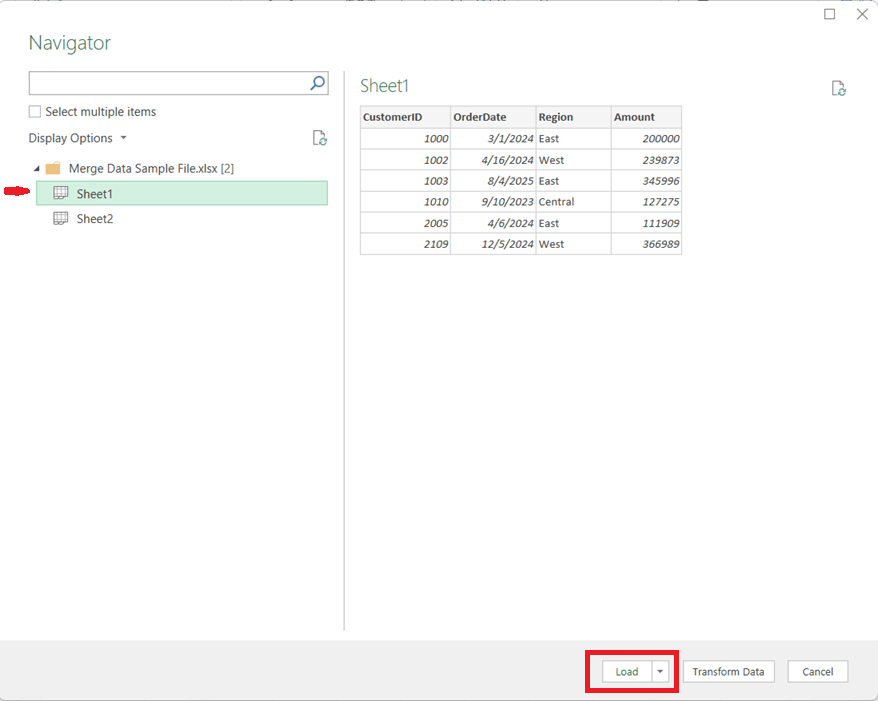
1. Load Both Data Sources into Power Query

  • Open Excel and go to Data → Get Data
  • Choose From Workbook (for separate files) or From Table/Range (for sheets in the same file)

Tip: Ensure the columns you plan to merge on have the same data types (e.g., text vs. number).


  • Load each dataset into Power Query as a separate query

2. Start the Merge Operation

  • In Power Query, select the primary table
  • Go to Query → Merge Queries
  • Choose the secondary table from the dropdown

3. Select Multiple Matching Columns

  • Click the first matching column in the primary table
  • Hold Ctrl (or Cmd on Mac) and select additional matching columns
  • Repeat the same column selections in the secondary table, in the same order

For example, if you needed to perform the merge on CustomerID, OrderDate, and Region, you would click Customer ID, then hold the Ctrl key and click OrderDate, then (while still holding down the Ctrl key) click Region.

Power Query treats this as a composite key, and all selected columns must match for rows from both tables to merge.


4. Choose the Join Type

Select the appropriate join kind:

  • Left Outer – Keep all rows from the first table (most common) and brings in the values for the matching rows from the second table
  • Inner – Keep only matching rows from both tables
  • Full Outer – Keep all rows from both tables, merging the table where there is a match and having just the values from the respective tables when there is no match

Click OK to complete the merge.


5. Expand the Merged Data

  • A new column appears containing nested tables
  • Click the expand icon to select which columns to bring in
  • Remove unnecessary columns to keep the dataset clean

6. Load and Refresh

  • Click Close & Load
  • The merged dataset is now available in Excel
  • When source files change, simply click Refresh to update everything automatically

Key Benefits

  • Handles multi-column joins cleanly and reliably
  • Eliminates fragile lookup formulas
  • Fully refreshable and auditable
  • Scales well as data volume grows

In Summary

Using Power Query to merge Excel data on multiple columns brings database-style joins into Excel, making your workflows more robust, maintainable, and professional. Once set up, it saves time and reduces errors—especially for recurring reporting and analytics tasks.

Thanks for reading!

Developing metrics for your analytics project

When starting an analytics project, one of the most important decisions you will make is identifying the right metrics. Metrics serve as the compass for the initiative—they show whether you are on the right track, communicate achievements, highlight challenges, uncover blind spots, and ultimately, along with guiding future decisions, they demonstrate the value of the project to stakeholders. But designing metrics is not as simple as picking a single “success number.” To truly guide decision-making, you need a holistic set of measures that reflect multiple dimensions of performance.

Why a Holistic View Matters

Analytics projects sometimes fall into the trap of focusing on only one type of metric. For example, a project might track quantity (e.g., number of leads generated) while ignoring quality (e.g., lead conversion rate). Or it may measure cost savings but fail to consider user satisfaction, leading to short-term wins but long-term disengagement.

Develop Metrics from Multiple Dimensions

To avoid this pitfall, it’s critical to develop a balanced framework that includes multiple perspectives:

  • Quantity: How much output is produced? Examples include number of units produced, sales revenue, or number of new customers added.
  • Quality: What is the quality of the output? Examples include accuracy rates, defect counts, or error percentages.
  • Time: How long does it take to achieve the output? Or in other words, what timeframe is the quantity and quality measured over? Is it Sales revenue per hour, per day, per month, or per year?
  • Costs: What resources are being consumed? Metrics might include infrastructure costs, labor hours and costs, materials costs, or overall project spend.
  • Satisfaction: How do stakeholders, customers, or employees feel about the results? Feedback surveys, adoption rates, product ratings, and net promoter scores (NPS) are common ways of identifying this information.

Each of these perspectives contributes to the full story of your analytics project. If one dimension is missing, you risk optimizing for one outcome at the expense of another.

Efficiency, Effectiveness, and Impact Metrics

Another way you can classify your metrics to achieve a holistic view is with three overarching categories: Efficiency, Effectiveness, and Impact.

  • Efficiency Metrics
    • These measure how well resources are used and answers “are we doing things right?“. They focus on inputs versus outputs.
      • Example: “Average work hours per product” shows how quickly work gets done.
      • Example: “Cost per customer acquired” reflects the efficiency of your sales operations.
    • Efficiency metrics often tie directly to quantity, cost, and time.
  • Effectiveness Metrics
    • These measure how well goals are achieved—whether the project delivers the intended results, and answers “are we doing the right things?“.
      • Example: “Customer satisfaction” demonstrates how happy customers are with our products and services.
      • Example: “Actual to Target” shows how things are tracking compared to the goals that were set.
    • Effectiveness metrics often involve quality, satisfaction, and time.
  • Impact Metrics
    • These measure the broader business or organizational outcomes influenced by some activity.
      • Example: “Market share and revenue growth” shows financial state from a broader market and overall standpoint.
      • Example: “Return on Investment (ROI)” is the ultimate metrics for financial performance.
    • Impact metrics communicates how we are doing with our long-term, strategic goals. They often combine quantity, quality, satisfaction, and time dimensions.

The Significance of the Time Dimension

Among all the dimensions used in metrics, time is especially powerful because it adds critical context to nearly every metric. Without time, numbers can be misleading. Just about all metrics are more relevant when the time component is added. Time transforms static measures into dynamic insights. For instance:

  • A quantity metric of “100 new customers” becomes far more meaningful when paired with “this month” versus “since company founding.”
  • A quality metric of “95% data accuracy” is less impressive if it takes weeks to achieve, compared to real-time cleansing.
  • A cost metric of “$100,000 project spend” raises different questions depending on whether it’s a one-time investment or a recurring monthly expense.

By always asking, “Over what time frame?”, you unlock a truer understanding of performance. In short, the time dimension transforms static measures into dynamic insights. It allows you to answer not just “What happened?” but also “When did it happen?”, “How long did it take?”, and “How is it changing over time?”—questions that are generally crucial for actionable decision-making.

Time adds context to every other metric. Think of it as the axis that brings your measures to life. Quantity without time tells you how much, but not how fast. Quality without time shows accuracy, but not whether results are timely enough to act upon. Costs without time hide the pace at which expenses accumulate. And satisfaction without time misses whether perceptions improve, decline, or stay consistent over an initiative’s lifecycle.

The Significance of the Timeliness

Another important consideration is timeliness. Metrics must be accessible to decision makers in a timely manner to allow them to make timely decisions. For example:

  • A metric may deliver accurate insights, but if it takes three weeks to refresh the data and the dashboard that displays it, the value erodes.
  • A machine learning model may predict outcomes with high accuracy, but if the scoring process delays operational decisions, the benefit diminishes.

Therefore, in addition to deciding on and building the metrics for a project, the delivery mechanism of the metrics (such as a dashboard) must also be thought out to ensure that the entire process, from data sourcing to aggregations to dashboard refresh for example, can all happen in a timely manner to, in turn, make the metrics available to users in a timely manner.

Putting It All Together

When developing metrics for your analytics project, take a step back and ensure you have a comprehensive, multi-angle approach, by asking:

  • Do we know how much is being achieved/produced (quantity)?
  • Do we know how well it is being achieved/produced (quality)?
  • Do we know how fast results are being delivered (time)?
  • Do we know how much it costs to achieve (costs)?
  • Do we know how it feels to those affected (satisfaction)?
  • Do we know whether we are efficiently using resources?
  • Do we know whether we are effective in reaching goals?
  • Do we know what impact this work is having on the organization?
  • And for the above questions, always get a perspective on time … when? over what timeframe?
  • When are updates to the metrics needed by (real-time, hourly, daily, weekly, monthly, etc.)?

By building metrics across these dimensions, you create a more reliable, meaningful, and balanced framework for measuring success. More importantly, you ensure that the analytics project supports not only the immediate technical objectives but also the broader organizational goals.

Thanks for reading! Good luck on your analytics journey!